Paterson Neil E, Vlachou Styliani, Guery Sebastien, Kaupmann Klemens, Froestl Wolfgang, Markou Athina
Department of Psychiatry, School of Medicine, University of California San Diego, 9500 Gilman Dr., La Jolla, CA 92093-0603, USA.
J Pharmacol Exp Ther. 2008 Jul;326(1):306-14. doi: 10.1124/jpet.108.139204. Epub 2008 Apr 29.
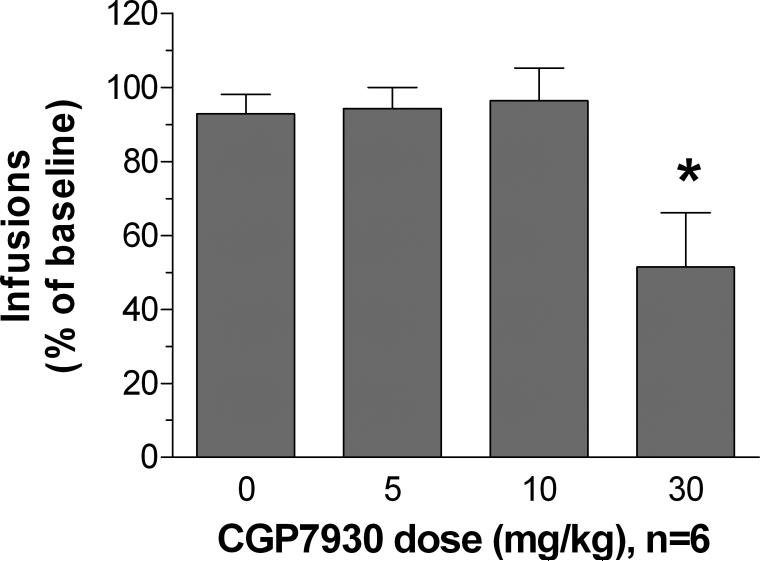
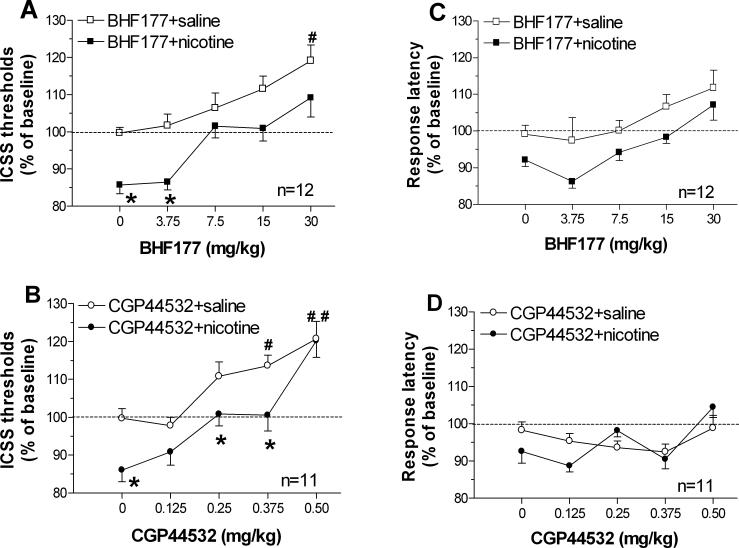
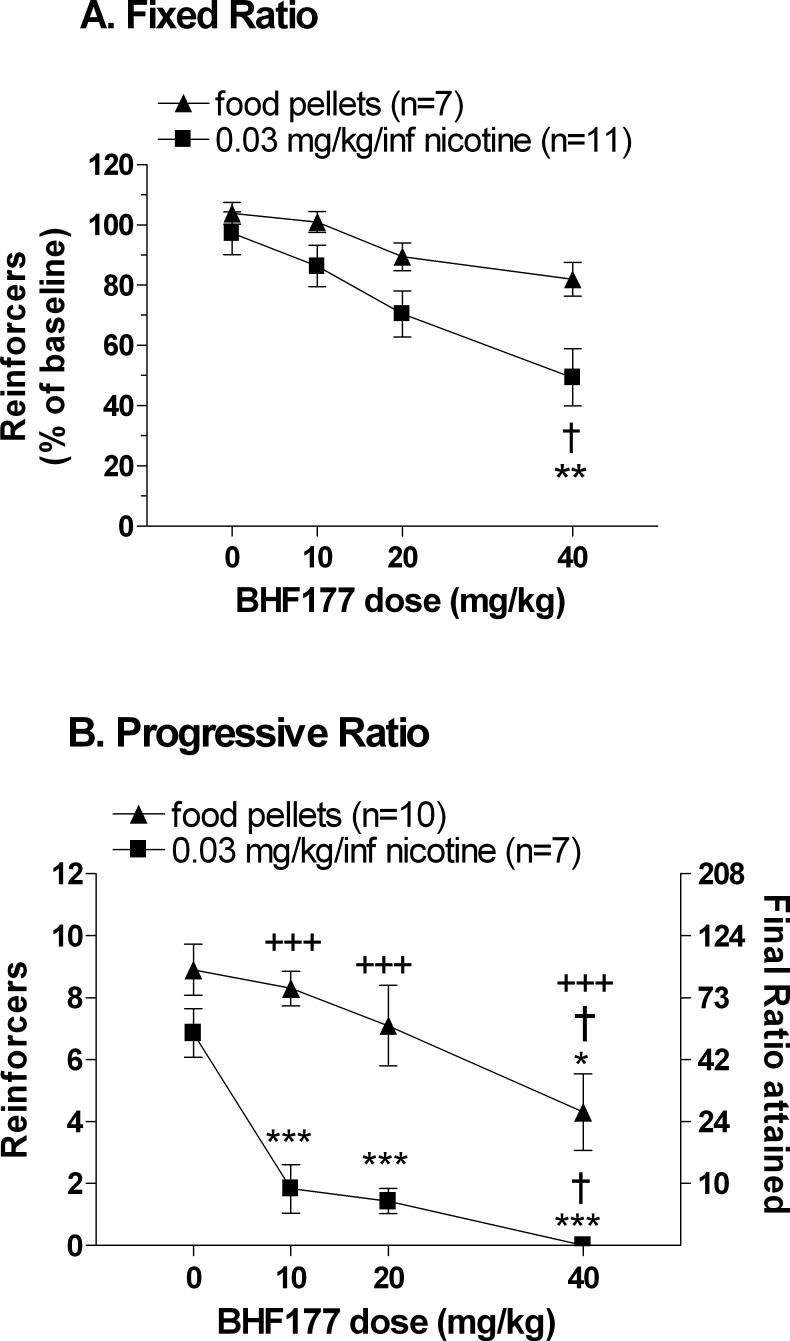
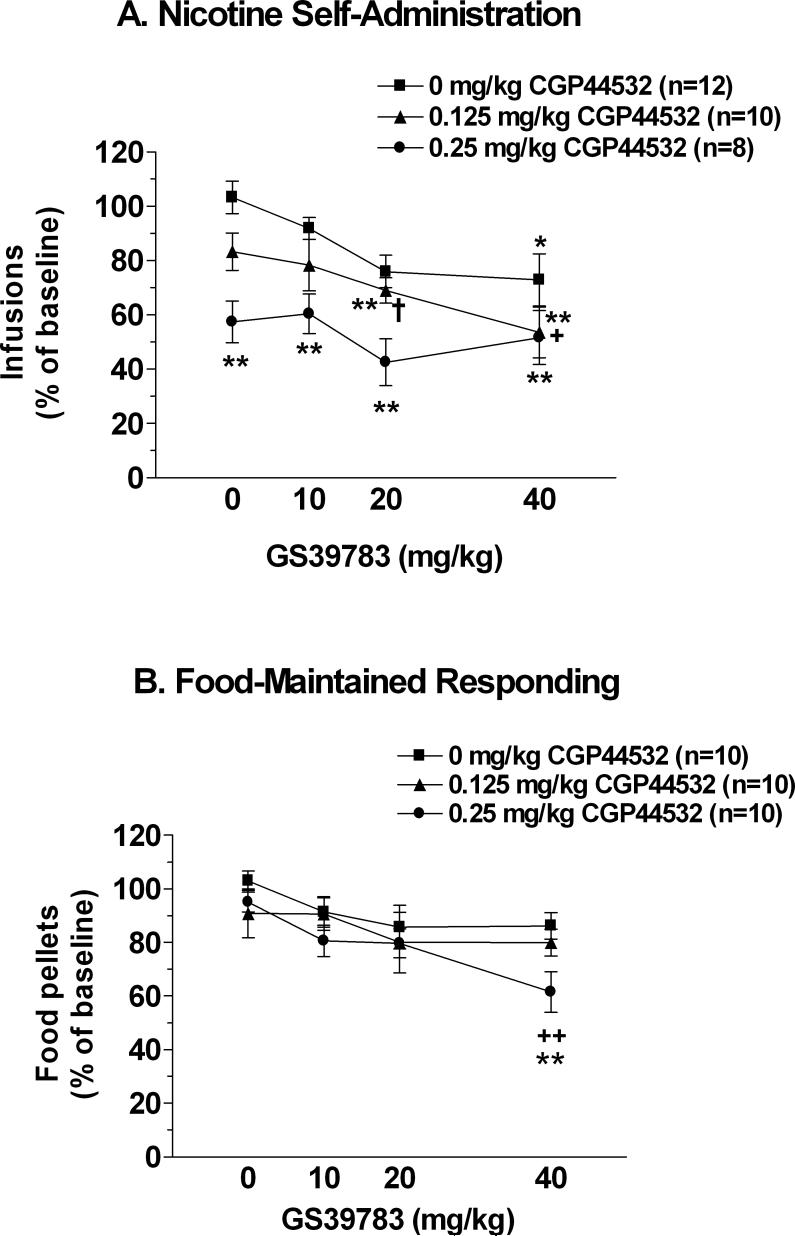
Acute administration of gamma-aminobutyric acid (GABA)-B receptor agonists decreases nicotine, cocaine, ethanol, and heroin self-administration and also decreases food-maintained responding and suppresses locomotor activity at high doses. GABA(B) receptor-positive modulators may represent potentially improved therapeutic compounds because of their fewer side effects than receptor agonists. The present study investigated the effects of administration of the GABA(B) receptor-positive modulators 2,6-di-tert-butyl-4-(3-hydroxy-2,2-dimethyl-propyl)-phenol (CGP7930) and N-[(1R,2R,4S)-bicyclo[2.2.1]hept-2-yl]-2-methyl-5-[4-(trifluoromethyl)phenyl]-4-pyrimidinamine (BHF177) and coadministration of the GABA(B) receptor-positive modulator N,N'-dicyclopentyl-2-methylsulfanyl-5-nitro-pyrimidine-4,6-diamine (GS39783) with the GABA(B) receptor agonist (3-amino-2[S]-hydroxypropyl)-methylphosphinic acid (CGP44532) on nicotine- and food-maintained responding under fixed ratio (FR) 5 and progressive ratio schedules of reinforcement. Furthermore, the effects of BHF177 and CGP44532 on nicotine-induced enhancement of brain reward function were evaluated. The results indicated that administration of CGP7930 decreased nicotine self-administration under an FR5 schedule. Administration of either GS39783 or CGP44532 selectively decreased nicotine self-administration, whereas coadministration of these compounds had additive effects. BHF177 administration selectively decreased nicotine- but not food-maintained responding under FR5 and progressive ratio schedules. The nicotine-induced enhancement of brain reward function was blocked by BHF177 or CGP44532, although the highest doses of both compounds, particularly CGP44532, decreased brain reward function when administered alone, suggesting an additive, rather than interactive, effect. Overall, the present results indicate that GABA(B) receptor-positive modulators, similarly to GABA(B) receptor agonists, attenuated the reinforcing and reward-enhancing effects of nicotine, perhaps with higher selectivity than GABA(B) receptor agonists. Thus, GABA(B) receptor-positive modulators may be useful antismoking medications.
急性给予γ-氨基丁酸(GABA)-B受体激动剂可减少尼古丁、可卡因、乙醇和海洛因的自我给药,还可减少食物维持的反应,并在高剂量时抑制运动活动。GABA(B)受体阳性调节剂可能是潜在的改良治疗化合物,因为它们的副作用比受体激动剂少。本研究调查了给予GABA(B)受体阳性调节剂2,6-二叔丁基-4-(3-羟基-2,2-二甲基丙基)-苯酚(CGP7930)和N-[(1R,2R,4S)-双环[2.2.1]庚-2-基]-2-甲基-5-[4-(三氟甲基)苯基]-4-嘧啶胺(BHF177),以及将GABA(B)受体阳性调节剂N,N'-二环戊基-2-甲基硫烷基-5-硝基嘧啶-4,6-二胺(GS39783)与GABA(B)受体激动剂(3-氨基-2[S]-羟丙基)-甲基次膦酸(CGP44532)共同给药,对固定比率(FR)5和渐进比率强化程序下尼古丁和食物维持反应的影响。此外,还评估了BHF177和CGP44532对尼古丁诱导的脑奖赏功能增强的影响。结果表明,给予CGP7930可减少FR5程序下的尼古丁自我给药。给予GS39783或CGP44532均可选择性减少尼古丁自我给药,而这两种化合物共同给药具有相加作用。在FR5和渐进比率程序下,给予BHF177可选择性减少尼古丁维持的反应,但对食物维持的反应无影响。BHF177或CGP44532可阻断尼古丁诱导的脑奖赏功能增强,尽管这两种化合物的最高剂量,尤其是CGP44532,单独给药时会降低脑奖赏功能,提示为相加而非相互作用效应。总体而言,本研究结果表明,GABA(B)受体阳性调节剂与GABA(B)受体激动剂类似,可减弱尼古丁的强化和奖赏增强作用,可能比GABA(B)受体激动剂具有更高的选择性。因此,GABA(B)受体阳性调节剂可能是有用的戒烟药物。