Shah Nirav R, Jones J B, Aperi Jaclyn, Shemtov Rachel, Karne Anita, Borenstein Jeff
Division of General Internal Medicine, New York University School of Medicine, New York, New York, USA.
Obstet Gynecol. 2008 May;111(5):1175-82. doi: 10.1097/AOG.0b013e31816fd73b.
To systematically review evidence of the treatment benefits of selective serotonin reuptake inhibitors (SSRIs) for symptoms related to severe premenstrual syndrome (PMS) and premenstrual dysphoric disorder.
We conducted electronic database searches of MEDLINE, Web of Science, Cochrane Library, Embase, PsycINFO, and Cinahl through March 2007, and hand-searched reference lists and pertinent journals.
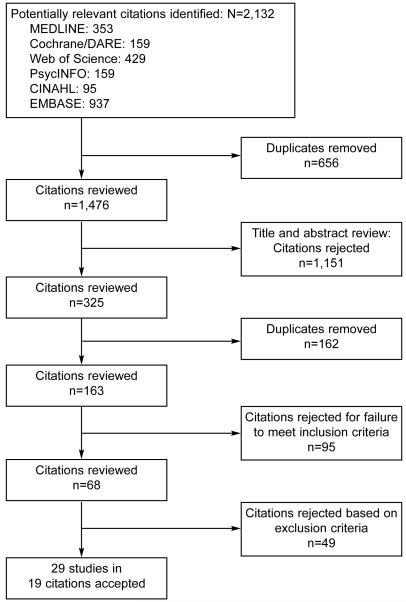
Studies included in the review were double-blind, randomized, controlled trials comparing an SSRI with placebo that reported a change in a validated score of premenstrual symptomatology. Studies had to report follow-up for any duration longer than one menstrual cycle among premenopausal women who met clinical diagnostic criteria for PMS or premenstrual dysphoric disorder. From 2,132 citations identified, we pooled results from 29 studies (in 19 citations) using random-effects meta-analyses and present results as odds ratios (ORs).
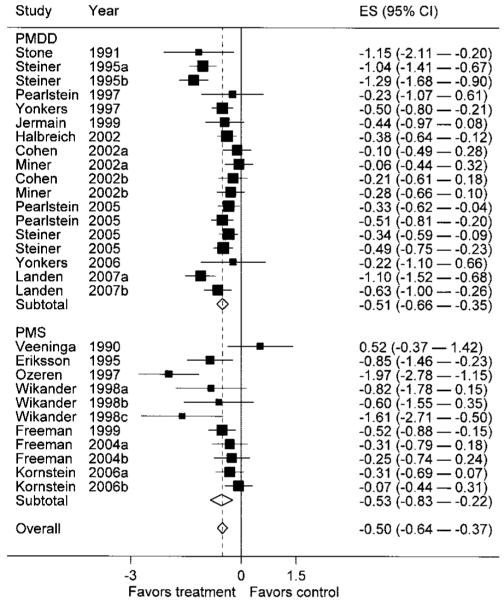
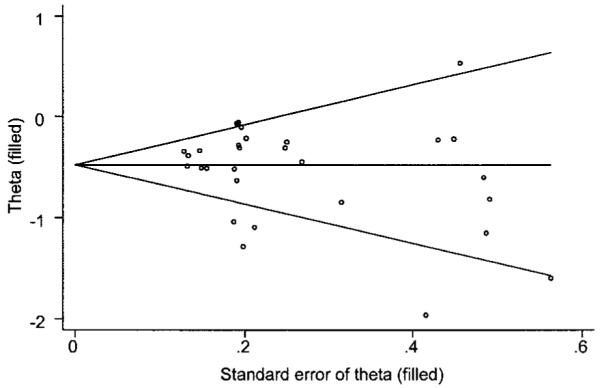
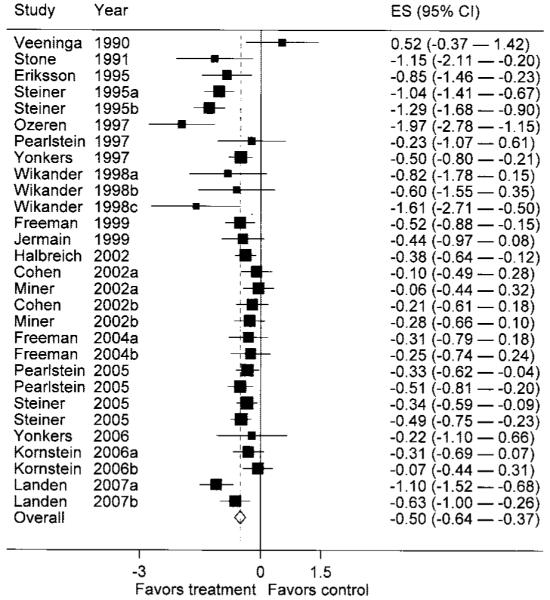
TABULATION, INTEGRATION, AND RESULTS: Our meta- analysis, which included 2,964 women, demonstrates that SSRIs are effective for treating PMS and premenstrual dysphoric disorder (OR 0.40, 95% confidence interval [CI] 0.31-0.51). Intermittent dosing regimens were found to be less effective (OR 0.55, 95% CI 0.45-0.68) than continuous dosing regimens (OR 0.28, 95% CI 0.18-0.42). No SSRI was demonstrably better than another. The choice of outcome measurement instrument was associated with effect size estimates. The overall effect size is smaller than reported previously.
Selective serotonin reuptake inhibitors were found to be effective in treating premenstrual symptoms, with continuous dosing regimens favored for effectiveness.
系统评价选择性5-羟色胺再摄取抑制剂(SSRIs)治疗与重度经前综合征(PMS)及经前烦躁障碍相关症状的疗效证据。
我们检索了截至2007年3月的MEDLINE、科学引文索引、考克兰图书馆、Embase、心理学文摘数据库及护理学与健康领域数据库等电子数据库,并手工检索了参考文献列表及相关期刊。
纳入综述的研究为双盲、随机、对照试验,比较了SSRI与安慰剂,并报告了经前症状有效评分的变化。研究必须报告对符合PMS或经前烦躁障碍临床诊断标准的绝经前女性进行的超过一个月经周期的随访情况。从检索到的2132篇文献中,我们采用随机效应荟萃分析汇总了29项研究(19篇文献)的结果,并以比值比(OR)呈现结果。
列表、整合及结果:我们的荟萃分析纳入了2964名女性,结果表明SSRIs对治疗PMS和经前烦躁障碍有效(OR 0.40,95%置信区间[CI] 0.31 - 0.51)。发现间歇给药方案(OR 0.55,95% CI 0.45 - 0.68)不如连续给药方案有效(OR 0.28,95% CI 0.18 - 0.42)。没有一种SSRI明显优于另一种。结局测量工具的选择与效应大小估计有关。总体效应大小比之前报道的要小。
发现选择性5-羟色胺再摄取抑制剂对治疗经前症状有效,连续给药方案疗效更佳。