Kato Toyonori, Shimano Hitoshi, Yamamoto Takashi, Ishikawa Mayumi, Kumadaki Shin, Matsuzaka Takashi, Nakagawa Yoshimi, Yahagi Naoya, Nakakuki Masanori, Hasty Alyssa H, Takeuchi Yoshinori, Kobayashi Kazuto, Takahashi Akimitsu, Yatoh Shigeru, Suzuki Hiroaki, Sone Hirohito, Yamada Nobuhiro
Department of Internal Medicine (Endocrinology and Metabolism), Graduate School of Comprehensive Human Sciences, University of Tsukuba, Tsukuba, Japan.
Diabetes. 2008 Sep;57(9):2382-92. doi: 10.2337/db06-1806. Epub 2008 May 5.
Chronic exposure to fatty acids causes beta-cell failure, often referred to as lipotoxicity. We investigated its mechanisms, focusing on contribution of SREBP-1c, a key transcription factor for lipogenesis.
We studied in vitro and in vivo effects of saturated and polyunsaturated acids on insulin secretion, insulin signaling, and expression of genes involved in beta-cell functions. Pancreatic islets isolated from C57BL/6 control and SREBP-1-null mice and adenoviral gene delivery or knockdown systems of related genes were used.
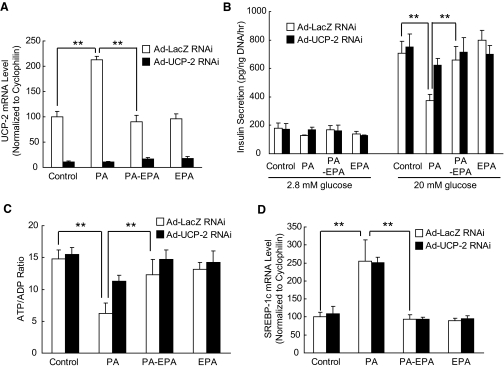
Incubation of C57BL/6 islets with palmitate caused inhibition of both glucose- and potassium-stimulated insulin secretion, but addition of eicosapentaenoate (EPA) restored both inhibitions. Concomitantly, palmitate activated and EPA abolished both mRNA and nuclear protein of SREBP-1c, accompanied by reciprocal changes of SREBP-1c target genes such as insulin receptor substrate-2 (IRS-2) and granuphilin. These palmitate-EPA effects on insulin secretion were abolished in SREBP-1-null islets. Suppression of IRS-2/Akt pathway could be a part of the downstream mechanism for the SREBP-1c-mediated insulin secretion defect because adenoviral constitutively active Akt compensated it. Uncoupling protein-2 (UCP-2) also plays a crucial role in the palmitate inhibition of insulin secretion, as confirmed by knockdown experiments, but SREBP-1c contribution to UCP-2 regulation was partial. The palmitate-EPA regulation of insulin secretion was similarly observed in islets from C57BL/6 mice pretreated with dietary manipulations. Furthermore, administration of EPA to diabetic KK-Ay mice ameliorated impairment of insulin secretion in their islets.
SREBP-1c plays a dominant role in palmitate-mediated insulin secretion defect, and EPA prevents it through SREBP-1c inhibition, implicating a therapeutic potential for treating diabetes related to lipotoxicity.
长期暴露于脂肪酸会导致β细胞功能衰竭,通常称为脂毒性。我们研究了其机制,重点关注脂肪生成的关键转录因子SREBP-1c的作用。
我们研究了饱和脂肪酸和多不饱和脂肪酸对胰岛素分泌、胰岛素信号传导以及参与β细胞功能的基因表达的体外和体内效应。使用从C57BL/6对照小鼠和SREBP-1基因敲除小鼠分离的胰岛以及相关基因的腺病毒基因递送或敲低系统。
用棕榈酸孵育C57BL/6胰岛会抑制葡萄糖和钾刺激的胰岛素分泌,但添加二十碳五烯酸(EPA)可恢复这两种抑制作用。同时,棕榈酸激活而EPA消除了SREBP-1c的mRNA和核蛋白,伴随着SREBP-1c靶基因如胰岛素受体底物-2(IRS-2)和颗粒体蛋白的相反变化。这些棕榈酸-EPA对胰岛素分泌的作用在SREBP-1基因敲除的胰岛中被消除。IRS-2/Akt途径的抑制可能是SREBP-1c介导的胰岛素分泌缺陷的下游机制的一部分,因为腺病毒组成型活性Akt可以补偿它。解偶联蛋白-2(UCP-2)在棕榈酸抑制胰岛素分泌中也起关键作用,敲低实验证实了这一点,但SREBP-1c对UCP-2调节的作用是部分的。在经过饮食处理的C57BL/6小鼠的胰岛中也观察到了棕榈酸-EPA对胰岛素分泌的调节作用。此外,给糖尿病KK-Ay小鼠施用EPA可改善其胰岛中胰岛素分泌的损伤。
SREBP-1c在棕榈酸介导的胰岛素分泌缺陷中起主导作用,EPA通过抑制SREBP-1c来预防这种缺陷,这意味着在治疗与脂毒性相关的糖尿病方面具有治疗潜力。