Hancock Melissa L, Canetta Sarah E, Role Lorna W, Talmage David A
Integrated Program in Cellular, Molecular and Biophysical Studies, Columbia University, New York, NY 10032, USA.
J Cell Biol. 2008 May 5;181(3):511-21. doi: 10.1083/jcb.200710037.
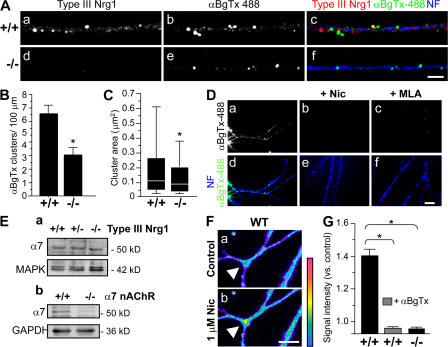
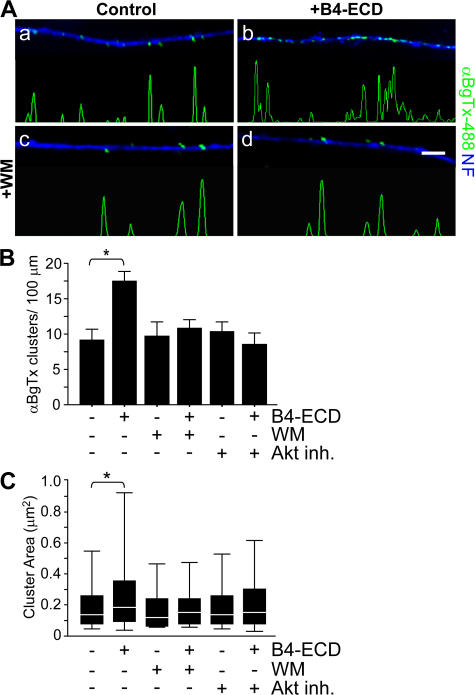
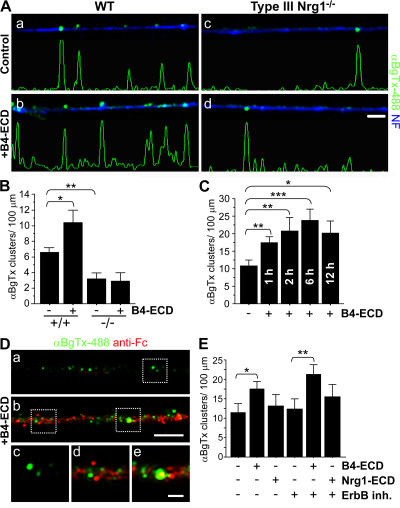
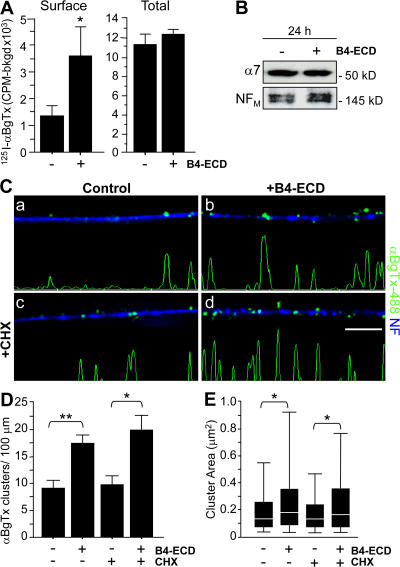
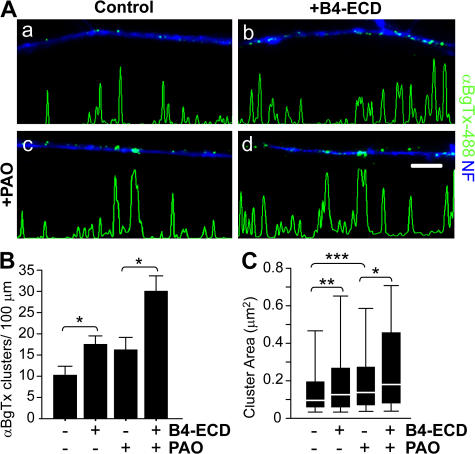
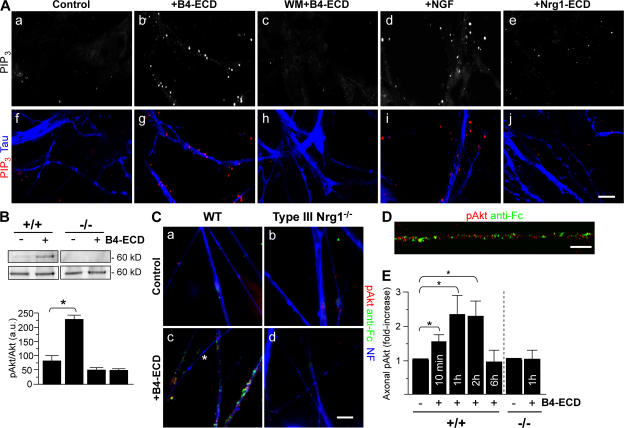
Type III Neuregulin1 (Nrg1) isoforms are membrane-tethered proteins capable of participating in bidirectional juxtacrine signaling. Neuronal nicotinic acetylcholine receptors (nAChRs), which can modulate the release of a rich array of neurotransmitters, are differentially targeted to presynaptic sites. We demonstrate that Type III Nrg1 back signaling regulates the surface expression of alpha7 nAChRs along axons of sensory neurons. Stimulation of Type III Nrg1 back signaling induces an increase in axonal surface alpha7 nAChRs, which results from a redistribution of preexisting intracellular pools of alpha7 rather than from increased protein synthesis. We also demonstrate that Type III Nrg1 back signaling activates a phosphatidylinositol 3-kinase signaling pathway and that activation of this pathway is required for the insertion of preexisting alpha7 nAChRs into the axonal plasma membrane. These findings, in conjunction with prior results establishing that Type III Nrg1 back signaling controls gene transcription, demonstrate that Type III Nrg1 back signaling can regulate both short-and long-term changes in neuronal function.
III型神经调节蛋白1(Nrg1)亚型是能够参与双向旁分泌信号传导的膜结合蛋白。可调节多种神经递质释放的神经元烟碱型乙酰胆碱受体(nAChRs)以不同方式靶向突触前位点。我们证明,III型Nrg1反向信号传导调节感觉神经元轴突上α7 nAChRs的表面表达。刺激III型Nrg1反向信号传导会导致轴突表面α7 nAChRs增加,这是由先前存在的细胞内α7池重新分布引起的,而非蛋白质合成增加所致。我们还证明,III型Nrg1反向信号传导激活磷脂酰肌醇3激酶信号通路,且该通路的激活是将先前存在的α7 nAChRs插入轴突质膜所必需的。这些发现,结合先前确定III型Nrg1反向信号传导控制基因转录的结果,表明III型Nrg1反向信号传导可调节神经元功能的短期和长期变化。