Sobral B W, Honeycutt R J, Atherly A G
Department of Genetics, Iowa State University, Ames 50011.
J Bacteriol. 1991 Jan;173(2):704-9. doi: 10.1128/jb.173.2.704-709.1991.
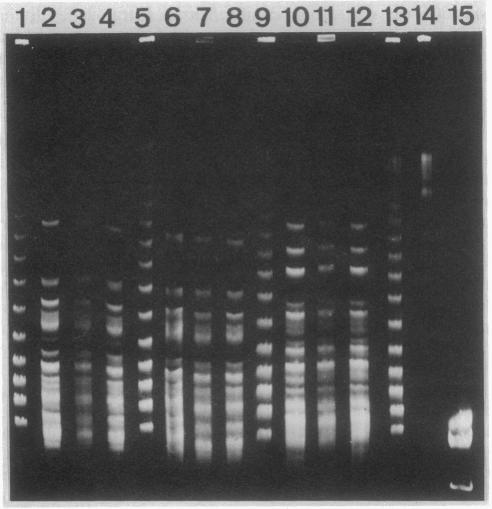
The lack of high-resolution genetic or physical maps for the family Rhizobiaceae limits our understanding of this agronomically important bacterial family. On the basis of statistical analyses of DNA sequences of the Rhizobiaceae and direct evaluation by pulsed-field agarose gel electrophoresis (PFE), five restriction endonucleases with AT-rich target sites were identified as the most rarely cutting: AseI (5'-ATTAAT-3'), DraI (5'-TTTAAA-3'), SpeI (5'-ACTAGT-3'), SspI (5'-AATAAT-3'), and XbaI (5'-TCTAGA-3'). We computed the sizes of the genomes of Bradyrhizobium japonicum USDA 424 and Rhizobium meliloti 1021 by adding the sizes of DNA fragments generated by SpeI digests. The genome sizes of R. meliloti 1021 and B. japonicum USDA 424 were 5,379 +/- 282.5 kb and 6,195 +/- 192.4 kb, respectively. We also compared the organization of the genomes of free-living and bacteroid forms of B. japonicum. No differences between the PFE-resolved genomic fingerprints of free-living and mature (35 days after inoculation) bacteroids of B. japonicum USDA 123 and USDA 122 were observed. Also, B. japonicum USDA 123 genomic fingerprints were unchanged after passage through nodules and after maintenance on a rich growth medium for 100 generations. We conclude that large-scale DNA rearrangements are not seen in mature bacteroids or during free-living growth on rich growth media under laboratory conditions.
根瘤菌科缺乏高分辨率的遗传图谱或物理图谱,这限制了我们对这个在农业上具有重要意义的细菌家族的了解。基于对根瘤菌科DNA序列的统计分析以及通过脉冲场琼脂糖凝胶电泳(PFE)进行的直接评估,确定了五个具有富含AT靶位点的限制性内切酶为切割频率最低的酶:AseI(5'-ATTAAT-3')、DraI(5'-TTTAAA-3')、SpeI(5'-ACTAGT-3')、SspI(5'-AATAAT-3')和XbaI(5'-TCTAGA-3')。我们通过将SpeI消化产生的DNA片段大小相加,计算了日本慢生根瘤菌USDA 424和苜蓿根瘤菌1021的基因组大小。苜蓿根瘤菌1021和日本慢生根瘤菌USDA 424的基因组大小分别为5379±282.5 kb和6195±192.4 kb。我们还比较了日本慢生根瘤菌自由生活形式和类菌体形式的基因组组织。未观察到日本慢生根瘤菌USDA 123和USDA 122的自由生活型和成熟型(接种后35天)类菌体的PFE解析基因组指纹之间存在差异。此外,日本慢生根瘤菌USDA 123的基因组指纹在通过根瘤后以及在丰富生长培养基上继代培养100代后均未改变。我们得出结论,在实验室条件下,成熟类菌体或在丰富生长培养基上自由生活生长期间未观察到大规模DNA重排。