Limban Carmen, Chifiriuc Mariana-Carmen Balotescu, Missir Alexandru-Vasile, Chiriţă Ileana Cornelia, Bleotu Coralia
Pharmaceutical Chemistry Department, Faculty of Farmacy, Carol Davila University of Medicine and Pharmacy, Traian Vuia 6, sect. 2, 020956, Bucharest, Romania.
Molecules. 2008 Mar 4;13(3):567-80. doi: 10.3390/molecules13030567.
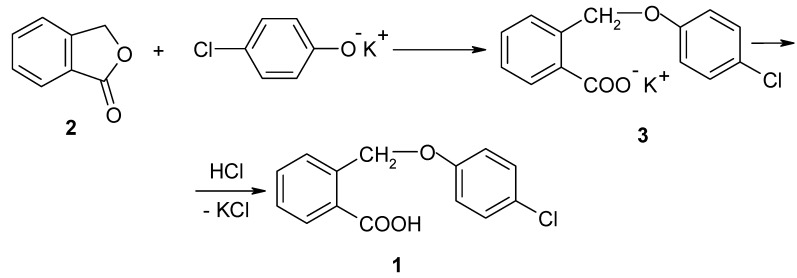
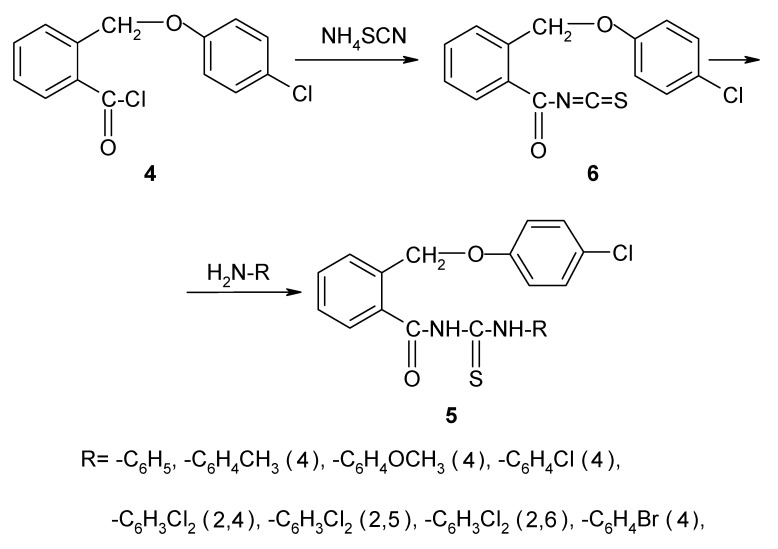
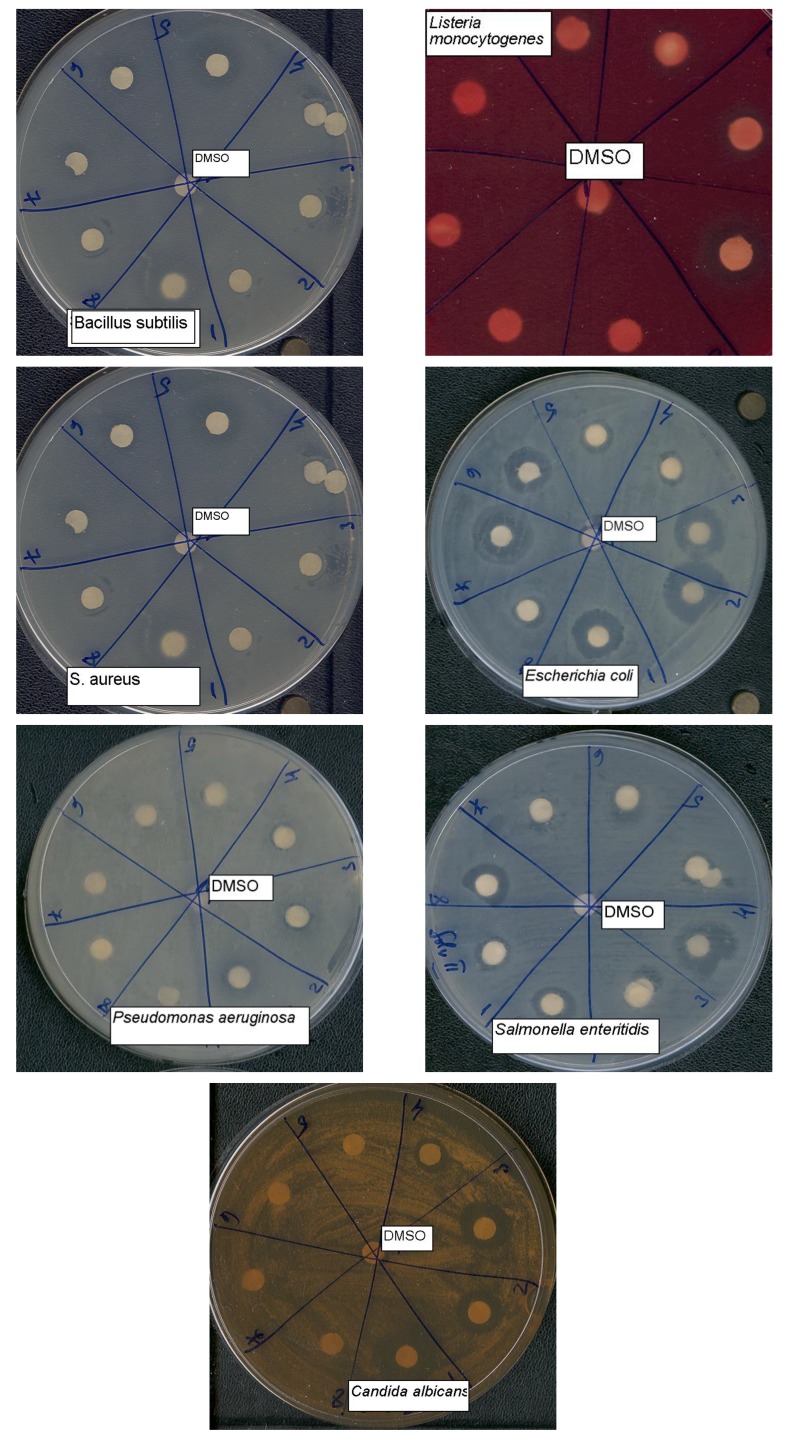
We report here the characterisation of eight newly synthesized thioureides of 2-(4-chlorophenoxymethyl)-benzoic acid and the evaluation of the in vitro antimicrobial activity of the new compounds against Gram-positive [Listeria monocytogenes,Staphylococcus aureus, Bacillus subtilis], Gram-negative [Psedomonas aeruginosa,Escherichia coli, Salmonella enteritidis], as well as Candida spp., using both reference and clinical multidrug resistant strains to establish the minimal inhibitory concentration (MIC)values. Our results showed that the tested compounds exhibited specific antimicrobial activities, both concerning the spectrum of antimicrobial activity and the corresponding MIC values, which ranged widely between 1024 and 32 mug/mL, depending on the nature and position of the substituents on the benzene ring. The most active compounds were N-[2-(4-chlorophenoxymethyl)-benzoyl]-N'-(2,6-dichlorophenyl)-thiourea (5 g) and N-[2-(4-chlorophenoxymethyl)-benzoyl]-N'-(4-bromophenyl)-thiourea (5h), which showed a broad spectrum of antimicrobial activity against enterobacterial strains (E. coli and S. enteritidis),P. aeruginosa, S. aureus and Candida spp. All the tested compounds except 5f were highly active against S. aureus (MIC=32 mug/mL), suggesting their possible use in the treatment of MRSA infections. Four of compounds also exhibited antifungal activity (MIC =256-32 microg/mL) against C. albicans, but L. monocytogenes as well as B. subtilis were resistant to all tested compounds. Our studies thus demonstrated that among other biological activities,the thioureides of 2-(4-chlorophenoxymethyl)-benzoic acid also exhibit selective and effective antimicrobial properties that could lead to the selection and use of these compounds as efficient antimicrobial agents, especially for the treatment of multidrug resistant infections.
我们在此报告8种新合成的2-(4-氯苯氧基甲基)苯甲酸硫脲类化合物的特性,并评估这些新化合物对革兰氏阳性菌[单核细胞增生李斯特菌、金黄色葡萄球菌、枯草芽孢杆菌]、革兰氏阴性菌[铜绿假单胞菌、大肠杆菌、肠炎沙门氏菌]以及念珠菌属的体外抗菌活性,使用参考菌株和临床多药耐药菌株来确定最低抑菌浓度(MIC)值。我们的结果表明,所测试的化合物表现出特定的抗菌活性,无论是在抗菌活性谱还是相应的MIC值方面,其范围在1024至32μg/mL之间广泛变化,这取决于苯环上取代基的性质和位置。活性最高的化合物是N-[2-(4-氯苯氧基甲基)苯甲酰基]-N'-(2,6-二氯苯基)硫脲(5g)和N-[2-(4-氯苯氧基甲基)苯甲酰基]-N'-(4-溴苯基)硫脲(5h),它们对肠道细菌菌株(大肠杆菌和肠炎沙门氏菌)、铜绿假单胞菌、金黄色葡萄球菌和念珠菌属表现出广泛的抗菌活性。除5f外,所有测试化合物对金黄色葡萄球菌均具有高活性(MIC = 32μg/mL),表明它们可能用于治疗耐甲氧西林金黄色葡萄球菌(MRSA)感染。其中四种化合物对白色念珠菌也表现出抗真菌活性(MIC = 256 - 32μg/mL),但单核细胞增生李斯特菌以及枯草芽孢杆菌对所有测试化合物均耐药。因此,我们的研究表明,在其他生物活性中,2-(4-氯苯氧基甲基)苯甲酸硫脲类化合物还表现出选择性和有效的抗菌特性,这可能导致选择和使用这些化合物作为有效的抗菌剂,特别是用于治疗多药耐药感染。