Cooper William B, Tobey Emily, Loizou Philipos C
Callier Advanced Hearing Research Center, The University at Dallas, Dallas, TX, USA.
Ear Hear. 2008 Aug;29(4):618-26. doi: 10.1097/AUD.0b013e318174e787.
The purpose of this study was to explore the utility/possibility of using the Montreal Battery for Evaluation of Amusia (MBEA) test (Peretz, et al., Ann N Y Acad Sci, 999, 58-75) to assess the music perception abilities of cochlear implant (CI) users.
The MBEA was used to measure six different aspects of music perception (Scale, Contour, Interval, Rhythm, Meter, and Melody Memory) by CI users and normal-hearing (NH) listeners presented with stimuli processed via CI simulations. The spectral resolution (number of channels) was varied in the CI simulations to determine: (a) the number of channels (4, 6, 8, 12, and 16) needed to achieve the highest levels of music perception and (b) the number of channels needed to produce levels of music perception performance comparable with that of CI users.
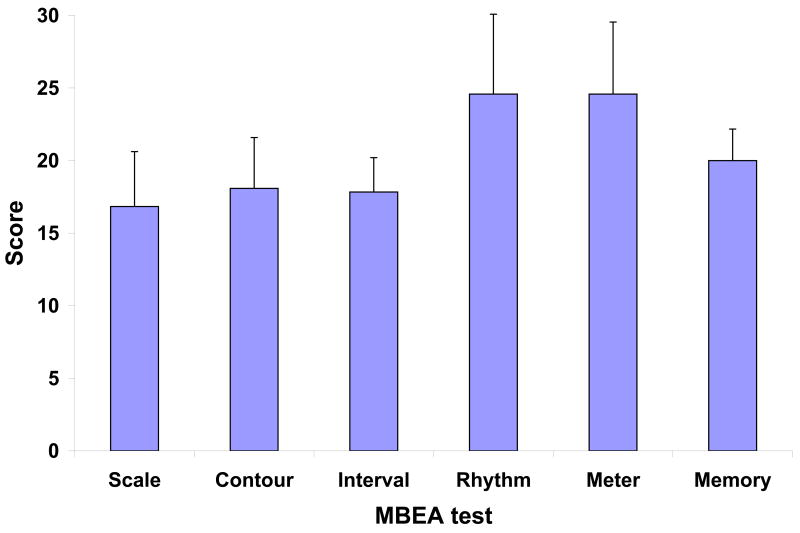
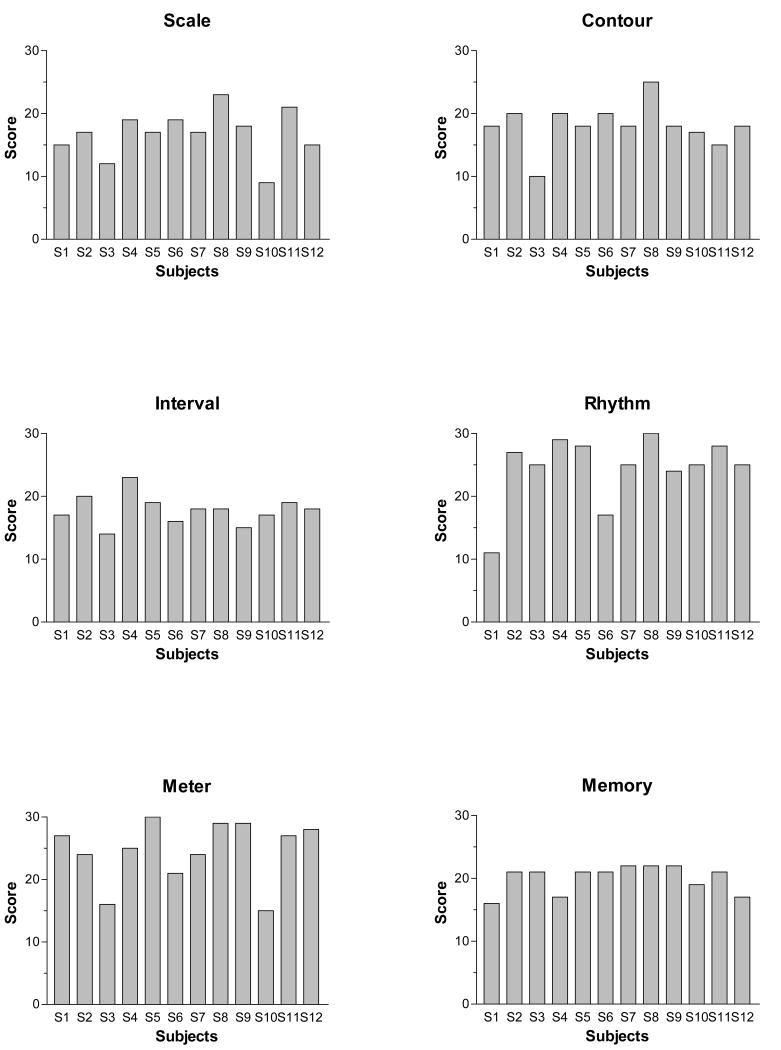
CI users and NH listeners performed higher on temporal-based tests (Rhythm and Meter) than on pitch-based tests (Scale, Contour, and Interval)--a finding that is consistent with previous research studies. The CI users' scores on pitch-based tests were near chance. The CI users' (but not NH listeners') scores for the Memory test, a test that incorporates an integration of both temporal-based and pitch-based aspects of music, were significantly higher than the scores obtained for the pitch-based Scale test and significantly lower than the temporal-based Rhythm and Meter tests. The data from NH listeners indicated that 16 channels of stimulation did not provide the highest music perception scores and performance was as good as that obtained with 12 channels. This outcome is consistent with other studies showing that NH listeners listening to vocoded speech are not able to use effectively F0 cues present in the envelopes, even when the stimuli are processed with a large number (16) of channels. The CI user data seem to most closely match with the 4- and 6-channel NH listener conditions for the pitch-based tasks.
Consistent with previous studies, both CI users and NH listeners showed the typical pattern of music perception in which scores are higher on tests measuring the perception of temporal aspects of music (Rhythm and Meter) than spectral (pitch) aspects of music (Scale, Contour, and Interval). On that regard, the pattern of results from this study indicates that the MBEA is a suitable test for measuring various aspects of music perception by CI users.
本研究旨在探讨使用蒙特利尔失乐感评估量表(MBEA)测试(佩雷茨等人,《纽约科学院学报》,999卷,58 - 75页)评估人工耳蜗(CI)使用者音乐感知能力的效用/可能性。
通过CI模拟处理刺激,使用MBEA测量CI使用者和听力正常(NH)的听众音乐感知的六个不同方面(音阶、轮廓、音程、节奏、节拍和旋律记忆)。在CI模拟中改变频谱分辨率(通道数)以确定:(a)达到最高音乐感知水平所需的通道数(4、6、8、12和16),以及(b)产生与CI使用者相当的音乐感知表现水平所需的通道数。
CI使用者和NH听众在基于时间的测试(节奏和节拍)中的表现高于基于音高的测试(音阶、轮廓和音程)——这一发现与先前的研究一致。CI使用者在基于音高的测试中的得分接近随机水平。CI使用者(而非NH听众)在记忆测试中的得分显著高于基于音高的音阶测试的得分,且显著低于基于时间的节奏和节拍测试的得分,记忆测试综合了音乐基于时间和基于音高的方面。NH听众的数据表明,16通道刺激并未提供最高的音乐感知分数,且表现与12通道时一样好。这一结果与其他研究一致,这些研究表明,即使刺激用大量(16)通道处理,听声码语音的NH听众也无法有效利用包络中存在的F0线索。对于基于音高的任务,CI使用者的数据似乎与4通道和6通道NH听众的情况最为匹配。
与先前的研究一致,CI使用者和NH听众都表现出典型的音乐感知模式,即测量音乐时间方面(节奏和节拍)感知的测试得分高于音乐频谱(音高)方面(音阶、轮廓和音程)感知的测试得分。在这方面,本研究的结果模式表明MBEA是测量CI使用者音乐感知各个方面的合适测试。