Naiser Thomas, Ehler Oliver, Kayser Jona, Mai Timo, Michel Wolfgang, Ott Albrecht
Experimentalphysik I, Universität Bayreuth, D-95440 Bayreuth, Germany.
BMC Biotechnol. 2008 May 13;8:48. doi: 10.1186/1472-6750-8-48.
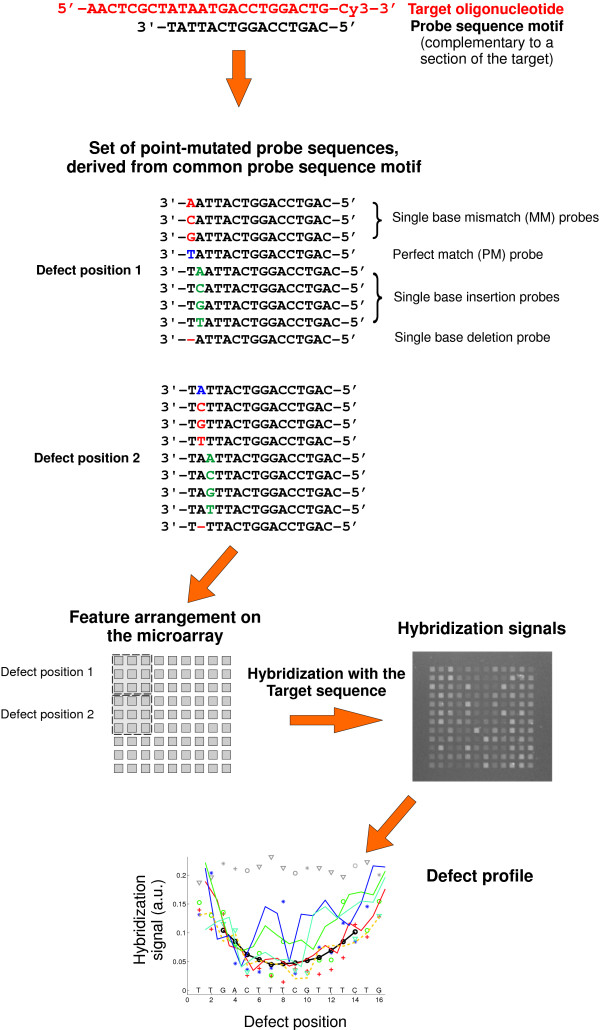
The high binding specificity of short 10 to 30 mer oligonucleotide probes enables single base mismatch (MM) discrimination and thus provides the basis for genotyping and resequencing microarray applications. Recent experiments indicate that the underlying principles governing DNA microarray hybridization - and in particular MM discrimination - are not completely understood. Microarrays usually address complex mixtures of DNA targets. In order to reduce the level of complexity and to study the problem of surface-based hybridization with point defects in more detail, we performed array based hybridization experiments in well controlled and simple situations.
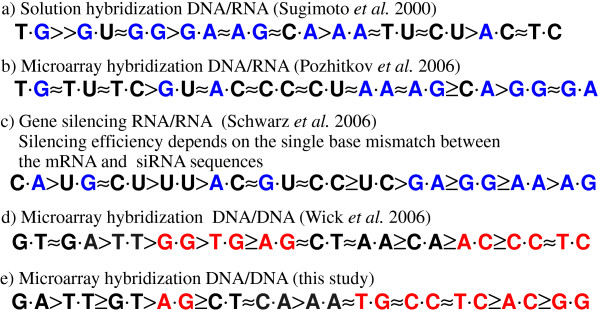
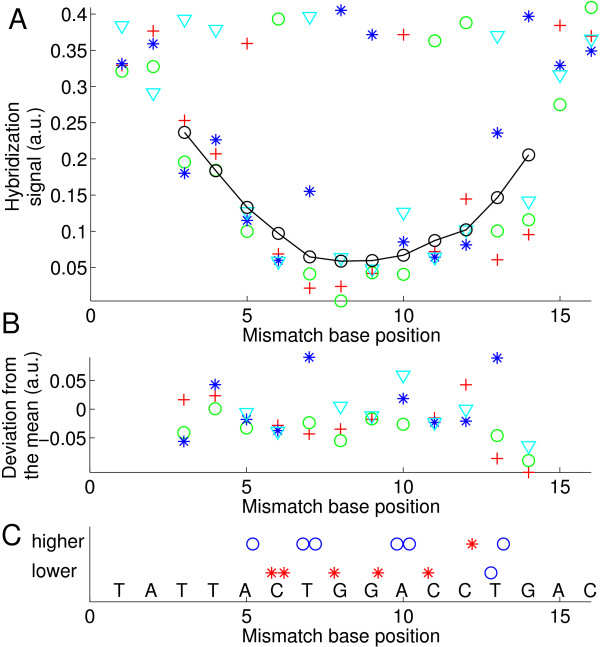
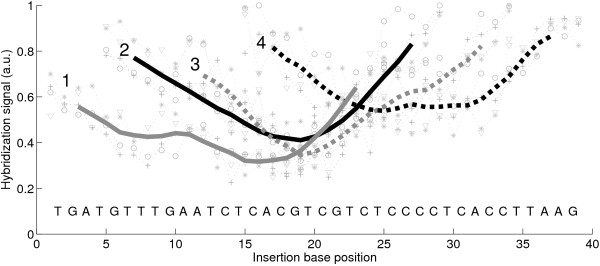
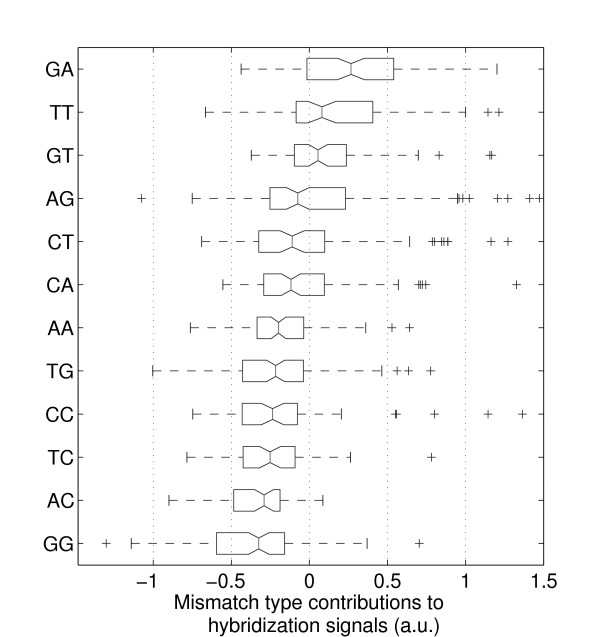
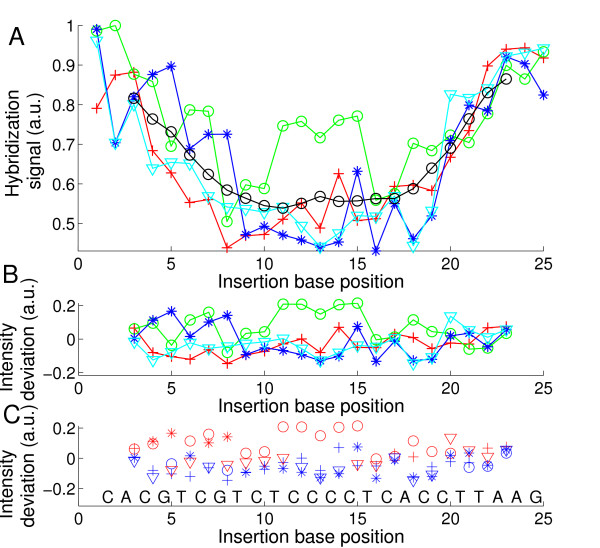
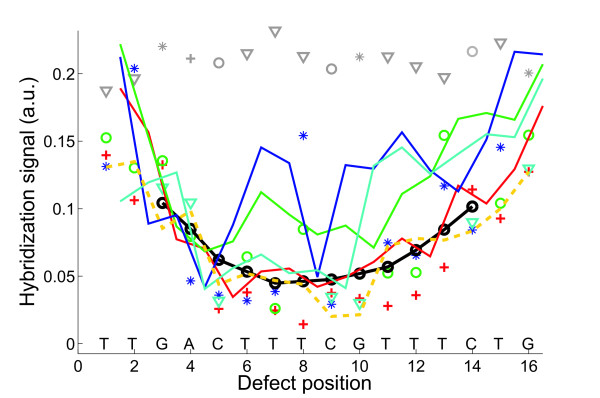
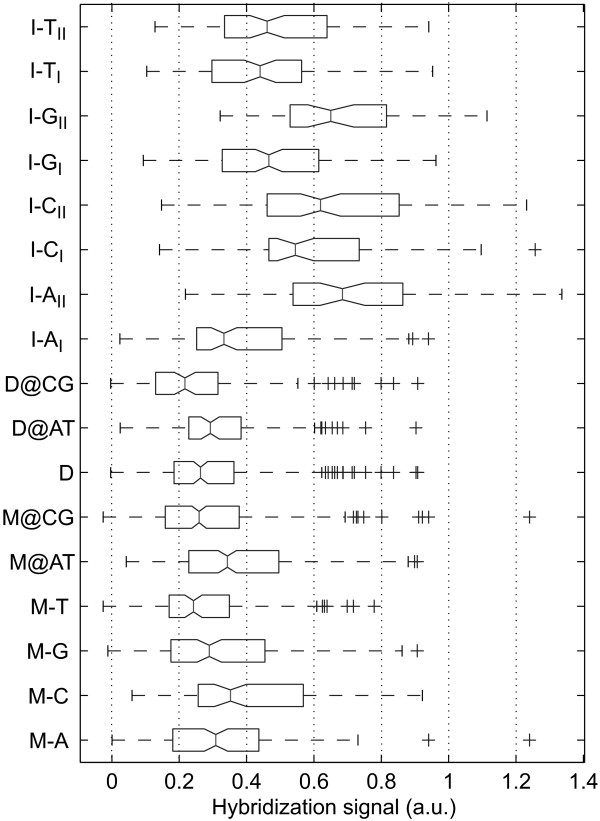
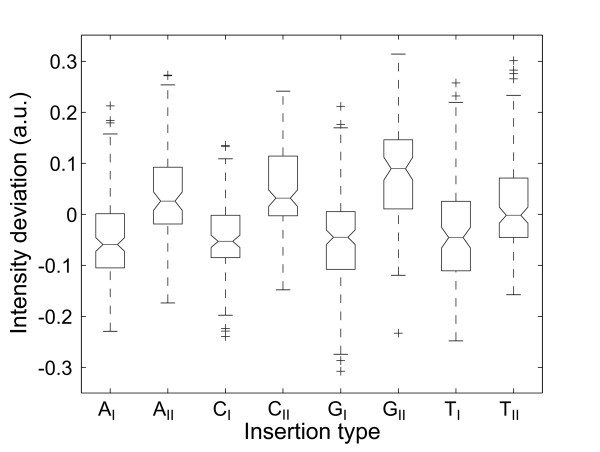
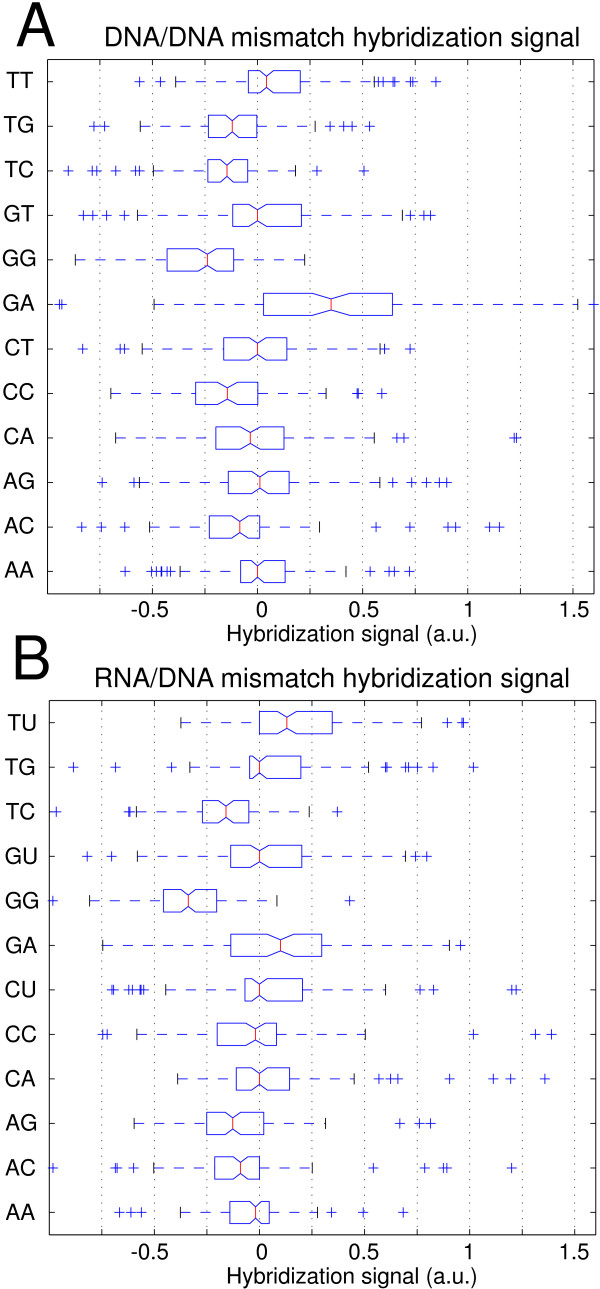
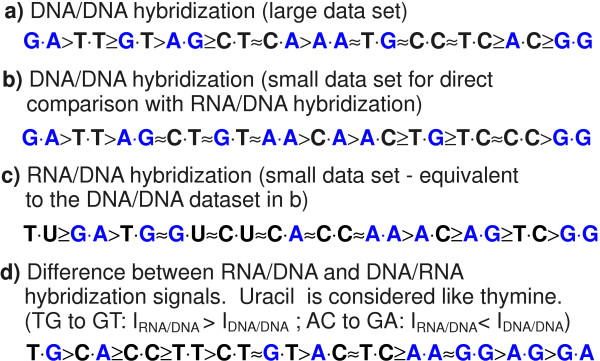
We performed microarray hybridization experiments with short 16 to 40 mer target and probe lengths (in situations without competitive hybridization) in order to systematically investigate the impact of point-mutations - varying defect type and position - on the oligonucleotide duplex binding affinity. The influence of single base bulges and single base MMs depends predominantly on position - it is largest in the middle of the strand. The position-dependent influence of base bulges is very similar to that of single base MMs, however certain bulges give rise to an unexpectedly high binding affinity. Besides the defect (MM or bulge) type, which is the second contribution in importance to hybridization affinity, there is also a sequence dependence, which extends beyond the defect next-neighbor and which is difficult to quantify. Direct comparison between binding affinities of DNA/DNA and RNA/DNA duplexes shows, that RNA/DNA purine-purine MMs are more discriminating than corresponding DNA/DNA MMs. In DNA/DNA MM discrimination the affected base pair (C.G vs. A.T) is the pertinent parameter. We attribute these differences to the different structures of the duplexes (A vs. B form).
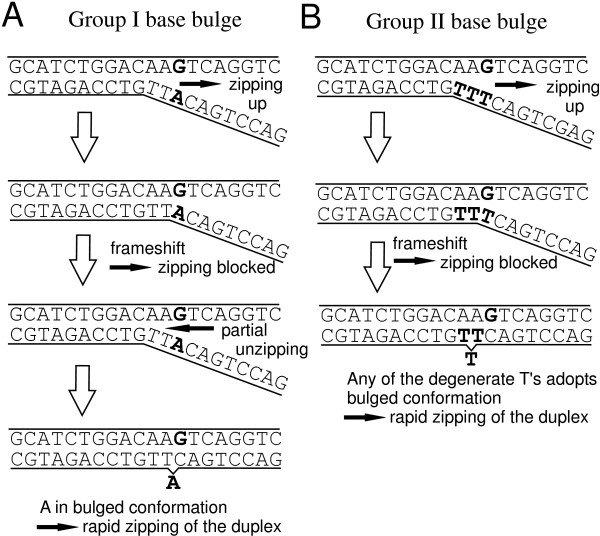
We have shown that DNA microarrays can resolve even subtle changes in hybridization affinity for simple target mixtures. We have further shown that the impact of point defects on oligonucleotide stability can be broken down to a hierarchy of effects. In order to explain our observations we propose DNA molecular dynamics - in form of zipping of the oligonucleotide duplex - to play an important role.
10至30个碱基的短寡核苷酸探针具有高度的结合特异性,能够区分单碱基错配(MM),从而为基因分型和重测序微阵列应用提供了基础。最近的实验表明,DNA微阵列杂交背后的基本原理,尤其是单碱基错配区分原理,尚未被完全理解。微阵列通常处理复杂的DNA靶标混合物。为了降低复杂性水平并更详细地研究基于表面的杂交与点缺陷问题,我们在可控且简单的情况下进行了基于阵列的杂交实验。
我们进行了微阵列杂交实验,使用16至40个碱基的短靶标和探针长度(在无竞争性杂交的情况下),以便系统地研究点突变(不同的缺陷类型和位置)对寡核苷酸双链体结合亲和力的影响。单碱基凸起和单碱基错配的影响主要取决于位置,在链的中间最大。碱基凸起的位置依赖性影响与单碱基错配非常相似,然而某些凸起会产生意想不到的高结合亲和力。除了缺陷(错配或凸起)类型,这是对杂交亲和力第二重要的贡献外,还存在序列依赖性,其延伸超出缺陷的相邻碱基,且难以量化。DNA/DNA和RNA/DNA双链体结合亲和力的直接比较表明,RNA/DNA嘌呤-嘌呤错配比相应的DNA/DNA错配更具区分性。在DNA/DNA错配区分中,受影响的碱基对(C.G对A.T)是相关参数。我们将这些差异归因于双链体的不同结构(A形式与B形式)。
我们已经表明,DNA微阵列能够分辨简单靶标混合物中杂交亲和力的细微变化。我们还进一步表明,点缺陷对寡核苷酸稳定性的影响可以分解为一系列层次效应。为了解释我们的观察结果,我们提出DNA分子动力学——以寡核苷酸双链体的拉链形式——发挥重要作用。