Gordon Lorenzo A, Morrison Errol Y, McGrowder Donovan A, Young Ronald, Fraser Yeiny Terry Pena, Zamora Eslaen Martorell, Alexander-Lindo Ruby L, Irving Rachael R
Department of Medicine, University of the West Indies, Kingston 7, Jamaica.
BMC Complement Altern Med. 2008 May 13;8:21. doi: 10.1186/1472-6882-8-21.
Yoga has been shown to be a simple and economical therapeutic modality that may be considered as a beneficial adjuvant for type 2 diabetes mellitus. This study investigated the impact of Hatha yoga and conventional physical training (PT) exercise regimens on biochemical, oxidative stress indicators and oxidant status in patients with type 2 diabetes.
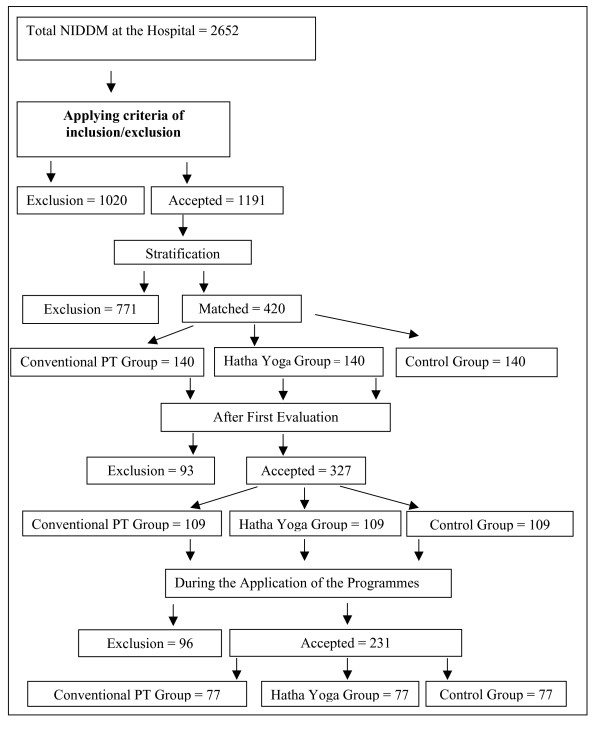
This prospective randomized study consisted of 77 type 2 diabetic patients in the Hatha yoga exercise group that were matched with a similar number of type 2 diabetic patients in the conventional PT exercise and control groups. Biochemical parameters such as fasting blood glucose (FBG), serum total cholesterol (TC), triglycerides, low-density lipoprotein (LDL), very low-density lipoproteins (VLDL) and high-density lipoprotein (HDL) were determined at baseline and at two consecutive three monthly intervals. The oxidative stress indicators (malondialdehyde - MDA, protein oxidation - POX, phospholipase A2 - PLA2 activity) and oxidative status [superoxide dismutase (SOD) and catalase activities] were measured.
The concentrations of FBG in the Hatha yoga and conventional PT exercise groups after six months decreased by 29.48% and 27.43% respectively (P < 0.0001) and there was a significant reduction in serum TC in both groups (P < 0.0001). The concentrations of VLDL in the managed groups after six months differed significantly from baseline values (P = 0.036). Lipid peroxidation as indicated by MDA significantly decreased by 19.9% and 18.1% in the Hatha yoga and conventional PT exercise groups respectively (P < 0.0001); whilst the activity of SOD significantly increased by 24.08% and 20.18% respectively (P = 0.031). There was no significant difference in the baseline and 6 months activities of PLA2 and catalase after six months although the latter increased by 13.68% and 13.19% in the Hatha yoga and conventional PT exercise groups respectively (P = 0.144).
The study demonstrate the efficacy of Hatha yoga exercise on fasting blood glucose, lipid profile, oxidative stress markers and antioxidant status in patients with type 2 diabetes and suggest that Hatha yoga exercise and conventional PT exercise may have therapeutic preventative and protective effects on diabetes mellitus by decreasing oxidative stress and improving antioxidant status.
Australian New Zealand Clinical Trials Registry (ANZCTR): ACTRN12608000217303.
瑜伽已被证明是一种简单且经济的治疗方式,可被视为2型糖尿病的有益辅助治疗方法。本研究调查了哈他瑜伽和传统体育锻炼(PT)方案对2型糖尿病患者生化指标、氧化应激指标和氧化状态的影响。
这项前瞻性随机研究包括77名哈他瑜伽运动组的2型糖尿病患者,他们与传统PT运动组和对照组中数量相似的2型糖尿病患者相匹配。在基线以及连续两个三个月的间隔时间测定生化参数,如空腹血糖(FBG)、血清总胆固醇(TC)、甘油三酯、低密度脂蛋白(LDL)、极低密度脂蛋白(VLDL)和高密度脂蛋白(HDL)。测量氧化应激指标(丙二醛 - MDA、蛋白质氧化 - POX、磷脂酶A2 - PLA2活性)和氧化状态[超氧化物歧化酶(SOD)和过氧化氢酶活性]。
六个月后,哈他瑜伽组和传统PT运动组的FBG浓度分别下降了29.48%和27.43%(P < 0.0001),两组的血清TC均显著降低(P < 0.0001)。六个月后,干预组的VLDL浓度与基线值有显著差异(P = 0.036)。MDA所表明的脂质过氧化在哈他瑜伽组和传统PT运动组中分别显著降低了19.9%和18.1%(P < 0.0001);而SOD活性分别显著增加了24.08%和20.18%(P = 0.031)。六个月后,PLA2和过氧化氢酶的基线和六个月活性无显著差异,尽管后者在哈他瑜伽组和传统PT运动组中分别增加了13.68%和13.19%(P = 0.144)。
该研究证明了哈他瑜伽运动对2型糖尿病患者的空腹血糖、血脂谱、氧化应激标志物和抗氧化状态的疗效,并表明哈他瑜伽运动和传统PT运动可能通过降低氧化应激和改善抗氧化状态对糖尿病具有治疗、预防和保护作用。
澳大利亚新西兰临床试验注册中心(ANZCTR):ACTRN12608000217303。