Cha Yong-Mei, Oh Jae, Miyazaki Chinami, Hayes David L, Rea Robert F, Shen Win-Kuang, Asirvatham Samuel J, Kemp Brad J, Hodge David O, Chen Peng-Sheng, Chareonthaitawee Panithaya
Division of Cardiovascular Diseases, Department of Medicine, Mayo Clinic College of Medicine, Rochester, Minnesota, USA.
J Cardiovasc Electrophysiol. 2008 Oct;19(10):1045-52. doi: 10.1111/j.1540-8167.2008.01190.x. Epub 2008 May 9.
To determine the effect of cardiac resynchronization therapy (CRT) on sympathetic nervous function in heart failure (HF).
Neurohormonal dysregulation and cardiac autonomic dysfunction are associated with HF and contribute to HF progression and its poor prognosis. We hypothesized that mechanical resynchronization improves cardiac sympathetic function in HF.
Sixteen consecutive patients receiving CRT for advanced cardiomyopathy and 10 controls were included in this prospective study. NYHA class, 6-minute walk distance, echocardiographic parameters, plasma norepinephrine (NE) were assessed at baseline, 3-month and 6-month follow-up. Cardiac sympathetic function was determined by (123)iodine metaiodobenzylguanidine ((123)I-MIBG) scintigraphy and 24-hour ambulatory electrocardiography.
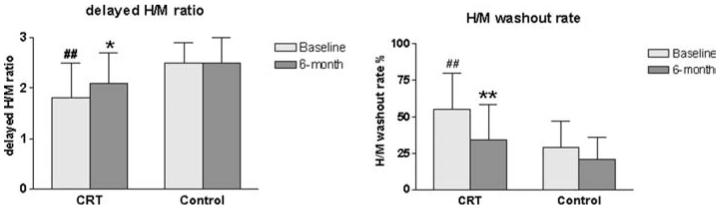
Along with improvement in NYHA class (3.1 +/- 0.3 to 2.1 +/- 0.4, P < 0.001) and LVEF (23 +/- 6% to 33 +/- 12%, P < 0.001), delayed heart/mediastinum (H/M) (123)I-MIBG ratio increased significantly (1.8 +/- 0.7 to 2.1 +/- 0.6, P = 0.04) while the H/M (123)I-MIBG washout rate decreased significantly (54 +/- 25% to 34 +/- 24%, P = 0.01) from baseline to 6-month follow-up. The heart rate variability (HRV) measured in SD of normal-to-normal intervals also increased significantly from baseline (82 +/- 30 ms) to follow-up (111 +/- 32 ms, P = 0.04). The improvement in NYHA after CRT was significantly associated with baseline (123)I-MIBG H/M washout rate (r = 0.65, P = 0.03). The improvement in LVESV index was associated with baseline (123)I-MIBG delayed H/M ratio (r =-0.67, P = 0.02) and H/M washout rate (r = 0.65, P = 0.03).
After CRT, improvements in cardiac symptoms and LV function were accompanied by rebalanced cardiac autonomic control as measured by (123)I-MIBG and HRV.
确定心脏再同步治疗(CRT)对心力衰竭(HF)患者交感神经功能的影响。
神经激素失调和心脏自主神经功能障碍与HF相关,并导致HF进展及其不良预后。我们假设机械再同步可改善HF患者的心脏交感神经功能。
本前瞻性研究纳入了16例因晚期心肌病接受CRT治疗的连续患者和10例对照。在基线、3个月和6个月随访时评估纽约心脏协会(NYHA)心功能分级、6分钟步行距离、超声心动图参数、血浆去甲肾上腺素(NE)。通过(123)碘间碘苄胍((123)I-MIBG)闪烁显像和24小时动态心电图测定心脏交感神经功能。
随着NYHA心功能分级改善(从3.1±0.3降至2.1±0.4,P<0.001)和左心室射血分数(LVEF)提高(从23±6%升至33±12%,P<0.001),延迟的心/纵隔(H/M)(123)I-MIBG比值显著增加(从1.8±0.7升至2.1±0.6,P=0.04),而从基线至6个月随访时H/M(123)I-MIBG洗脱率显著降低(从54±25%降至34±24%,P=0.01)。正常RR间期标准差测量的心率变异性(HRV)从基线(82±30毫秒)至随访时也显著增加(111±32毫秒,P=0.04)。CRT后NYHA分级的改善与基线(123)I-MIBG H/M洗脱率显著相关(r=0.65,P=0.03)。左心室舒张末期容积指数的改善与基线(123)I-MIBG延迟H/M比值(r=-0.67,P=0.02)和H/M洗脱率(r=0.65,P=0.03)相关。
CRT后,心脏症状和左心室功能改善的同时,通过(123)I-MIBG和HRV测量显示心脏自主神经控制恢复平衡。