Okada Kinya, Asai Kiyoshi
Department of Computational Biology, Graduate School of Frontier Sciences, The University of Tokyo, Kashiwa, Chiba, Japan.
BMC Genomics. 2008 May 14;9:218. doi: 10.1186/1471-2164-9-218.
The adaptive immune system (AIS) of jawed vertebrates is a sophisticated system mediated by numerous genes in specialized cells. Phylogenetic analysis indicates that emergence of the AIS followed the occurrence of two rounds of whole-genome duplication (2R-WGD) in early vertebrates, but little direct evidence linking these two events is available.
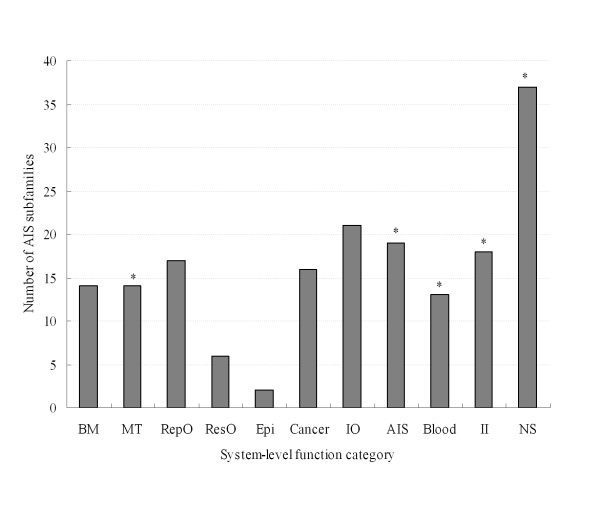
We examined the relationship between 2R-WGD and the gain of AIS-related functions by numerous genes. To analyze the evolution of the many genes related to signal transduction in the AIS (defined as AIS genes), we identified groups of genes (defined as AIS subfamilies) that included at least one human AIS gene, its paralogs (if any), and its Drosophila ortholog(s). Genomic mapping revealed that numerous pairs of AIS genes and their paralogs were part of paralogons - series of paralogous regions that derive from a common ancestor - throughout the human genome, indicating that the genes were retained as duplicates after 2R-WGD. Outgroup comparison analysis revealed that subfamilies in which human and fly genes shared a nervous system-related function were significantly enriched among AIS subfamilies, as compared with the overall incidence of shared nervous system-related functions among all subfamilies in bilaterians. This finding statistically supports the hypothesis that AIS-related signaling genes were ancestrally involved in the nervous system of urbilaterians.
The current results suggest that 2R-WGD played a major role in the duplication of many signaling genes, ancestrally used in nervous system development and function, that were later co-opted for new functions during evolution of the AIS.
有颌脊椎动物的适应性免疫系统(AIS)是一个由特化细胞中的众多基因介导的复杂系统。系统发育分析表明,AIS的出现是在早期脊椎动物两轮全基因组复制(2R-WGD)之后,但几乎没有将这两个事件联系起来的直接证据。
我们研究了2R-WGD与众多基因获得AIS相关功能之间的关系。为了分析AIS中许多与信号转导相关的基因(定义为AIS基因)的进化,我们鉴定了一些基因组(定义为AIS亚家族),这些基因组至少包含一个人类AIS基因、其旁系同源基因(如果有的话)及其果蝇直系同源基因。基因组图谱显示,在整个人类基因组中,众多AIS基因及其旁系同源基因对是旁系同原区(源自共同祖先的一系列旁系同源区域)的一部分,这表明这些基因在2R-WGD之后作为重复基因被保留了下来。外群比较分析显示,与两侧对称动物所有亚家族中共享的神经系统相关功能的总体发生率相比,人类和果蝇基因共享神经系统相关功能的亚家族在AIS亚家族中显著富集。这一发现从统计学上支持了这样一个假设,即AIS相关信号基因在祖先时期参与了原口动物的神经系统。
目前的结果表明,2R-WGD在许多信号基因的复制中起了主要作用,这些信号基因在祖先时期用于神经系统发育和功能,后来在AIS进化过程中被用于新的功能。