Deane Janet E, Graham Stephen C, Mitchell Edward P, Flot David, Johnson Steven, Lea Susan M
Sir William Dunn School of Pathology, South Parks Rd, University of Oxford, OX1 3RE, UK.
Mol Microbiol. 2008 Jul;69(1):267-76. doi: 10.1111/j.1365-2958.2008.06293.x. Epub 2008 May 15.
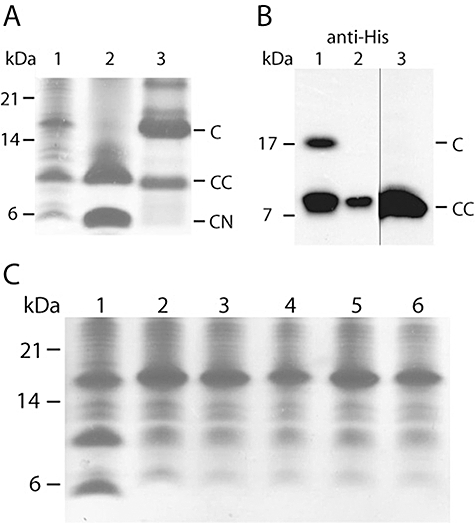
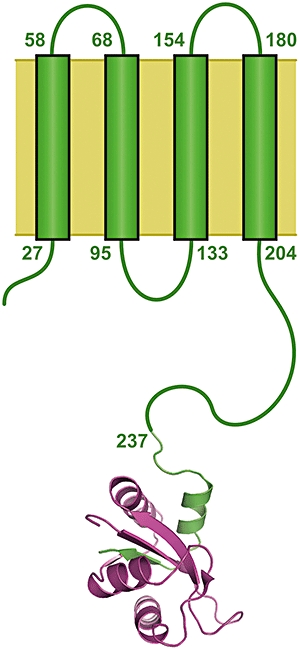
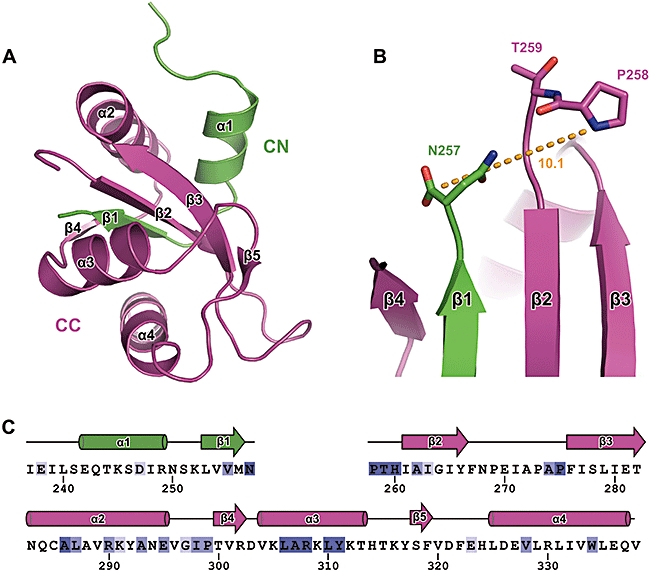
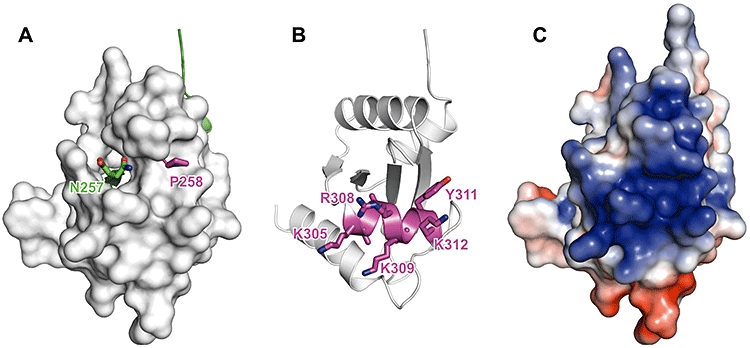
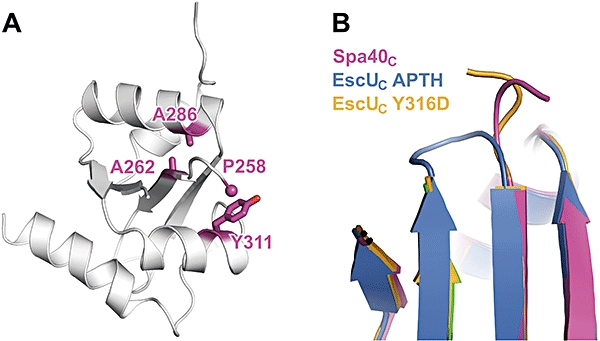
The pathogenic bacterium Shigella flexneri uses a type III secretion system to inject virulence factors from the bacterial cytosol directly into host cells. The machinery that identifies secretion substrates and controls the export of extracellular components and effector proteins consists of several inner-membrane and cytoplasmic proteins. One of the inner membrane components, Spa40, belongs to a family of proteins proposed to regulate the switching of substrate specificity of the export apparatus. We show that Spa40 is cleaved within the strictly conserved amino acid sequence NPTH and substitution of the proposed autocatalytic residue abolishes cleavage. Here we also report the crystal structure of the cytoplasmic complex Spa40(C) and compare it with the recent structures of the homologues from Escherichia coli and Salmonella typhimurium. These structures reveal the tight association of the cleaved fragments and show that the conserved NPTH sequence lies on a loop which, when cleaved, swings away from the catalytic N257 residue, resulting in different surface features in this region. This structural rearrangement suggests a mechanism by which non-cleaving forms of these proteins interfere with correct substrate switching of the apparatus.
志贺氏菌利用III型分泌系统将细菌胞质溶胶中的毒力因子直接注入宿主细胞。识别分泌底物并控制细胞外成分和效应蛋白输出的机制由几种内膜和细胞质蛋白组成。内膜成分之一Spa40属于一个蛋白质家族,该家族被认为可调节输出装置底物特异性的转换。我们发现Spa40在严格保守的氨基酸序列NPTH内被切割,并且所提出的自催化残基的取代消除了切割。在此我们还报道了细胞质复合物Spa40(C)的晶体结构,并将其与来自大肠杆菌和鼠伤寒沙门氏菌的同源物的最新结构进行比较。这些结构揭示了切割片段的紧密结合,并表明保守的NPTH序列位于一个环上,当被切割时,该环会从催化性N257残基处摆动开,导致该区域出现不同的表面特征。这种结构重排提示了这些蛋白质的非切割形式干扰装置正确底物转换的一种机制。