Wagner Samuel, Grin Iwan, Malmsheimer Silke, Singh Nidhi, Torres-Vargas Claudia E, Westerhausen Sibel
University of Tübingen, Interfaculty Institute of Microbiology and Infection Medicine (IMIT), Elfriede-Aulhorn-Str. 6, 72076 Tübingen, Germany.
German Center for Infection Research (DZIF), partner-site Tübingen, Elfriede-Aulhorn-Str. 6, 72076 Tübingen, Germany.
FEMS Microbiol Lett. 2018 Oct 1;365(19). doi: 10.1093/femsle/fny201.
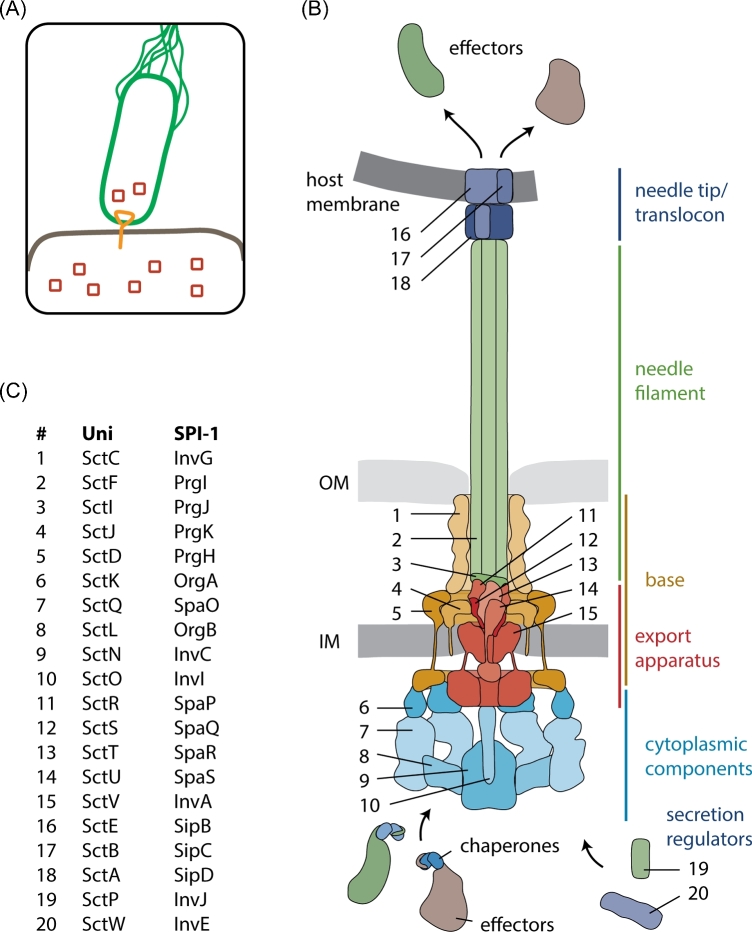
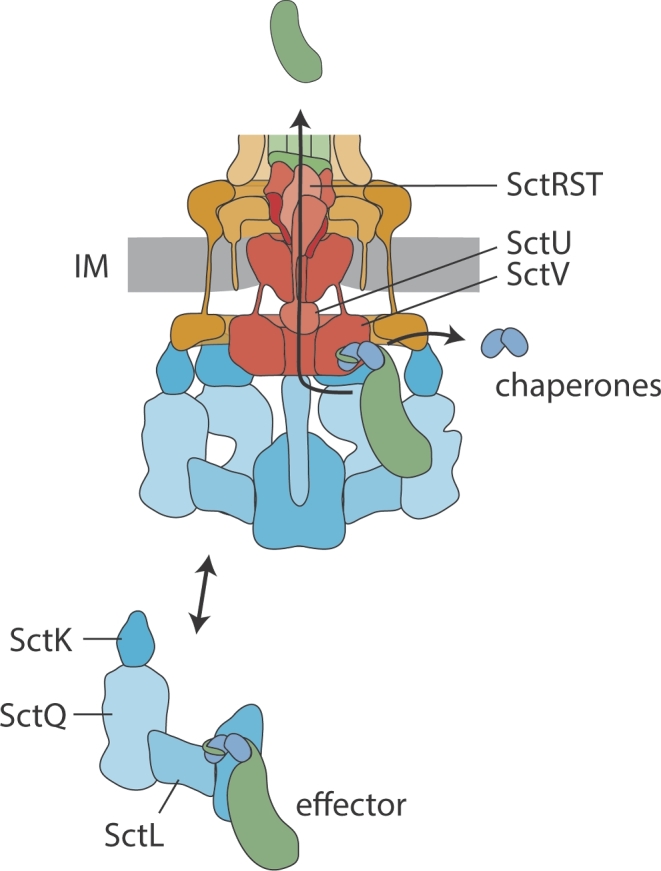
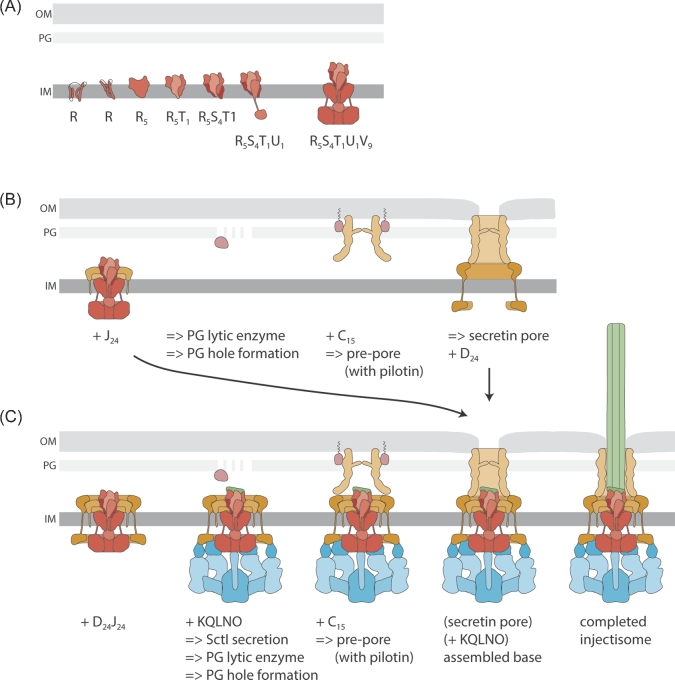
Virulence-associated type III secretion systems (T3SS) serve the injection of bacterial effector proteins into eukaryotic host cells. They are able to secrete a great diversity of substrate proteins in order to modulate host cell function, and have evolved to sense host cell contact and to inject their substrates through a translocon pore in the host cell membrane. T3SS substrates contain an N-terminal signal sequence and often a chaperone-binding domain for cognate T3SS chaperones. These signals guide the substrates to the machine where substrates are unfolded and handed over to the secretion channel formed by the transmembrane domains of the export apparatus components and by the needle filament. Secretion itself is driven by the proton motive force across the bacterial inner membrane. The needle filament measures 20-150 nm in length and is crowned by a needle tip that mediates host-cell sensing. Secretion through T3SS is a highly regulated process with early, intermediate and late substrates. A strict secretion hierarchy is required to build an injectisome capable of reaching, sensing and penetrating the host cell membrane, before host cell-acting effector proteins are deployed. Here, we review the recent progress on elucidating the assembly, structure and function of T3SS injectisomes.
与毒力相关的III型分泌系统(T3SS)负责将细菌效应蛋白注入真核宿主细胞。它们能够分泌多种底物蛋白以调节宿主细胞功能,并已进化到能够感知宿主细胞接触,并通过宿主细胞膜上的转运孔注入其底物。T3SS底物包含一个N端信号序列,并且通常具有用于同源T3SS伴侣蛋白的伴侣结合结构域。这些信号将底物引导至机器,在那里底物被展开并传递至由输出装置组件的跨膜结构域和针状丝形成的分泌通道。分泌本身由跨细菌内膜的质子动力驱动。针状丝长度为20 - 150纳米,顶端是介导宿主细胞感知的针尖。通过T3SS的分泌是一个高度调控的过程,有早期、中期和晚期底物。在部署作用于宿主细胞的效应蛋白之前,需要严格的分泌层级来构建一个能够到达、感知并穿透宿主细胞膜的注射体。在此,我们综述了在阐明T3SS注射体的组装、结构和功能方面的最新进展。