Kroeze Willemieke, Oenema Anke, Campbell Marci, Brug Johannes
Erasmus MC, University Medical Center, Department of Public Health, PO Box 2040, 3000 CA Rotterdam, The Netherlands.
J Med Internet Res. 2008 Apr 29;10(2):e12. doi: 10.2196/jmir.940.
Computer-tailored health education, a promising health education technique, is increasingly being delivered interactively, for example, over the Internet. It has been suggested that there may be differences in use and appreciation between print and interactive delivery of computer-tailored interventions, which may influence information processing. This may especially be the case for women, older people, and people of lower socioeconomic status. Knowledge about differences in use and appreciation could help in choosing the appropriate delivery mode for a particular target audience.
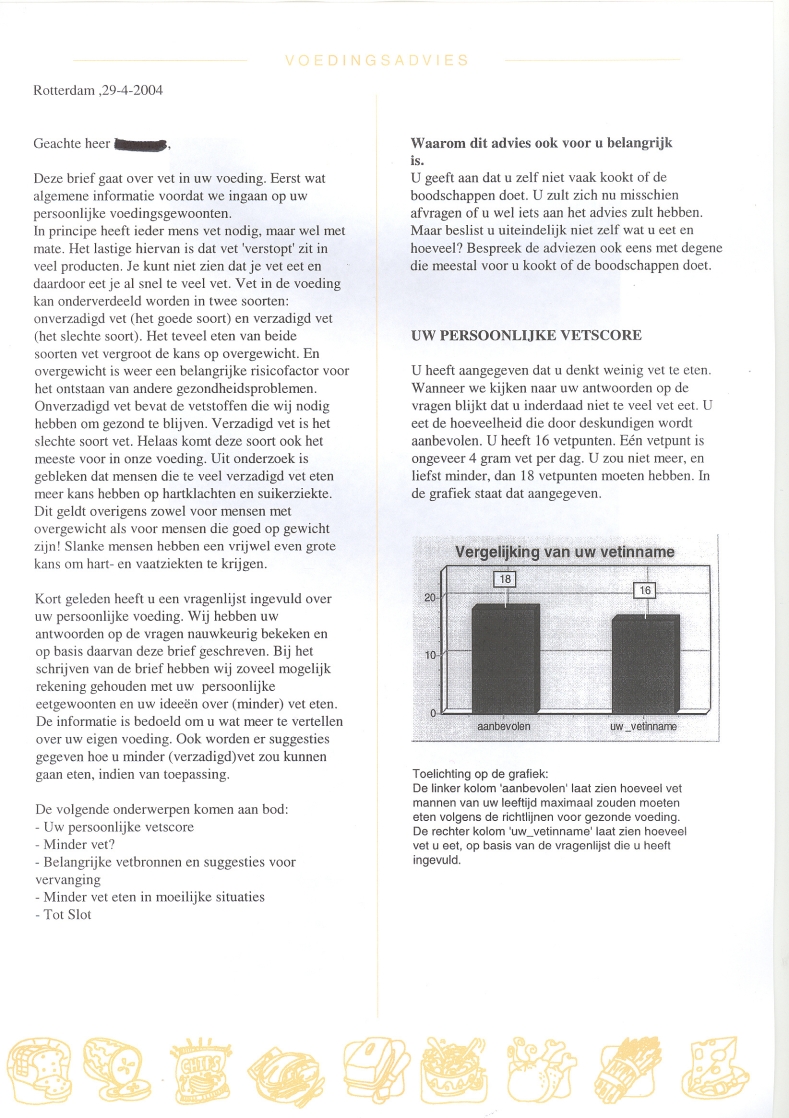
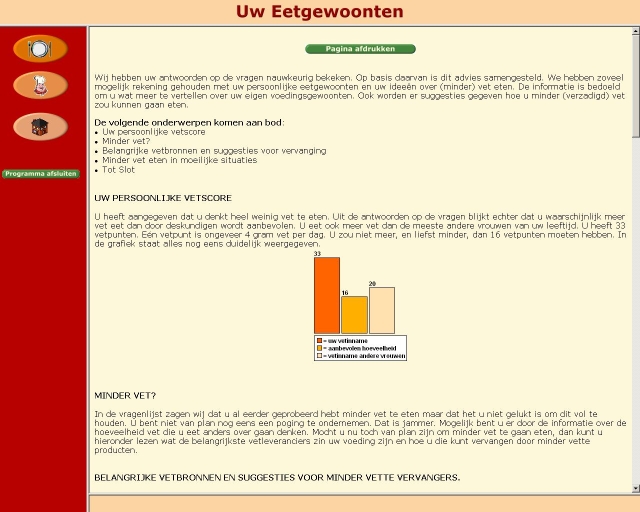
The study investigates a content-identical, computer-tailored intervention addressing saturated fat intake delivered via print or CD-ROM. We analyzed consumer use and appreciation of the feedback information and explored whether possible differences exist among gender, age, and education subgroups.
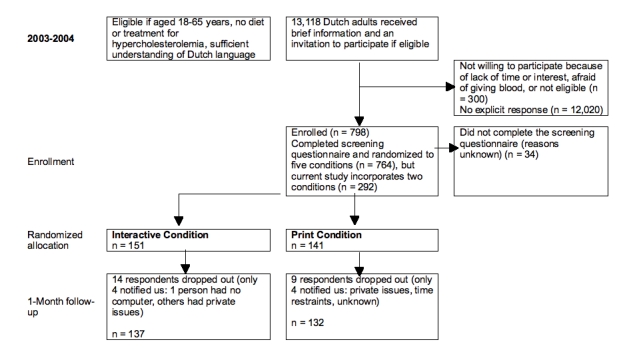
Healthy Dutch adults (18-65 years), none of whom were under treatment for hypercholesterolemia, were randomly allocated to receive a computer-tailored program on CD-ROM (n = 151) or in print (n = 141). At baseline, data were collected on gender, age, and education level. One month post-intervention, data were collected on the use (feedback information read, saved, discussed) and appreciation (trustworthiness, perceived individualization, perceived personal relevance, and user-friendliness) of the feedback. Statistical analyses on the use and appreciation items were performed using chi-square tests and independent-samples t tests.
After exclusion of individuals with missing values, a total of 257 and 240 respondents were included in the analyses of the use outcomes of feedback read and saved, respectively. The results indicate that among the total population, the print feedback was read more often than the CD-ROM feedback (95% vs 81%; P = .001) and saved more often than the CD-ROM feedback (97% vs 77%; P < .001). Similar results were found among the gender, age, and education subgroups. After exclusion of individuals who did not read the information and those with missing values, a total of 208-223 respondents were included in the analyses of the use outcome of feedback discussed and the appreciation items. The personal relevance of the print feedback was rated higher than for the CD-ROM-delivered feedback (0.97 vs 0.68; P = .04), but the effect size was small (0.28). These differences in personal relevance were also seen among women (1.06 vs 0.67; P = .04) and respondents aged 35-49 years (1.00 vs 0.58; P = .03), with moderate effect sizes (0.38 and 0.44, respectively).
Despite the possible advantages of interactive feedback, the present study indicates that interactive-delivered feedback was used less and perceived as less personally relevant compared to the print-delivered feedback. These differences in use and appreciation of delivery modes should be taken into consideration when selecting a delivery mode for a specific subgroup in order to optimize exposure.
ISRCTN 01557410; http://www.webcitation.org/5XMylWleH.
计算机定制健康教育是一种很有前景的健康教育技术,越来越多地通过互联网等方式进行交互式传递。有人认为,计算机定制干预措施的印刷版和交互式传递方式在使用和接受程度上可能存在差异,这可能会影响信息处理。对于女性、老年人以及社会经济地位较低的人群来说,情况可能尤其如此。了解使用和接受程度上的差异有助于为特定目标受众选择合适的传递方式。
本研究调查了通过印刷品或光盘提供的、针对饱和脂肪摄入量的内容相同的计算机定制干预措施。我们分析了消费者对反馈信息的使用和接受情况,并探讨了性别、年龄和教育亚组之间是否存在可能的差异。
健康的荷兰成年人(18 - 65岁),均未接受高胆固醇血症治疗,被随机分配接受光盘版(n = 151)或印刷版(n = 141)的计算机定制程序。在基线时,收集了性别、年龄和教育水平的数据。干预后一个月,收集了关于反馈信息的使用(阅读、保存、讨论)和接受程度(可信度、个性化感知、个人相关性感知和用户友好性)的数据。使用卡方检验和独立样本t检验对使用和接受程度项目进行统计分析。
在排除有缺失值的个体后,分别有257名和240名受访者被纳入反馈信息阅读和保存使用结果的分析。结果表明,在总体人群中,印刷版反馈信息的阅读率高于光盘版(95%对81%;P = .001),保存率也高于光盘版(97%对77%;P < .001)。在性别、年龄和教育亚组中也发现了类似结果。在排除未阅读信息的个体和有缺失值的个体后,共有208 - 223名受访者被纳入反馈信息讨论使用结果和接受程度项目的分析。印刷版反馈信息的个人相关性评分高于光盘版(0.97对0.68;P = .04),但效应量较小(0.28)。在女性(1.06对0.67;P = .04)和35 - 49岁的受访者(1.00对0.58;P = .03)中也观察到了这些个人相关性差异,效应量适中(分别为0.38和0.44)。
尽管交互式反馈可能有优势,但本研究表明,与印刷版反馈相比,交互式传递的反馈使用较少,且个人相关性感知较低。在为特定亚组选择传递方式时,应考虑传递方式在使用和接受程度上的这些差异,以优化信息传播。
ISRCTN 01557410;http://www.webcitation.org/5XMylWleH。