Roberts Jonathan A, Digby Helen R, Kara Madina, El Ajouz Sam, Sutcliffe Michael J, Evans Richard J
Department of Cell Physiology and Pharmacology, Henry Wellcome Building, University of Leicester, Leicester, UK.
J Biol Chem. 2008 Jul 18;283(29):20126-36. doi: 10.1074/jbc.M800294200. Epub 2008 May 16.
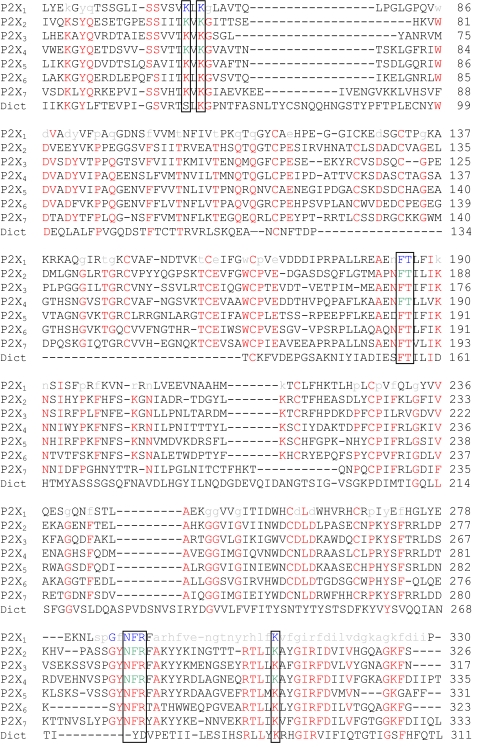
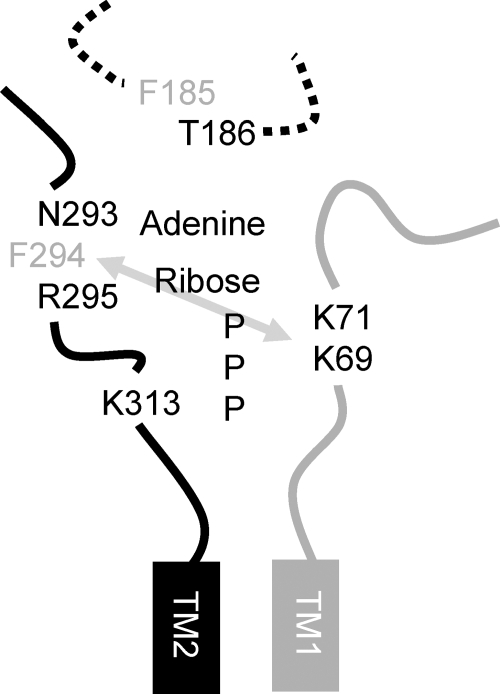
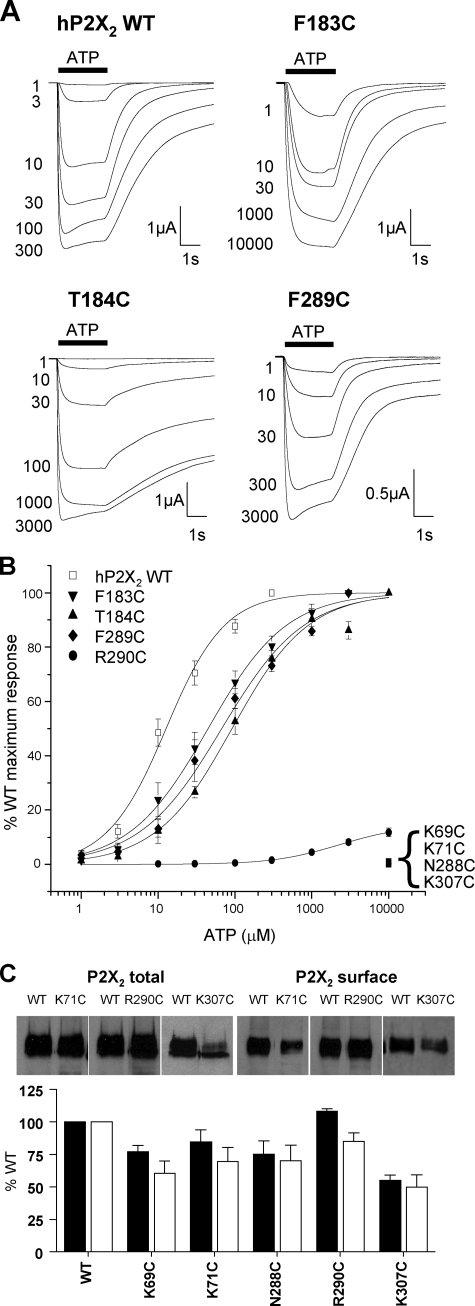
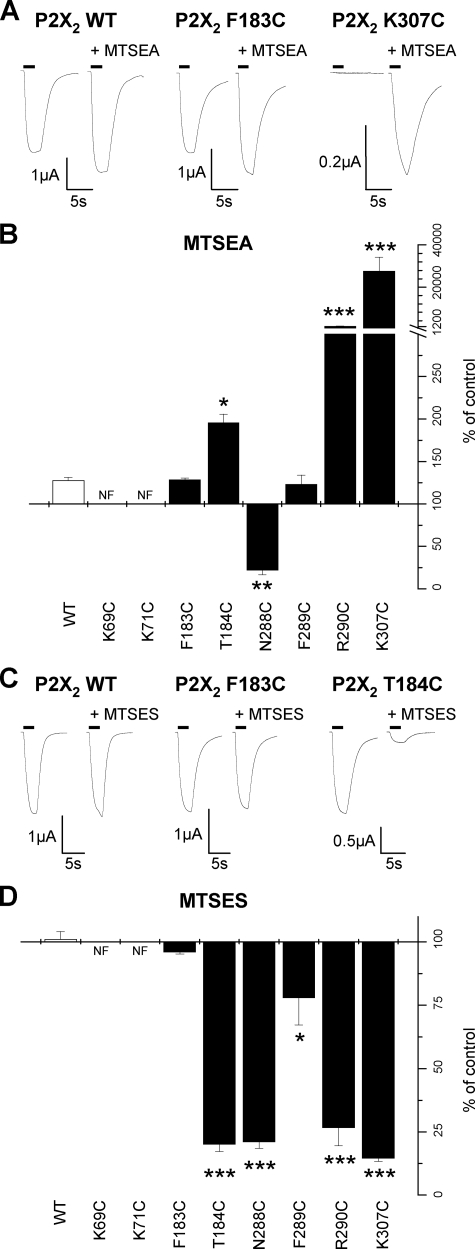
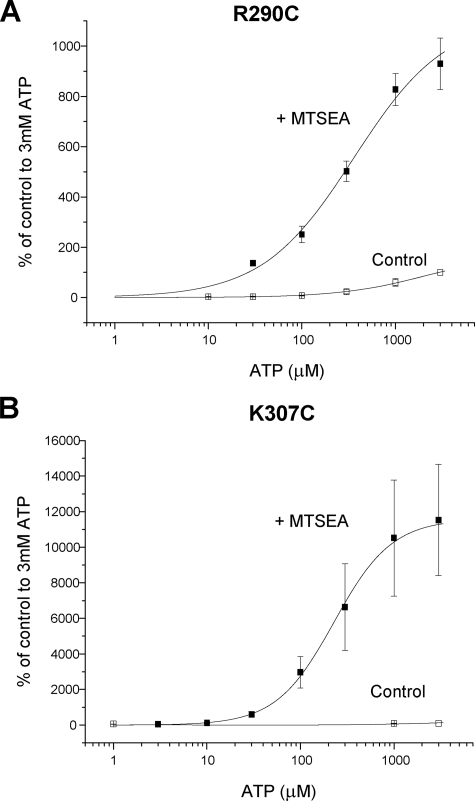
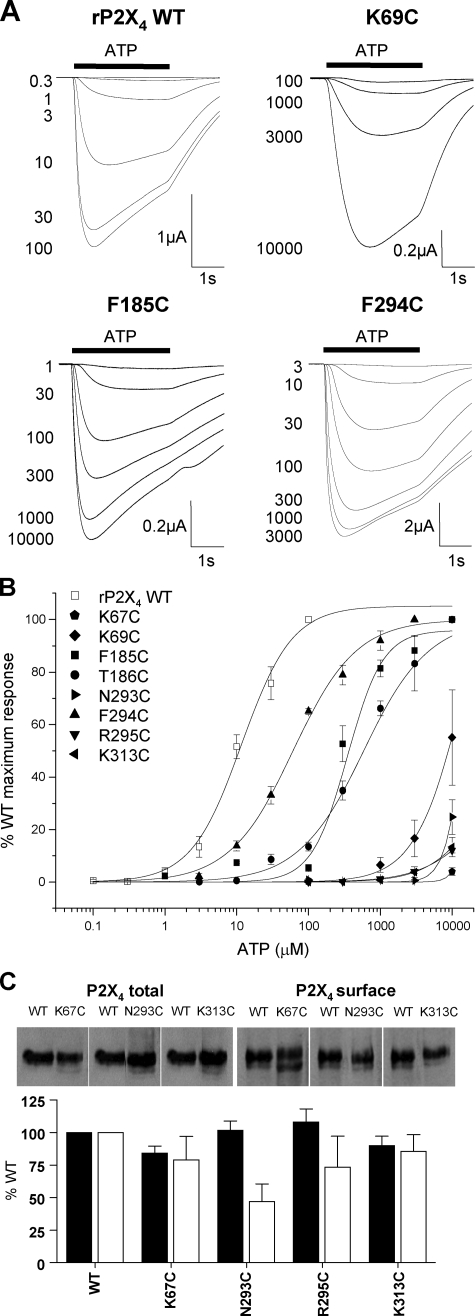
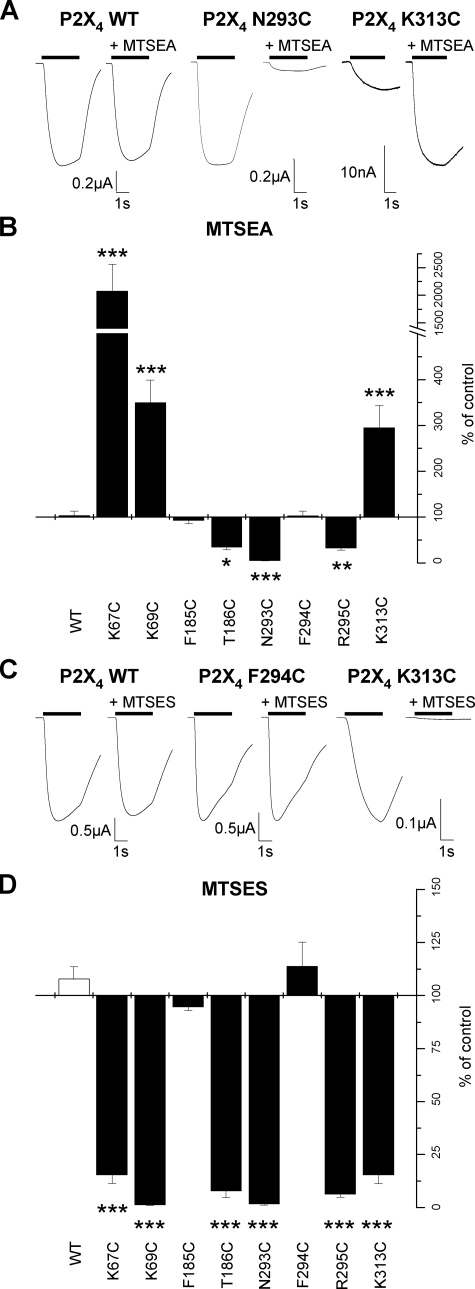
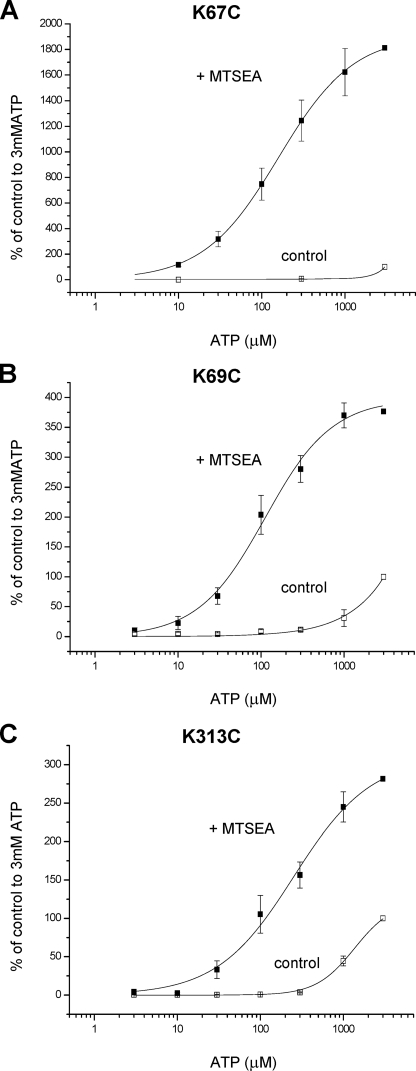
The agonist binding site of ATP-gated P2X receptors is distinct from other ATP-binding proteins. Mutagenesis on P2X(1) receptors of conserved residues in mammalian P2X receptors has established the paradigm that three lysine residues, as well as FT and NFR motifs, play an important role in mediating ATP action. In this study we have determined whether cysteine substitution mutations of equivalent residues in P2X(2) and P2X(4) receptors have similar effects and if these mutant receptors can be regulated by charged methanethiosulfonate (MTS) compounds. All the mutants (except the P2X(2) K69C and K71C that were expressed, but non-functional) showed a significant decrease in ATP potency, with >300-fold decreases for mutants of the conserved asparagine, arginine, and lysine residues close to the end of the extracellular loop. MTS reagents had no effect at the phenylalanine of the FT motif, in contrast, cysteine mutation of the threonine was sensitive to MTS reagents and suggested a role of this residue in ATP action. The lysine-substituted receptors were sensitive to the charge of the MTS reagent consistent with the importance of positive charge at this position for coordination of the negatively charged phosphate of ATP. At the NFR motif the asparagine and arginine residues were sensitive to MTS reagents, whereas the phenylalanine was either unaffected or showed only a small decrease. These results support a common site of ATP action at P2X receptors and suggest that non-conserved residues also play a regulatory role in agonist action.
ATP门控P2X受体的激动剂结合位点与其他ATP结合蛋白不同。对哺乳动物P2X受体保守残基在P2X(1)受体上进行的诱变已确立了这样一种模式:三个赖氨酸残基以及FT和NFR基序在介导ATP作用中起重要作用。在本研究中,我们确定了P2X(2)和P2X(4)受体中等位残基的半胱氨酸替代突变是否具有类似效应,以及这些突变受体是否可被带电荷的甲硫基磺酸盐(MTS)化合物调节。所有突变体(除了已表达但无功能的P2X(2) K69C和K71C)的ATP效力均显著降低,靠近细胞外环末端的保守天冬酰胺、精氨酸和赖氨酸残基的突变体降低幅度超过300倍。MTS试剂对FT基序的苯丙氨酸无作用,相反,苏氨酸的半胱氨酸突变对MTS试剂敏感,提示该残基在ATP作用中发挥作用。赖氨酸取代的受体对MTS试剂的电荷敏感,这与该位置的正电荷对ATP带负电荷磷酸基团配位的重要性一致。在NFR基序处,天冬酰胺和精氨酸残基对MTS试剂敏感,而苯丙氨酸要么未受影响,要么仅显示小幅降低。这些结果支持了ATP在P2X受体上的共同作用位点,并表明非保守残基在激动剂作用中也发挥调节作用。