Weech Marie-Hélène, Chapleau Mélanie, Pan Li, Ide Christine, Bede Jacqueline C
Department of Plant Science, McGill University, 21,111 Lakeshore, Ste-Anne-de-Bellevue, Québec, Canada.
J Exp Bot. 2008;59(9):2437-48. doi: 10.1093/jxb/ern108. Epub 2008 May 17.
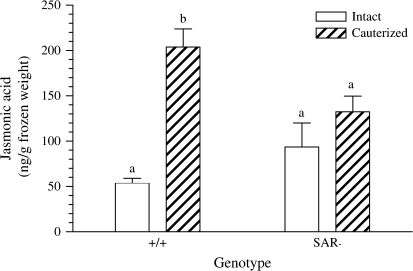
Arabidopsis thaliana (L.) Heynh. genotypes limited in their ability to mount either octadecanoid-dependent induced resistance (IR(-)) or systemic acquired resistance (SAR(-)) were used to characterize the roles of these pathways in plant-herbivore interactions. Molecular and biochemical markers of IR were analysed in plants subject to herbivory by caterpillars of the beet armyworm, Spodoptera exigua Hübner, which had either intact or impaired salivary secretions since salivary enzymes, such as glucose oxidase, have been implicated in the ability of caterpillars to circumvent induced plant defences. Transcript expression of genes encoding laccase-like multicopper oxidase [AtLMCO4 (polyphenol oxidase)] and defensin (AtPDF1.2) showed salivary-specific patterns which were disrupted in the SAR(-) mutant plants. The activity of octadecanoid-associated anti-nutritive proteins, such as LMCO and trypsin inhibitor, showed similar patterns. Gene and protein changes parallel plant hormone levels where elevated jasmonic acid was observed in wild-type plants fed upon by caterpillars with impaired salivary secretions compared with plants subject to herbivory by normal caterpillars. This salivary-specific difference in jasmonic acid levels was alleviated in SAR(-) mutants. These results support the model that caterpillar saliva interferes with jasmonate-dependent plant defences by activating the SAR pathway.
利用拟南芥(Arabidopsis thaliana (L.) Heynh.)中十八烷酸依赖性诱导抗性(IR(-))或系统获得性抗性(SAR(-))能力受限的基因型,来表征这些途径在植物与食草动物相互作用中的作用。对受甜菜夜蛾(Spodoptera exigua Hübner)幼虫取食的植物进行了IR的分子和生化标记分析,这些幼虫的唾液分泌要么完整要么受损,因为唾液酶(如葡萄糖氧化酶)与幼虫规避诱导型植物防御的能力有关。编码漆酶样多铜氧化酶[AtLMCO4(多酚氧化酶)]和防御素(AtPDF1.2)的基因的转录表达呈现出唾液特异性模式,而在SAR(-)突变体植物中这些模式被破坏。十八烷酸相关抗营养蛋白(如LMCO和胰蛋白酶抑制剂)的活性也呈现出类似模式。基因和蛋白质的变化与植物激素水平平行,与受到正常幼虫取食的植物相比,在受到唾液分泌受损的幼虫取食的野生型植物中观察到茉莉酸水平升高。在SAR(-)突变体中,茉莉酸水平的这种唾液特异性差异得到缓解。这些结果支持了这样一个模型,即毛虫唾液通过激活SAR途径干扰茉莉酸依赖性植物防御。