Nguyen Phuong Dung T, Pike Sharon, Wang Jianying, Nepal Poudel Arati, Heinz Robert, Schultz Jack C, Koo Abraham J, Mitchum Melissa G, Appel Heidi M, Gassmann Walter
Division of Plant Sciences and Interdisciplinary Plant Group, University of Missouri, Columbia, MO, 65211-7310, USA.
Christopher S. Bond Life Sciences Center, University of Missouri, Columbia, MO, 65211-7310, USA.
Mol Plant Pathol. 2016 May;17(4):588-600. doi: 10.1111/mpp.12304. Epub 2015 Nov 6.
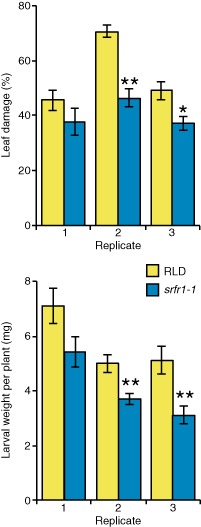
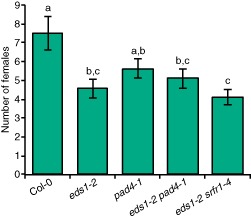
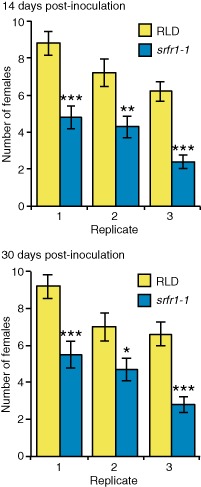
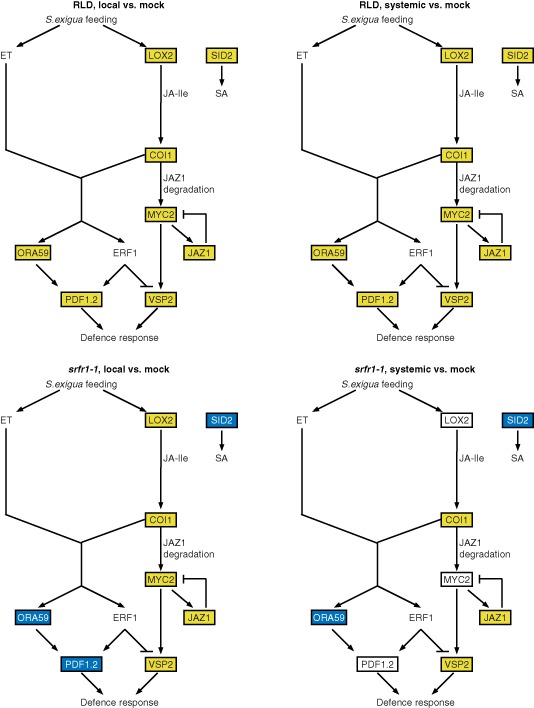
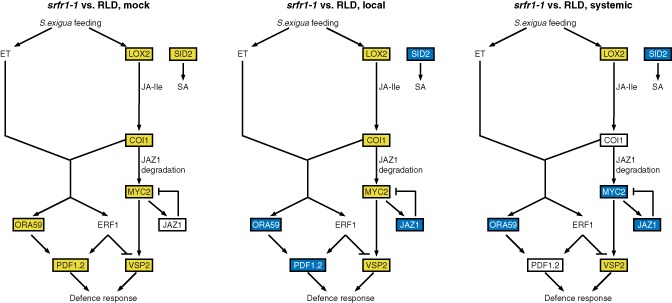
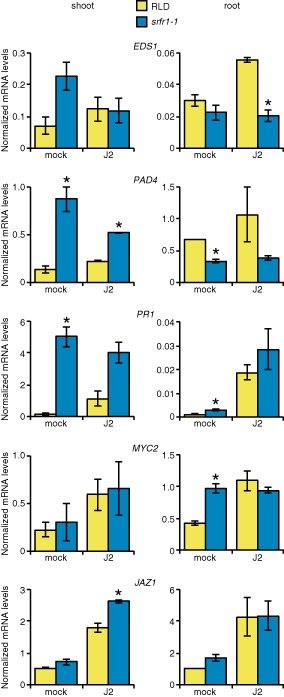
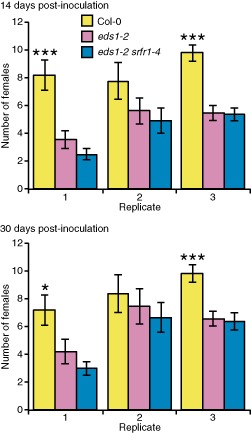
Plants have developed diverse mechanisms to fine tune defence responses to different types of enemy. Cross-regulation between signalling pathways may allow the prioritization of one response over another. Previously, we identified SUPPRESSOR OF rps4-RLD1 (SRFR1) as a negative regulator of ENHANCED DISEASE SUSCEPTIBILITY1 (EDS1)-dependent effector-triggered immunity against the bacterial pathogen Pseudomonas syringae pv. tomato strain DC3000 expressing avrRps4. The use of multiple stresses is a powerful tool to further define gene function. Here, we examined whether SRFR1 also impacts resistance to a herbivorous insect in leaves and to a cyst nematode in roots. Interestingly, srfr1-1 plants showed increased resistance to herbivory by the beet army worm Spodoptera exigua and to parasitism by the cyst nematode Heterodera schachtii compared with the corresponding wild-type Arabidopsis accession RLD. Using quantitative real-time PCR (qRT-PCR) to measure the transcript levels of salicylic acid (SA) and jasmonate/ethylene (JA/ET) pathway genes, we found that enhanced resistance of srfr1-1 plants to S. exigua correlated with specific upregulation of the MYC2 branch of the JA pathway concurrent with suppression of the SA pathway. In contrast, the greater susceptibility of RLD was accompanied by simultaneously increased transcript levels of SA, JA and JA/ET signalling pathway genes. Surprisingly, mutation of either SRFR1 or EDS1 increased resistance to H. schachtii, indicating that the concurrent presence of both wild-type genes promotes susceptibility. This finding suggests a novel form of resistance in Arabidopsis to the biotrophic pathogen H. schachtii or a root-specific regulation of the SA pathway by EDS1, and places SRFR1 at an intersection between multiple defence pathways.
植物已经进化出多种机制来微调对不同类型敌人的防御反应。信号通路之间的交叉调节可能使一种反应优先于另一种反应。此前,我们鉴定出rps4-RLD1的抑制子(SRFR1)是增强疾病易感性1(EDS1)依赖性效应子触发的免疫反应的负调节因子,该免疫反应针对表达avrRps4的番茄细菌性病原菌丁香假单胞菌番茄致病变种DC3000。使用多种胁迫是进一步确定基因功能的有力工具。在这里,我们研究了SRFR1是否也影响叶片对食草昆虫和根部对孢囊线虫的抗性。有趣的是,与相应的野生型拟南芥品系RLD相比,srfr1-1植物对甜菜夜蛾的食草作用和孢囊线虫的寄生作用表现出更高的抗性。使用定量实时PCR(qRT-PCR)来测量水杨酸(SA)和茉莉酸/乙烯(JA/ET)途径基因的转录水平,我们发现srfr1-1植物对甜菜夜蛾增强的抗性与JA途径的MYC2分支的特异性上调相关,同时SA途径受到抑制。相比之下,RLD更高的易感性伴随着SA、JA和JA/ET信号通路基因转录水平的同时增加。令人惊讶的是,SRFR1或EDS1的突变均增加了对甜菜孢囊线虫的抗性,这表明两个野生型基因同时存在会促进易感性。这一发现揭示了拟南芥对活体营养型病原菌甜菜孢囊线虫的一种新的抗性形式,或者是EDS1对SA途径的根特异性调节,并将SRFR1置于多种防御途径的交叉点上。