Hahn Markus, Okamgba Stella, Scheler Peter, Freidel Klaus, Hoffmann Gerald, Kraemer Bernhard, Wallwiener Diethelm, Krainick-Strobel Ute
Clinic for Obstetrics and Gynaecology, University of Tuebingen, Germany.
World J Surg Oncol. 2008 May 19;6:51. doi: 10.1186/1477-7819-6-51.
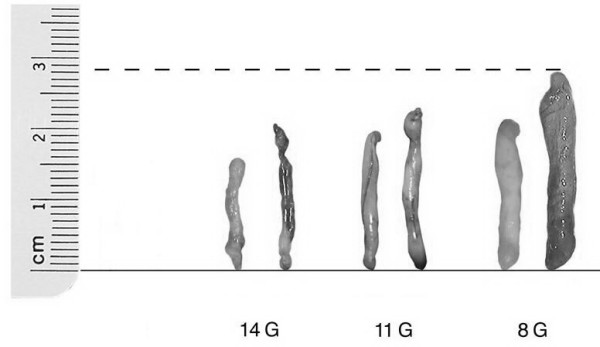
Minimal invasive breast biopsy is standard care for the diagnosis of suspicious breast lesions. There are different vacuum biopsy (VB) systems in use. The aim of the study was to determine the differences between the 8-gauge and the 11-gauge needle with respect to a) diagnostic reliability, b) complication rate and c) subjective perception of pain when used for vacuum-assisted breast biopsy.
Between 01/2000 and 09/2004, 923 patients at St. Josefs-Hospital Wiesbaden underwent VB using the Mammotome (Ethicon Endosurgery, Hamburg). Depending on preoperative detection, the procedure was performed under sonographic or mammographic guidance under local anaesthesia. All patients included in the study were followed up both clinically and using imaging techniques one week after the VB and a second time after a median of 41 months. Excisional biopsy on the ipsilateral breast was an exclusion criteria. Subjective pain scores were recorded on a scale of 0 - 10 (0 = no pain, 10 = unbearable pain). The mean age of the patients was 53 years (30 - 88).
123 patients were included in the study in total. 48 patients were biopsied with the 8-gauge needle and 75 with the 11-gauge needle. The use of the 8-gauge needle did not show any significant differences to the 11-gauge needle with regard to diagnostic reliability, complication rate and subjective perception of pain.
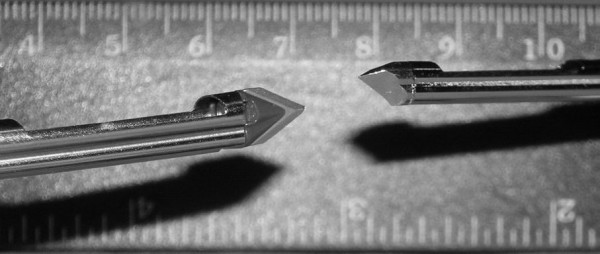
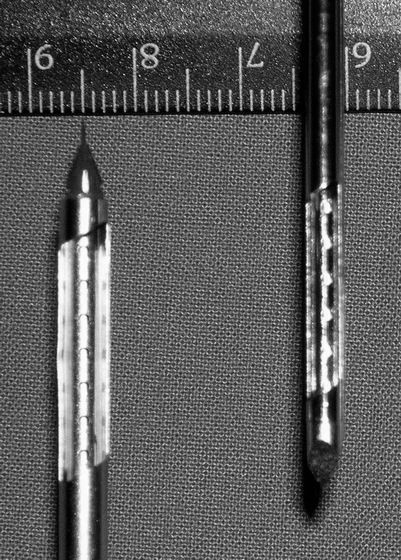
Our data show that there are no relevant differences between the 8-gauge and 11-gauge needle when used for VB. Under sonographic guidance, the use of the 8-gauge needle is recommended for firm breast tissue due to its sharp scalpel point and especially for complete removal of benign lesions. We did not find any advantages in the use of the larger 8-gauge needle compared to the 11-gauge needle in the mammography setting. The utilisation costs of the 8-gauge needle are somewhat higher.
微创乳腺活检是诊断可疑乳腺病变的标准治疗方法。目前使用着不同的真空活检(VB)系统。本研究的目的是确定8号针和11号针在用于真空辅助乳腺活检时,在以下方面的差异:a)诊断可靠性;b)并发症发生率;c)疼痛主观感受。
2000年1月至2004年9月期间,威斯巴登圣约瑟夫医院的923例患者使用Mammotome(Ethicon Endosurgery,汉堡)进行了VB。根据术前检测结果,该操作在局部麻醉下于超声或乳腺X线引导下进行。研究纳入的所有患者在VB术后1周以及中位时间41个月后进行了临床和影像学随访。同侧乳腺切除活检为排除标准。主观疼痛评分采用0至10分制记录(0分 = 无疼痛,10分 = 难以忍受的疼痛)。患者的平均年龄为53岁(30 - 88岁))。
本研究共纳入123例患者。48例患者使用8号针进行活检,75例使用11号针。在诊断可靠性、并发症发生率和疼痛主观感受方面,8号针与11号针相比未显示出任何显著差异。
我们的数据表明,8号针和11号针用于VB时无相关差异。在超声引导下,由于8号针的手术刀尖端锋利,推荐用于质地较硬的乳腺组织,特别是用于完全切除良性病变。在乳腺X线检查中,我们未发现使用较大的8号针相较于11号针有任何优势。8号针的使用成本略高。