Walsh Elizabeth Rose, Sahu Nisebita, Kearley Jennifer, Benjamin Ebony, Kang Boo Hyon, Humbles Alison, August Avery
Center for Molecular Immunology and Infectious Disease and Department of Veterinary and Biomedical Sciences, Pennsylvania State University, University Park, PA 16802, USA.
J Exp Med. 2008 Jun 9;205(6):1285-92. doi: 10.1084/jem.20071836. Epub 2008 May 19.
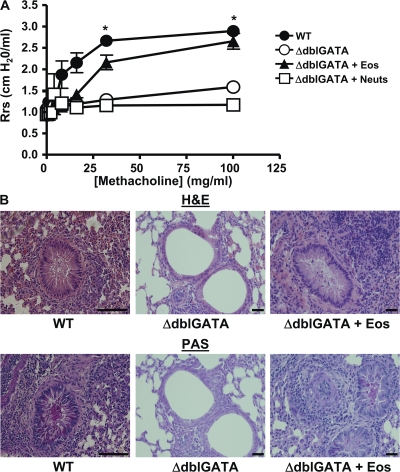
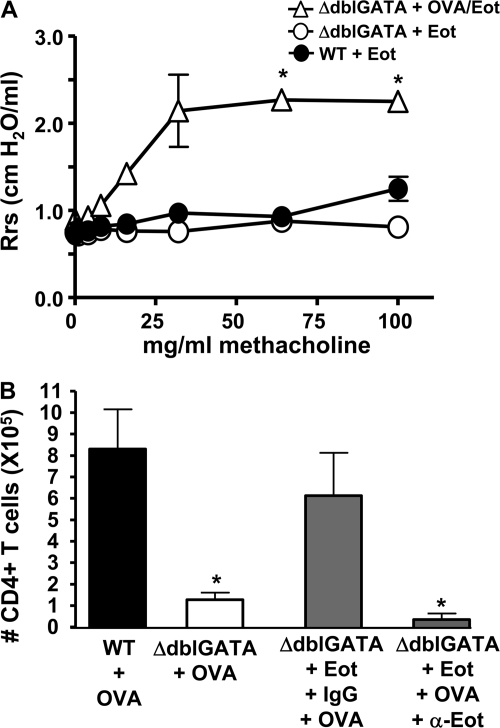
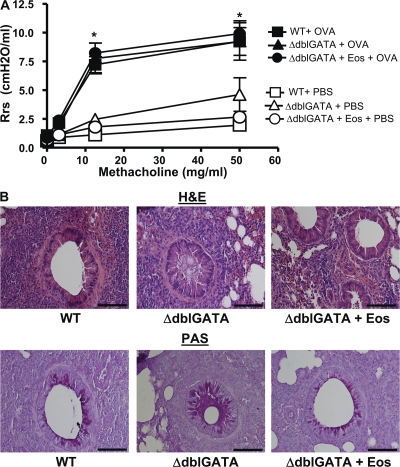
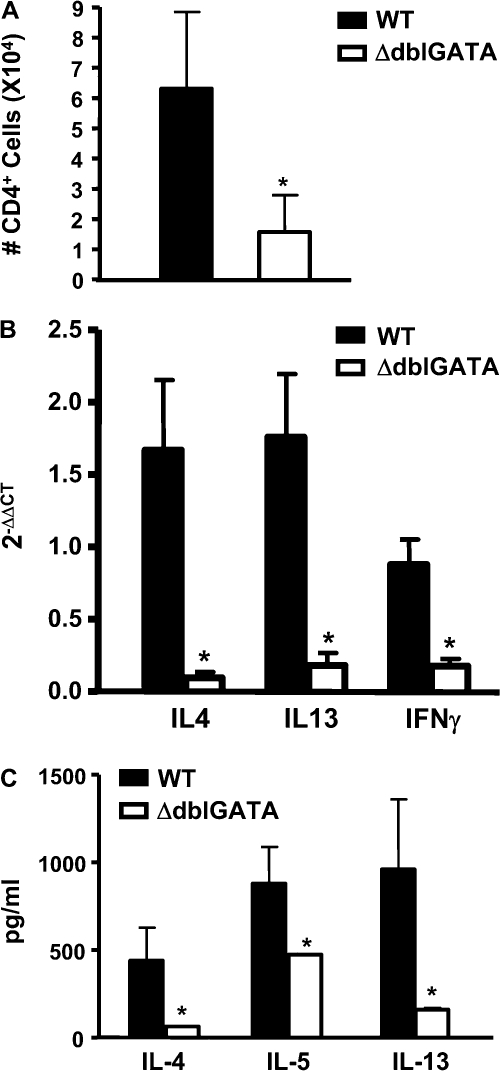
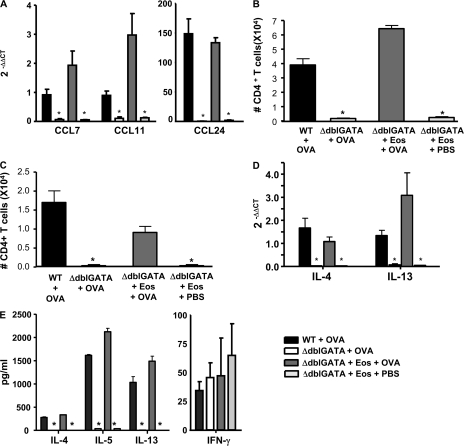
Eosinophils have been implicated as playing a major role in allergic airway responses. However, the importance of these cells to the development of this disease has remained ambiguous despite many studies, partly because of lack of appropriate model systems. In this study, using transgenic murine models, we more clearly delineate a role for eosinophils in asthma. We report that, in contrast to results obtained on a BALB/c background, eosinophil-deficient C57BL/6 Delta dblGATA mice (eosinophil-null mice via the Delta DblGATA1 mutation) have reduced airway hyperresponsiveness, and cytokine production of interleukin (IL)-4, -5, and -13 in ovalbumin-induced allergic airway inflammation. This was caused by reduced T cell recruitment into the lung, as these mouse lungs had reduced expression of CCL7/MCP-3, CC11/eotaxin-1, and CCL24/eotaxin-2. Transferring eosinophils into these eosinophil-deficient mice and, more importantly, delivery of CCL11/eotaxin-1 into the lung during the development of this disease rescued lung T cell infiltration and airway inflammation when delivered together with allergen. These studies indicate that on the C57BL/6 background, eosinophils are integral to the development of airway allergic responses by modulating chemokine and/or cytokine production in the lung, leading to T cell recruitment.
嗜酸性粒细胞被认为在过敏性气道反应中起主要作用。然而,尽管进行了许多研究,但这些细胞对该疾病发展的重要性仍不明确,部分原因是缺乏合适的模型系统。在本研究中,我们使用转基因小鼠模型,更清楚地描绘了嗜酸性粒细胞在哮喘中的作用。我们报告,与在BALB/c背景下获得的结果相反,嗜酸性粒细胞缺陷的C57BL/6 Delta dblGATA小鼠(通过Delta DblGATA1突变产生的嗜酸性粒细胞缺失小鼠)在卵清蛋白诱导的过敏性气道炎症中,气道高反应性降低,白细胞介素(IL)-4、-5和-13的细胞因子产生减少。这是由于进入肺的T细胞募集减少所致,因为这些小鼠肺中CCL7/MCP-3、CC11/嗜酸性粒细胞趋化因子-1和CCL24/嗜酸性粒细胞趋化因子-2的表达降低。将嗜酸性粒细胞转移到这些嗜酸性粒细胞缺陷小鼠中,更重要的是,在该疾病发展过程中将CCL11/嗜酸性粒细胞趋化因子-1输送到肺中,当与过敏原一起输送时,可挽救肺T细胞浸润和气道炎症。这些研究表明,在C57BL/6背景下,嗜酸性粒细胞通过调节肺中的趋化因子和/或细胞因子产生,对气道过敏反应的发展不可或缺,从而导致T细胞募集。