Sun Ting, Surles Rebecca L, Tanumihardjo Sherry A
Department of Nutritional Sciences, University of Wisconsin, Madison, WI 53706, USA.
J Nutr. 2008 Jun;138(6):1101-6. doi: 10.1093/jn/138.6.1101.
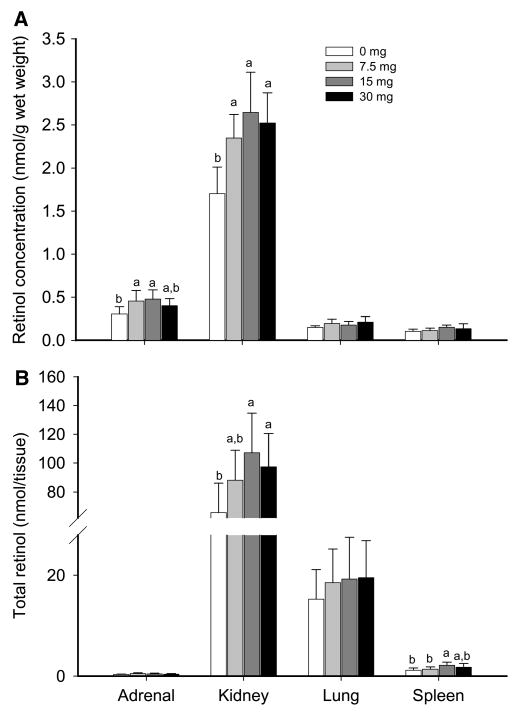
Periodic supplementation to infants and young children is encouraged in developing countries by the WHO. We investigated vitamin A (VA) in extrahepatic tissues of piglets after supplementation with retinyl acetate to determine long-term storage. 3, 4-Didehydroretinyl acetate (DRA) as a tracer was used to evaluate uptake from chylomicra in 4 h. Sows were fed a VA-depleted diet throughout pregnancy and lactation. Male castrated piglets (n = 28, 11.6 +/- 0.5 d) from these sows were weaned onto a VA-free diet for 1 wk, assigned to 4 groups, and dosed orally with 0, 26.2, 52.4, or 105 micromol VA. After 10 d, 5.3 micromol DRA was administered to determine short-term uptake of 3, 4-didehydroretinol (DR). Four hours later, piglets were killed; adrenal glands, kidney, lung, and spleen were collected and analyzed for retinol and DR. Retinol concentrations of kidney and adrenal gland were higher than control, but treated groups did not differ. Retinol concentration was highest in kidney (1.70-2.52 nmol/g), followed by adrenal gland (0.30-0.48 nmol/g), lung (0.15-0.21 nmol/g), and spleen (0.11-0.15 nmol/g). Total retinol in kidney and spleen was different among the groups (P < 0.05). Unesterified retinol was the major VA form; the percent retinol of total VA was lowest in adrenal glands. DR did not differ among the groups. In 4 h, the minimum estimated chylomicron contribution to tissue DR was 63-280% higher than the maximum DR exposure from retinol-binding protein. Constant dietary intake may be important in maintaining VA concentrations in extrahepatic tissues.
世界卫生组织鼓励发展中国家对婴幼儿进行定期营养补充。我们在给仔猪补充醋酸视黄酯后,对其肝外组织中的维生素A(VA)进行了研究,以确定长期储存情况。使用3,4-二脱氢视黄酯醋酸酯(DRA)作为示踪剂,评估4小时内乳糜微粒的摄取情况。母猪在整个怀孕和哺乳期间喂食VA缺乏的日粮。这些母猪所产的雄性去势仔猪(n = 28,11.6±0.5日龄)断奶后喂食不含VA的日粮1周,分为4组,分别口服0、26.2、52.4或105微摩尔VA。10天后,给予5.3微摩尔DRA以确定3,4-二脱氢视黄醇(DR)的短期摄取情况。4小时后,处死仔猪;收集肾上腺、肾脏、肺和脾脏,分析视黄醇和DR。肾脏和肾上腺的视黄醇浓度高于对照组,但各处理组之间无差异。视黄醇浓度在肾脏中最高(1.70 - 2.52纳摩尔/克),其次是肾上腺(0.30 - 0.48纳摩尔/克)、肺(0.15 - 0.21纳摩尔/克)和脾脏(0.11 - 0.15纳摩尔/克)。肾脏和脾脏中的总视黄醇在各组之间存在差异(P < 0.05)。未酯化视黄醇是主要的VA形式;肾上腺中视黄醇占总VA的百分比最低。各组之间DR无差异。在4小时内,估计乳糜微粒对组织DR的最小贡献比视黄醇结合蛋白的最大DR暴露高63 - 280%。持续的饮食摄入对于维持肝外组织中的VA浓度可能很重要。