Skupien Jan, Gorczynska-Kosiorz Sylwia, Klupa Tomasz, Wanic Krzysztof, Button Eric A, Sieradzki Jacek, Malecki Maciej T
1Department of Metabolic Diseases, Jagiellonian University, Medical College, Krakow, Poland.
Diabetes Care. 2008 Aug;31(8):1496-501. doi: 10.2337/dc07-2334. Epub 2008 May 20.
1,5-anhydroglucitol (1,5-AG) is a short-term marker of metabolic control in diabetes. Its renal loss is stimulated in hyperglycemic conditions by glycosuria, which results in a lowered plasma concentration. As a low renal threshold for glucose has been described in hepatocyte nuclear factor-1alpha (HNF-1alpha) maturity-onset diabetes of the young (MODY), the 1,5-AG level may be altered in these patients. The purpose of this study was to assess the 1,5-AG levels in patients with HNF-1alpha MODY and in type 2 diabetic subjects with a similar degree of metabolic control. In addition, we aimed to evaluate this particle as a biomarker for HNF-1alpha MODY.
We included 33 diabetic patients from the Polish Nationwide Registry of MODY. In addition, we examined 43 type 2 diabetic patients and 47 nondiabetic control subjects. The 1,5-AG concentration was measured with an enzymatic assay (GlycoMark). Receiver operating characteristic (ROC) curve analysis was used to evaluate 1,5-AG as a screening marker for HNF-1alpha MODY.
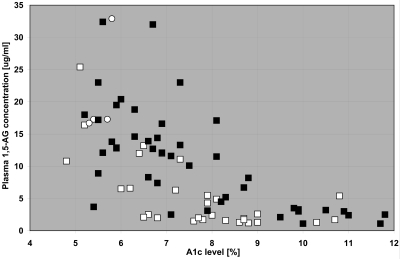
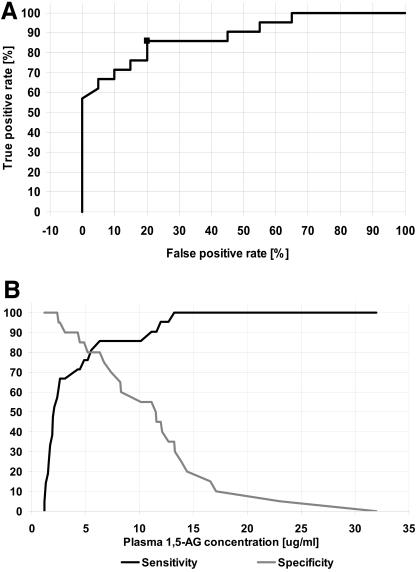
The mean 1,5-AG plasma concentration in diabetic HNF-1alpha mutation carriers was 5.9 microg/ml, and it was lower than that in type 2 diabetic patients (11.0 microg/ml, P = 0.003) and in nondiabetic control subjects (23.9 microg/ml, P < 0.00005). The ROC curve analysis revealed 85.7% sensitivity and 80.0% specificity of 1,5-AG in screening for HNF-1alpha MODY at the criterion of <6.5 microg/ml in patients with an A1C level between 6.5 and 9.0%.
1,5-AG may be a useful biomarker for differential diagnosis of patients with HNF-1alpha MODY with a specific range of A1C, although this requires further investigation. However, the clinical use of this particle in diabetic HNF-1alpha mutation carriers for metabolic control has substantial limitations.
1,5 - 脱水葡萄糖醇(1,5 - AG)是糖尿病代谢控制的短期标志物。在高血糖情况下,其经肾排泄因糖尿而增加,导致血浆浓度降低。由于在肝细胞核因子 - 1α(HNF - 1α)相关的青年发病型成年糖尿病(MODY)中已描述了较低的肾葡萄糖阈值,这些患者的1,5 - AG水平可能会改变。本研究的目的是评估HNF - 1α MODY患者以及代谢控制程度相似的2型糖尿病患者的1,5 - AG水平。此外,我们旨在评估该物质作为HNF - 1α MODY生物标志物的价值。
我们纳入了来自波兰全国MODY登记处的33例糖尿病患者。此外,我们检查了43例2型糖尿病患者和47例非糖尿病对照者。采用酶法(GlycoMark)测量1,5 - AG浓度。采用受试者工作特征(ROC)曲线分析来评估1,5 - AG作为HNF - 1α MODY筛查标志物的价值。
糖尿病HNF - 1α突变携带者的平均血浆1,5 - AG浓度为5.9微克/毫升,低于2型糖尿病患者(11.0微克/毫升,P = 0.003)和非糖尿病对照者(23.9微克/毫升,P < 0.00005)。ROC曲线分析显示,在糖化血红蛋白(A1C)水平介于6.5%至9.0%的患者中,以<6.5微克/毫升为标准筛查HNF - 1α MODY时,1,5 - AG的敏感性为85.7%,特异性为80.0%。
1,5 - AG可能是用于鉴别特定A1C范围的HNF - 1α MODY患者的有用生物标志物,尽管这需要进一步研究。然而,该物质在糖尿病HNF - 1α突变携带者中用于代谢控制的临床应用存在很大局限性。