Souza Glauco R, Yonel-Gumruk Esra, Fan Davin, Easley Jeffrey, Rangel Roberto, Guzman-Rojas Liliana, Miller J Houston, Arap Wadih, Pasqualini Renata
Department of Genitourinary Medical Oncology, The University of Texas M. D. Anderson Cancer Center, Houston, Texas, United States of America.
PLoS One. 2008 May 21;3(5):e2242. doi: 10.1371/journal.pone.0002242.
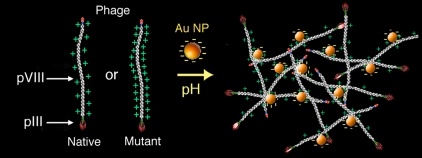
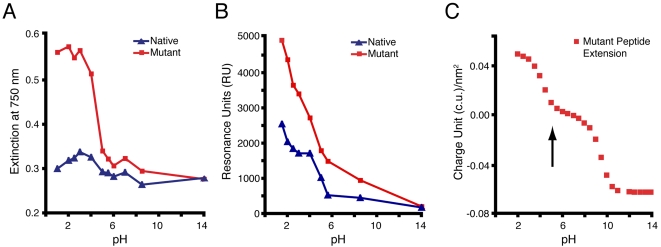
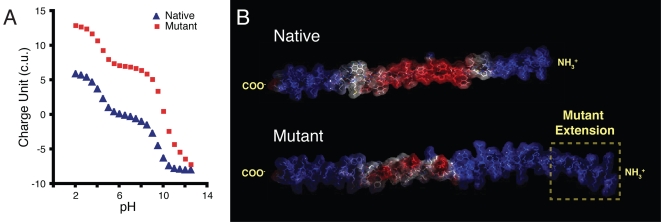
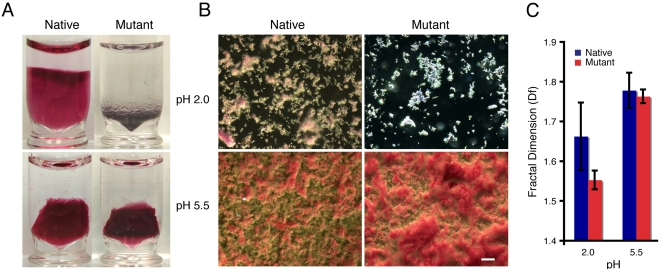
Hydrogels have become a promising research focus because of their potential for biomedical application. Here we explore the long-range, electrostatic interactions by following the effect of trans-acting (pH) and cis-acting factors (peptide mutation) on the formation of Au-phage hydrogels. These bioinorganic hydrogels can be generated from the bottom-up assembly of Au nanoparticles (Au NP) with either native or mutant bacteriophage (phage) through electrostatic interaction of the phage pVIII major capsid proteins (pVIII). The cis-acting factor consists of a peptide extension displayed on the pVIII that mutates the phage. Our results show that pH can dictate the direct-assembly and stability of Au-phage hydrogels in spite of the differences between the native and the mutant pVIII. The first step in characterizing the interactions of Au NP with phage was to generate a molecular model that identified the charge distribution and structure of the native and mutant pVIII. This model indicated that the mutant peptide extension carried a higher positive charge relative to the native pVIII at all pHs. Next, by monitoring the Au-phage interaction by means of optical microscopy, elastic light scattering, fractal dimension analysis as well as Uv-vis and surface plasmon resonance spectroscopy, we show that the positive charge of the mutant peptide extension favors the opposite charge affinity between the phage and Au NP as the pH is decreased. These results show the versatility of this assembly method, where the stability of these hydrogels can be achieved by either adjusting the pH or by changing the composition of the phage pVIII without the need of phage display libraries.
水凝胶因其在生物医学应用中的潜力而成为一个有前景的研究焦点。在此,我们通过追踪反式作用(pH值)和顺式作用因子(肽突变)对金-噬菌体水凝胶形成的影响,来探究长程静电相互作用。这些生物无机水凝胶可通过金纳米颗粒(Au NP)与天然或突变噬菌体(噬菌体)的自下而上组装,经由噬菌体pVIII主要衣壳蛋白(pVIII)的静电相互作用而生成。顺式作用因子由展示在pVIII上使噬菌体发生突变的肽延伸组成。我们的结果表明,尽管天然pVIII和突变pVIII之间存在差异,但pH值仍可决定金-噬菌体水凝胶的直接组装和稳定性。表征Au NP与噬菌体相互作用的第一步是生成一个分子模型,该模型可识别天然pVIII和突变pVIII的电荷分布和结构。该模型表明,在所有pH值下,突变肽延伸相对于天然pVIII携带更高的正电荷。接下来,通过光学显微镜、弹性光散射、分形维数分析以及紫外可见光谱和表面等离子体共振光谱监测金-噬菌体相互作用,我们发现随着pH值降低,突变肽延伸的正电荷有利于噬菌体与Au NP之间的相反电荷亲和力。这些结果显示了这种组装方法的多功能性,即通过调节pH值或改变噬菌体pVIII的组成即可实现这些水凝胶的稳定性,而无需噬菌体展示文库。