Dardalhon Valérie, Korn Thomas, Kuchroo Vijay K, Anderson Ana C
Center for Neurologic Diseases, Brigham and Women's Hospital, Harvard Medical School, Cambridge, MA 02139, USA.
J Autoimmun. 2008 Nov;31(3):252-6. doi: 10.1016/j.jaut.2008.04.017. Epub 2008 May 27.
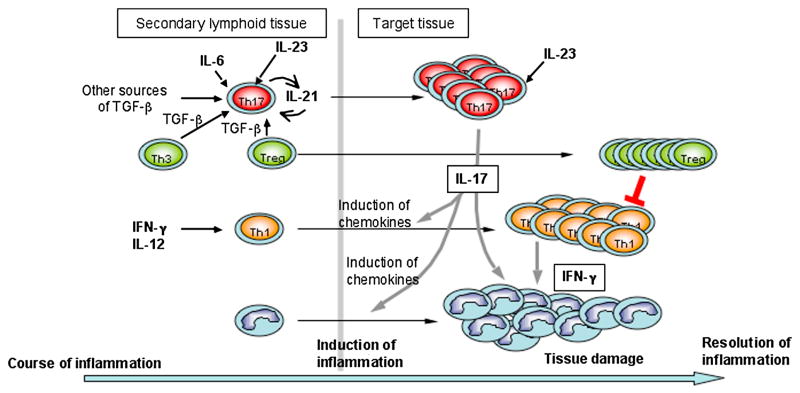
CD4(+) IFN-gamma-producing Th1 cells have long been associated with the pathogenesis of many organ-specific autoimmune diseases; however, the observation of disease in mice deficient in molecules involved in Th1 cell differentiation raised the possibility that other effector T cells were responsible for inducing autoimmunity. Recently, a new CD4(+) effector T cell subset that produces IL-17 (Th17) has emerged. The fact that Th17 cells are highly auto-pathogenic has fueled a debate as to what role, if any, Th1 cells play in the induction of tissue inflammation and autoimmune disease. This review will discuss the respective roles of the Th1 and Th17 subsets in organ-specific autoimmunity.
长期以来,产生干扰素-γ的CD4(+) Th1细胞一直与许多器官特异性自身免疫性疾病的发病机制相关;然而,在Th1细胞分化相关分子缺陷的小鼠中观察到疾病,这引发了一种可能性,即其他效应T细胞可能负责诱导自身免疫。最近,一种产生白细胞介素-17的新型CD4(+)效应T细胞亚群(Th17)出现了。Th17细胞具有高度自身致病性这一事实引发了一场关于Th1细胞在组织炎症和自身免疫性疾病诱导中所起作用(如果有作用的话)的争论。本综述将讨论Th1和Th17亚群在器官特异性自身免疫中的各自作用。