Chen Xiao-Wei, Feng Ya-Qin, Hao Chan-Juan, Guo Xiao-Li, He Xin, Zhou Zhi-Yong, Guo Ning, Huang Hong-Ping, Xiong Wei, Zheng Hui, Zuo Pan-Li, Zhang Claire Xi, Li Wei, Zhou Zhuan
Institute of Molecular Medicine and 2State Key Laboratory of Biomembrane Engineering, Peking University, Beijing 100871, China.
J Cell Biol. 2008 Jun 2;181(5):791-801. doi: 10.1083/jcb.200711021. Epub 2008 May 26.
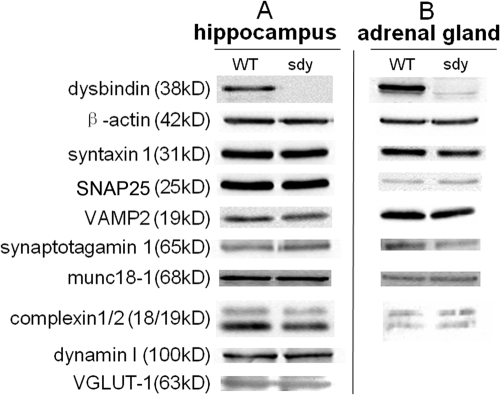
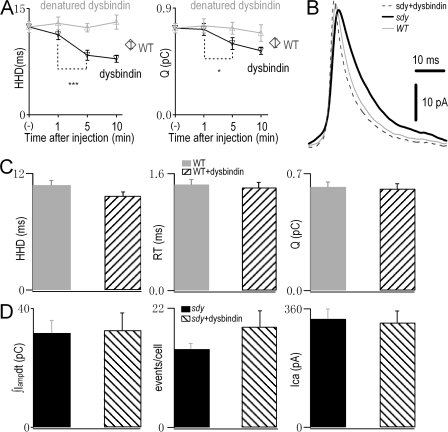
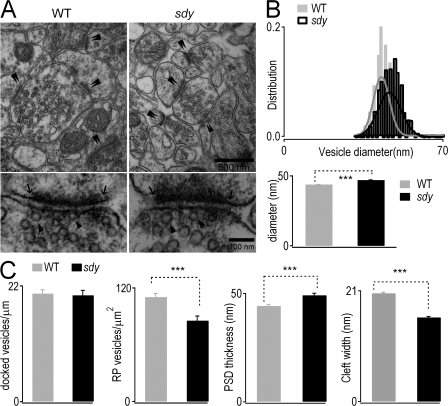
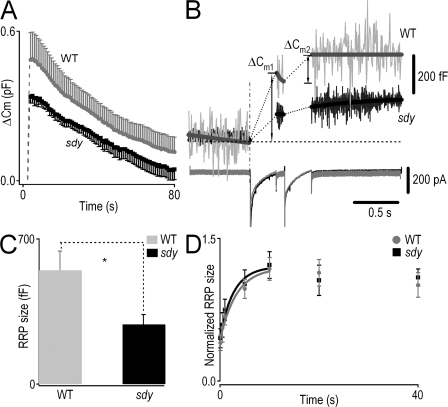
Schizophrenia is one of the most debilitating neuropsychiatric disorders, affecting 0.5-1.0% of the population worldwide. Its pathology, attributed to defects in synaptic transmission, remains elusive. The dystrobrevin-binding protein 1 (DTNBP1) gene, which encodes a coiled-coil protein, dysbindin, is a major susceptibility gene for schizophrenia. Our previous results have demonstrated that the sandy (sdy) mouse harbors a spontaneously occurring deletion in the DTNBP1 gene and expresses no dysbindin protein (Li, W., Q. Zhang, N. Oiso, E.K. Novak, R. Gautam, E.P. O'Brien, C.L. Tinsley, D.J. Blake, R.A. Spritz, N.G. Copeland, et al. 2003. Nat. Genet. 35:84-89). Here, using amperometry, whole-cell patch clamping, and electron microscopy techniques, we discovered specific defects in neurosecretion and vesicular morphology in neuroendocrine cells and hippocampal synapses at the single vesicle level in sdy mice. These defects include larger vesicle size, slower quantal vesicle release, lower release probability, and smaller total population of the readily releasable vesicle pool. These findings suggest that dysbindin functions to regulate exocytosis and vesicle biogenesis in endocrine cells and neurons. Our work also suggests a possible mechanism in the pathogenesis of schizophrenia at the synaptic level.
精神分裂症是最使人衰弱的神经精神疾病之一,影响着全球0.5%-1.0%的人口。其病理归因于突触传递缺陷,仍不清楚。编码卷曲螺旋蛋白dysbindin的抗肌萎缩蛋白结合蛋白1(DTNBP1)基因是精神分裂症的主要易感基因。我们之前的结果表明,沙质(sdy)小鼠的DTNBP1基因存在自发缺失,且不表达dysbindin蛋白(Li, W., Q. Zhang, N. Oiso, E.K. Novak, R. Gautam, E.P. O'Brien, C.L. Tinsley, D.J. Blake, R.A. Spritz, N.G. Copeland等人,2003年。《自然遗传学》35:84-89)。在这里,我们使用电流测定法、全细胞膜片钳技术和电子显微镜技术,在单囊泡水平上发现了sdy小鼠神经内分泌细胞和海马突触中神经分泌和囊泡形态的特定缺陷。这些缺陷包括囊泡尺寸更大、量子囊泡释放更慢、释放概率更低以及易释放囊泡池的总数更少。这些发现表明,dysbindin在调节内分泌细胞和神经元中的胞吐作用和囊泡生物发生方面发挥作用。我们的工作还提出了精神分裂症发病机制在突触水平的一种可能机制。