Sethi Jigme M, Choi Augustine M K, Calhoun William J, Ameredes Bill T
Division of Allergy, Pulmonary, Immunology, Critical Care and Sleep Division, Department of Internal Medicine, University of Texas Medical Branch, Galveston TX 77755-1083, USA.
Respir Res. 2008 May 27;9(1):45. doi: 10.1186/1465-9921-9-45.
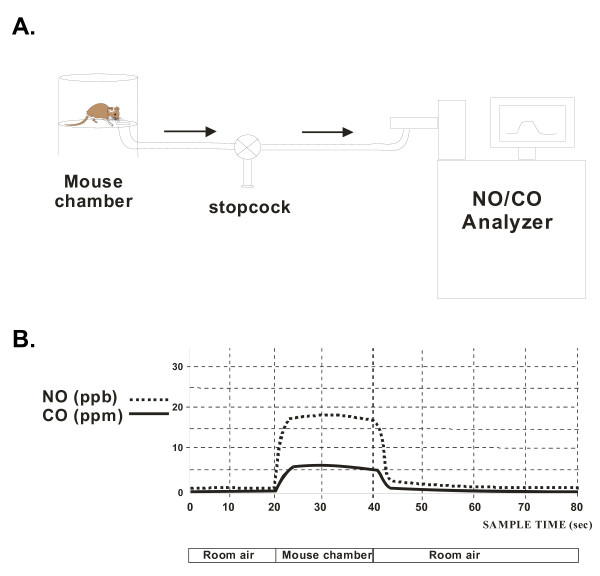
Nitric oxide (NO) and carbon monoxide (CO) in exhaled breath are considered obtainable biomarkers of physiologic mechanisms. Therefore, obtaining their measures simply, non-invasively, and repeatedly, is of interest, and was the purpose of the current study.
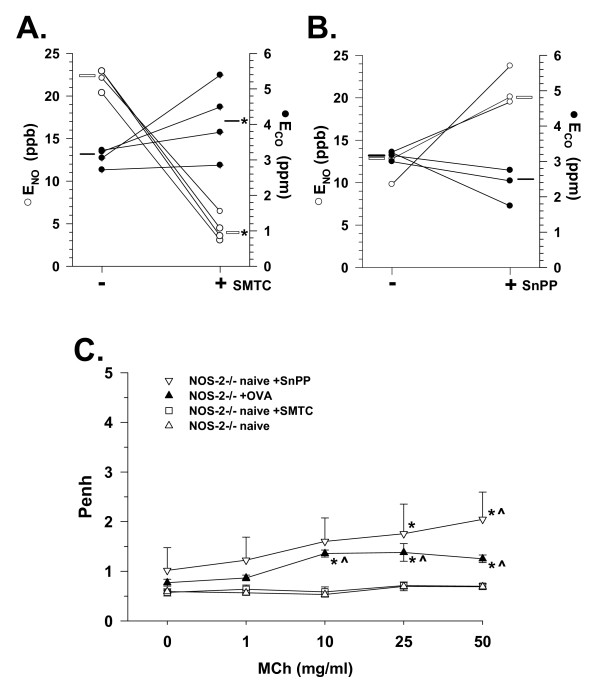
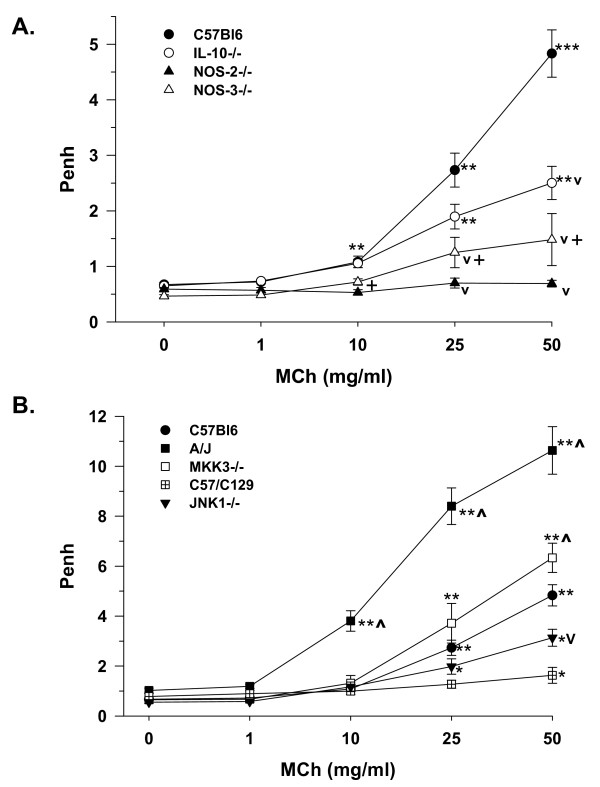
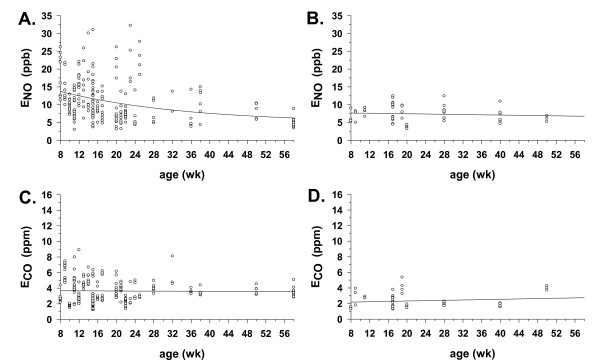
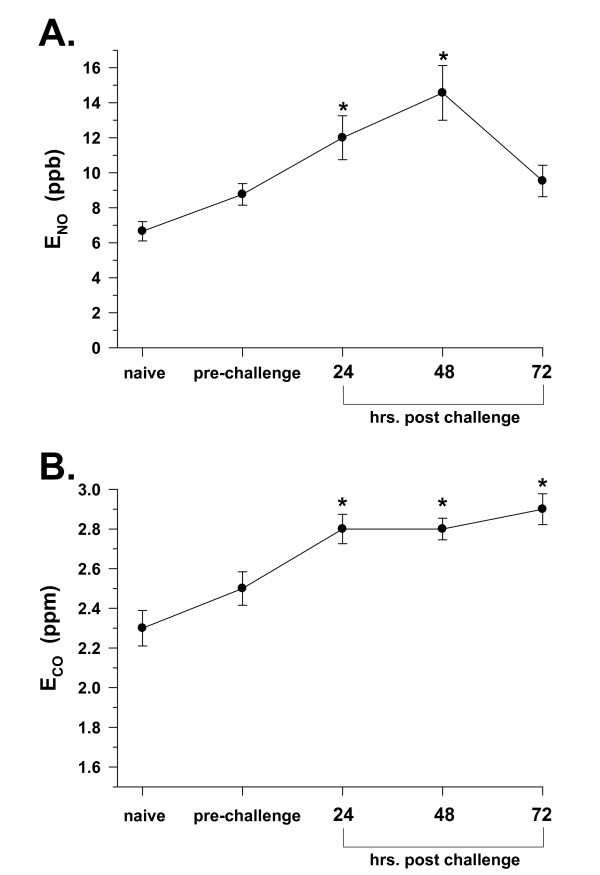
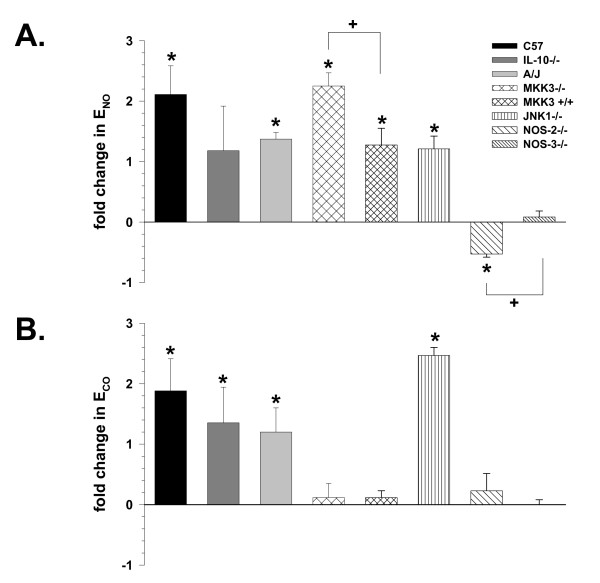
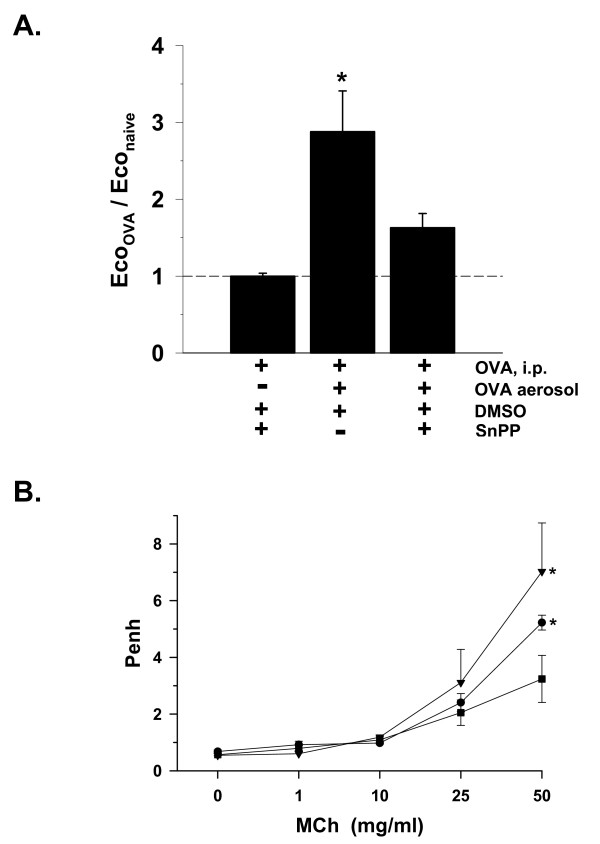
Expired NO (ENO) and CO (ECO) were measured non-invasively using a gas micro-analyzer on several strains of mice (C57Bl6, IL-10-/-, A/J, MKK3-/-, JNK1-/-, NOS-2-/- and NOS-3-/-) with and without allergic airway inflammation (AI) induced by ovalbumin systemic sensitization and aerosol challenge, compared using independent-sample t-tests between groups, and repeated measures analysis of variance (ANOVA) within groups over time of inflammation induction. ENO and ECO were also measured in C57Bl6 and IL-10-/- mice, ages 8-58 weeks old, the relationship of which was determined by regression analysis. S-methionyl-L-thiocitrulline (SMTC), and tin protoporphyrin (SnPP) were used to inhibit neuronal/constitutive NOS-1 and heme-oxygenase, respectively, and alter NO and CO production, respectively, as assessed by paired t-tests. Methacholine-associated airway responses (AR) were measured by the enhanced pause method, with comparisons by repeated measures ANOVA and post-hoc testing.
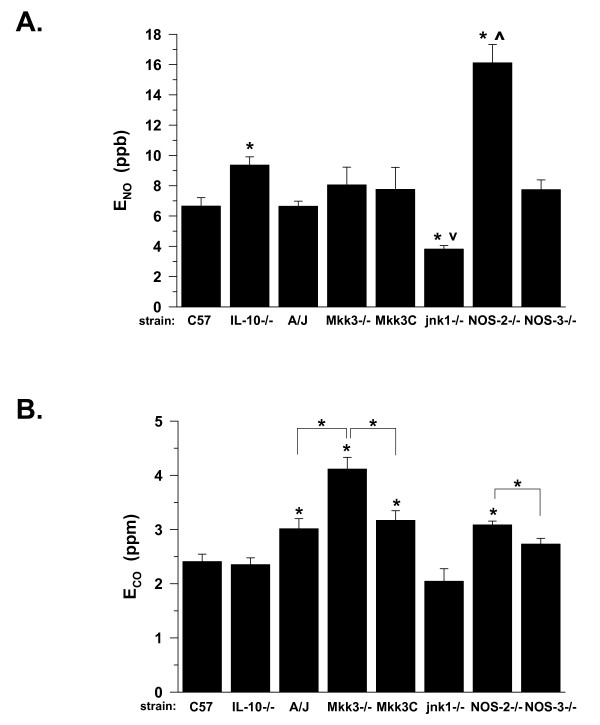
ENO was significantly elevated in naïve IL-10-/- (9-14 ppb) and NOS-2-/- (16 ppb) mice as compared to others (average: 5-8 ppb), whereas ECO was significantly higher in naïve A/J, NOS-3-/- (3-4 ppm), and MKK3-/- (4-5 ppm) mice, as compared to others (average: 2.5 ppm). As compared to C57Bl6 mice, AR of IL-10-/-, JNK1-/-, NOS-2-/-, and NOS-3-/- mice were decreased, whereas they were greater for A/J and MKK3-/- mice. SMTC significantly decreased ENO by ~30%, but did not change AR in NOS-2-/- mice. SnPP reduced ECO in C57Bl6 and IL-10-/- mice, and increased AR in NOS-2-/- mice. ENO decreased as a function of age in IL-10-/- mice, remaining unchanged in C57Bl6 mice.
These results are consistent with the ideas that: 1) ENO is associated with mouse strain and knockout differences in NO production and AR, 2) alterations of ENO and ECO can be measured non-invasively with induction of allergic AI or inhibition of key gas-producing enzymes, and 3) alterations in AR may be dependent on the relative balance of NO and CO in the airway.
呼出气体中的一氧化氮(NO)和一氧化碳(CO)被认为是生理机制可获取的生物标志物。因此,简单、无创且重复地获取它们的测量值备受关注,这也是本研究的目的。
使用气体微量分析仪对几株小鼠(C57Bl6、IL - 10 - / -、A/J、MKK3 - / -、JNK1 - / -、NOS - 2 - / - 和NOS - 3 - / -)进行无创测量呼出的NO(ENO)和CO(ECO),这些小鼠有或没有通过卵清蛋白全身致敏和气溶胶激发诱导的过敏性气道炎症(AI)。组间比较采用独立样本t检验,炎症诱导过程中组内采用重复测量方差分析(ANOVA)。还对8 - 58周龄的C57Bl6和IL - 10 - / - 小鼠测量了ENO和ECO,通过回归分析确定它们之间的关系。分别使用S - 甲硫氨酰 - L - 硫代瓜氨酸(SMTC)和锡原卟啉(SnPP)抑制神经元/组成型NOS - 1和血红素加氧酶,从而分别改变NO和CO的产生,并通过配对t检验进行评估。通过增强暂停法测量乙酰甲胆碱相关的气道反应(AR),采用重复测量ANOVA和事后检验进行比较。
与其他小鼠(平均:5 - 8 ppb)相比,未致敏的IL - 10 - / -(9 - 14 ppb)和NOS - 2 - / -(16 ppb)小鼠的ENO显著升高,而与其他小鼠(平均:2.5 ppm)相比,未致敏的A/J、NOS - 3 - / -(3 - 4 ppm)和MKK3 - / -(4 - 5 ppm)小鼠的ECO显著更高。与C57Bl6小鼠相比,IL - 10 - / -、JNK1 - / -、NOS - 2 - / - 和NOS - 3 - / - 小鼠的AR降低,而A/J和MKK3 - / - 小鼠的AR更高。SMTC使NOS - 2 - / - 小鼠的ENO显著降低约30%,但未改变AR。SnPP降低了C57Bl6和IL - 10 - / - 小鼠的ECO,并增加了NOS - 2 - / - 小鼠的AR。在IL - 10 - / - 小鼠中,ENO随年龄增长而降低,在C57Bl6小鼠中保持不变。
这些结果与以下观点一致:1)ENO与小鼠品系以及NO产生和AR中的基因敲除差异有关;2)在过敏性AI诱导或关键气体产生酶抑制的情况下,可以无创测量ENO和ECO的变化;3)AR的变化可能取决于气道中NO和CO的相对平衡。