College of Pharmacy, Chungbuk National University, 12 Gaesin-dong, Heungduk-gu, Cheongju, Chungbuk 361-763, Korea.
J Inflamm (Lond). 2008 May 29;5:7. doi: 10.1186/1476-9255-5-7.
Bee venom therapy has been used to treat inflammatory diseases including rheumatoid arthritis in humans and in experimental animals. We previously found that bee venom and melittin (a major component of bee venom) have anti-inflammatory effect by reacting with the sulfhydryl group of p50 of nuclear factor-kappa B (NF-kappaB) and IkappaB kinases (IKKs). Since mitogen activated protein (MAP) kinase family is implicated in the NF-kappaB activation and inflammatory reaction, we further investigated whether activation of MAP kinase may be also involved in the anti-inflammatory effect of melittin and bee venom.
The anti-inflammatory effects of melittin and bee venom were investigated in cultured Raw 264.7 cells, THP-1 human monocytic cells and Synoviocytes. The activation of NF-kappaB was investigated by electrophoretic mobility shift assay. Nitric oxide (NO) and prostaglandin E2 (PGE2) were determined either by Enzyme Linked Immuno Sorbent Assay or by biochemical assay. Expression of IkappaB, p50, p65, inducible nitric oxide synthetase (iNOS), cyclooxygenase-2 (COX-2) as well as phosphorylation of MAP kinase family was determined by Western blot.
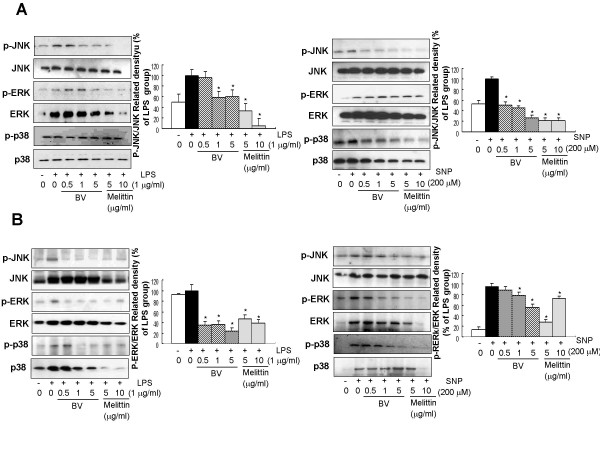
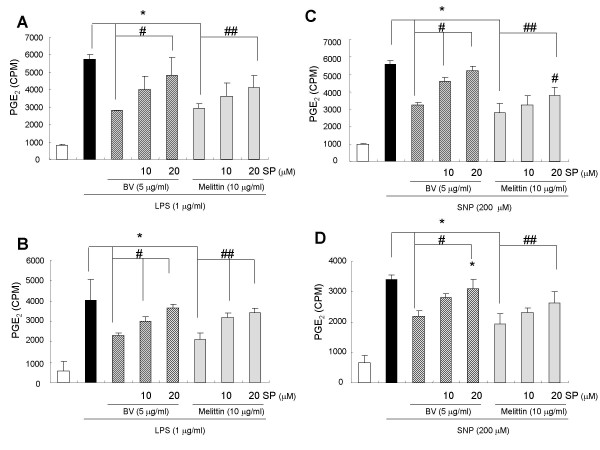
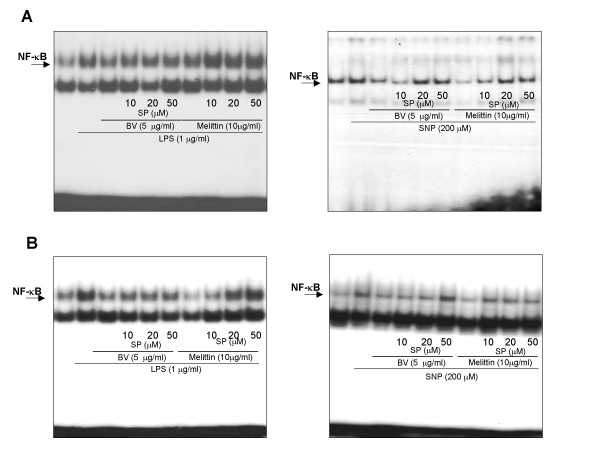
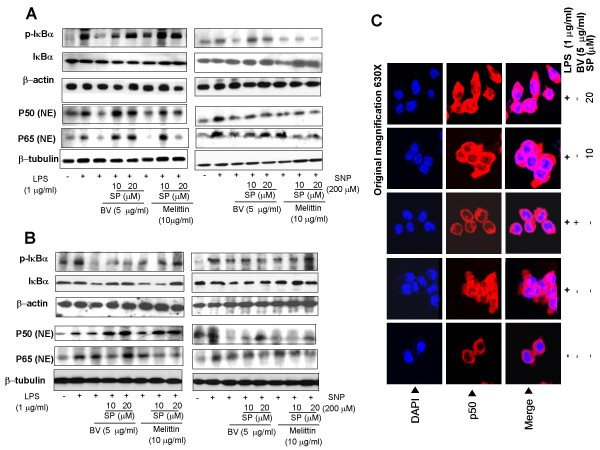
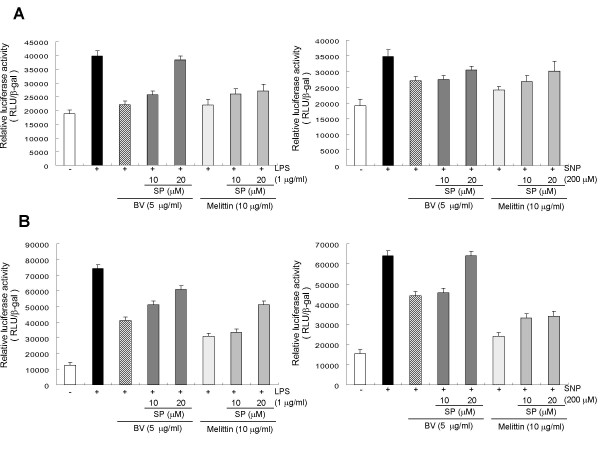
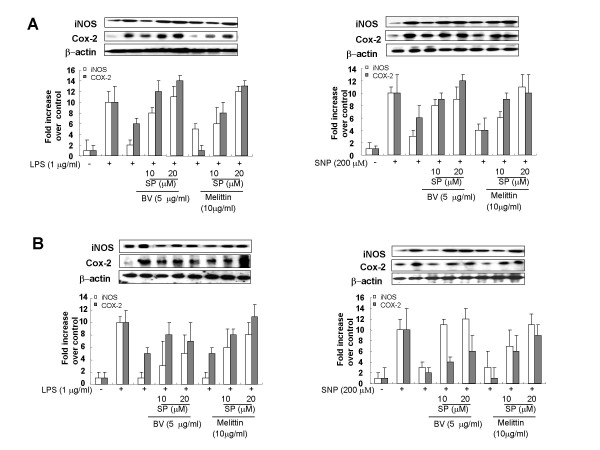
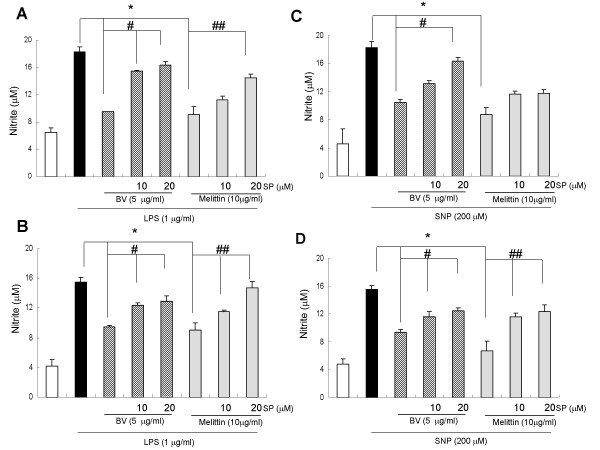
Melittin (0.5-5 mug/ml) and bee venom (5 and 10 mug/ml) inhibited lipopolysaccharide (LPS, 1 mug/ml) and sodium nitroprusside (SNP, 200 muM)-induced activation of c-Jun NH2-terminal kinase (JNK) in RAW 264.7 cells in a dose dependent manner. However, JNK inhibitor, anthra [1,9-cd]pyrazole-6 (2H)-one (SP600215, 10-50 muM) dose dependently suppressed the inhibitory effects of melittin and bee venom on NF-kappaB dependent luciferase and DNA binding activity via suppression of the inhibitory effect of melittin and bee venom on the LPS and SNP-induced translocation of p65 and p50 into nucleus as well as cytosolic release of IkappaB. Moreover, JNK inhibitor suppressed the inhibitory effects of melittin and bee venom on iNOS and COX-2 expression, and on NO and PGE2 generation.
These data show that melittin and bee venom prevent LPS and SNP-induced NO and PGE2 production via JNK pathway dependent inactivation of NF-kappaB, and suggest that inactivation of JNK pathways may also contribute to the anti-inflammatory and anti-arthritis effects of melittin and bee venom.
蜂毒疗法已被用于治疗包括类风湿性关节炎在内的炎症性疾病,在人类和实验动物中均有应用。我们之前发现,蜂毒和蜂毒素(蜂毒的主要成分)通过与核因子-κB(NF-κB)的 p50 和 IkappaB 激酶(IKKs)的巯基反应发挥抗炎作用。由于丝裂原激活蛋白(MAP)激酶家族参与 NF-κB 的激活和炎症反应,因此我们进一步研究了 MAP 激酶的激活是否也参与了蜂毒素和蜂毒的抗炎作用。
在培养的 Raw 264.7 细胞、THP-1 人单核细胞和滑膜细胞中研究了蜂毒素和蜂毒的抗炎作用。通过电泳迁移率变动分析研究 NF-κB 的激活。通过酶联免疫吸附测定或生化测定来测定一氧化氮(NO)和前列腺素 E2(PGE2)的含量。通过 Western blot 测定 IkappaB、p50、p65、诱导型一氧化氮合酶(iNOS)、环氧化酶-2(COX-2)的表达以及 MAP 激酶家族的磷酸化。
蜂毒素(0.5-5 μg/ml)和蜂毒(5 和 10 μg/ml)以剂量依赖的方式抑制脂多糖(LPS,1 μg/ml)和硝普钠(SNP,200 μM)诱导的 RAW 264.7 细胞中 c-Jun NH2-末端激酶(JNK)的激活。然而,JNK 抑制剂 anthra[1,9-cd]pyrazole-6(2H)-one(SP600215,10-50 μM)通过抑制蜂毒素和蜂毒对 LPS 和 SNP 诱导的 p65 和 p50 入核以及胞浆中 IkappaB 释放的抑制作用,剂量依赖性地抑制了蜂毒素和蜂毒对 NF-κB 依赖性荧光素酶和 DNA 结合活性的抑制作用。此外,JNK 抑制剂抑制了蜂毒素和蜂毒对 iNOS 和 COX-2 表达以及 NO 和 PGE2 生成的抑制作用。
这些数据表明,蜂毒素和蜂毒通过 JNK 途径依赖性失活 NF-κB 来预防 LPS 和 SNP 诱导的 NO 和 PGE2 的产生,提示 JNK 途径的失活可能也是蜂毒素和蜂毒抗炎和抗关节炎作用的原因之一。