Brennan T J, Edmondson D G, Li L, Olson E N
Department of Biochemistry and Molecular Biology, University of Texas M. D. Anderson Cancer Center, Houston 77030.
Proc Natl Acad Sci U S A. 1991 May 1;88(9):3822-6. doi: 10.1073/pnas.88.9.3822.
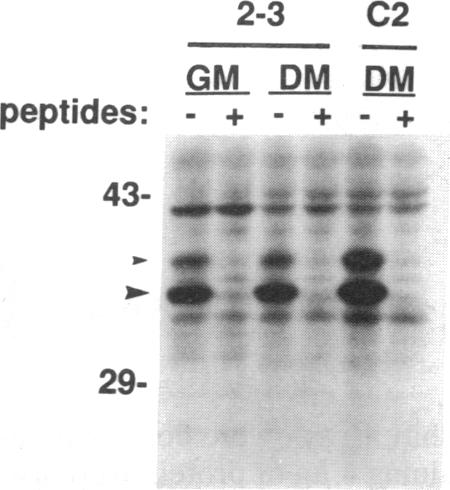
Myogenin belongs to a family of regulatory factors that can activate myogenesis when transfected into nonmyogenic cells. A conserved DNA sequence, known as an E box, serves as the target for binding and trans-activation by myogenin. Using 10T1/2 fibroblasts that constitutively express a transfected myogenin cDNA, we show that myogenin accumulates in the nucleus but is unable to initiate myogenesis when cells are maintained with transforming growth factor beta (TGF-beta) or high serum. Although the final effect of TGF-beta and high serum--inhibition of myogenesis--was the same, their effects on the DNA-binding properties of myogenin in vitro differed. TGF-beta did not affect the ability of myogenin to bind DNA, whereas serum diminished the in vitro DNA-binding activity of myogenin. The helix-loop-helix (HLH) protein Id, postulated to inhibit DNA binding of other HLH proteins, was induced by high serum but not by TGF-beta. The presence of Id correlated with the failure of myogenin to bind the muscle creatine kinase enhancer in vitro. These findings suggest that serum can inhibit myogenesis by attenuating the DNA-binding activity of myogenin, possibly as a consequence of Id protein expression, whereas TGF-beta acts through a mechanism distal to DNA sequence recognition by myogenin and independent of Id.
肌细胞生成素属于一类调控因子家族,当转染到非肌源性细胞中时,它能够激活肌细胞生成。一种被称为E盒的保守DNA序列,是肌细胞生成素结合和反式激活的靶点。利用组成型表达转染的肌细胞生成素cDNA的10T1/2成纤维细胞,我们发现当细胞在转化生长因子β(TGF-β)或高血清条件下培养时,肌细胞生成素在细胞核中积累,但无法启动肌细胞生成。尽管TGF-β和高血清的最终作用——抑制肌细胞生成——是相同的,但它们对肌细胞生成素体外DNA结合特性的影响有所不同。TGF-β不影响肌细胞生成素结合DNA的能力,而血清则降低了肌细胞生成素的体外DNA结合活性。螺旋-环-螺旋(HLH)蛋白Id,推测可抑制其他HLH蛋白的DNA结合,它是由高血清诱导而非TGF-β诱导产生的。Id的存在与肌细胞生成素在体外无法结合肌肉肌酸激酶增强子相关。这些发现表明,血清可能通过减弱肌细胞生成素的DNA结合活性来抑制肌细胞生成,这可能是Id蛋白表达的结果,而TGF-β则通过一种位于肌细胞生成素对DNA序列识别下游且独立于Id的机制发挥作用。