Gabriele Michelle L, Ishikawa Hiroshi, Wollstein Gadi, Bilonick Richard A, Townsend Kelly A, Kagemann Larry, Wojtkowski Maciej, Srinivasan Vivek J, Fujimoto James G, Duker Jay S, Schuman Joel S
UPMC Eye Center, Eye and Ear Institute, Ophthalmology and Visual Science Research Center, Department of Ophthalmology, University of Pittsburgh School of Medicine, Pittsburgh, Pennsylvania 15213, USA.
Invest Ophthalmol Vis Sci. 2008 Jun;49(6):2315-21. doi: 10.1167/iovs.07-0873.
To investigate the effect on optical coherence tomography (OCT) retinal nerve fiber layer (RNFL) thickness measurements of varying the standard 3.4-mm-diameter circle location.
The optic nerve head (ONH) region of 17 eyes of 17 healthy subjects was imaged with high-speed, ultrahigh-resolution OCT (hsUHR-OCT; 501 x 180 axial scans covering a 6 x 6-mm area; scan time, 3.84 seconds) for a comprehensive sampling. This method allows for systematic simulation of the variable circle placement effect. RNFL thickness was measured on this three-dimensional dataset by using a custom-designed software program. RNFL thickness was resampled along a 3.4-mm-diameter circle centered on the ONH, then along 3.4-mm circles shifted horizontally (x-shift), vertically (y-shift) and diagonally up to +/-500 microm (at 100-microm intervals). Linear mixed-effects models were used to determine RNFL thickness as a function of the scan circle shift. A model for the distance between the two thickest measurements along the RNFL thickness circular profile (peak distance) was also calculated.
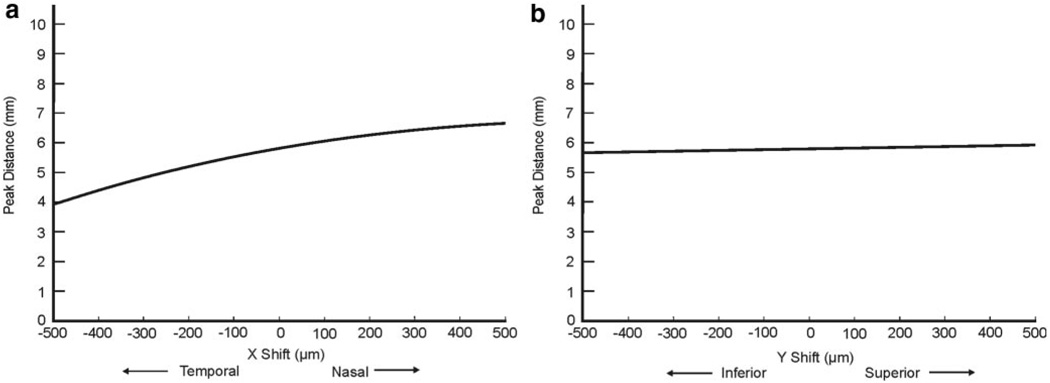
RNFL thickness tended to decrease with both positive and negative x- and y-shifts. The range of shifts that caused a decrease greater than the variability inherent to the commercial device was greater in both nasal and temporal quadrants than in the superior and inferior ones. The model for peak distance demonstrated that as the scan moves nasally, the RNFL peak distance increases, and as the circle moves temporally, the distance decreases. Vertical shifts had a minimal effect on peak distance.
The location of the OCT scan circle affects RNFL thickness measurements. Accurate registration of OCT scans is essential for measurement reproducibility and longitudinal examination (ClinicalTrials.gov number, NCT00286637).
研究改变标准3.4毫米直径圆的位置对光学相干断层扫描(OCT)测量视网膜神经纤维层(RNFL)厚度的影响。
对17名健康受试者的17只眼睛的视神经乳头(ONH)区域进行高速、超高分辨率OCT(hsUHR - OCT;501×180轴向扫描,覆盖6×6毫米区域;扫描时间3.84秒)成像,以进行全面采样。该方法允许系统模拟可变圆放置的效果。使用定制设计的软件程序在这个三维数据集中测量RNFL厚度。RNFL厚度首先沿以ONH为中心的3.4毫米直径圆进行重采样,然后沿水平(x轴偏移)、垂直(y轴偏移)和对角线方向最多偏移±500微米(以100微米间隔)的3.4毫米圆进行重采样。使用线性混合效应模型确定RNFL厚度作为扫描圆偏移的函数。还计算了沿RNFL厚度圆形轮廓的两个最厚测量值之间的距离模型(峰值距离)。
RNFL厚度在x轴和y轴正负偏移时均趋于减小。导致下降幅度大于商用设备固有变异性的偏移范围在鼻侧和颞侧象限均大于上侧和下侧象限。峰值距离模型表明,随着扫描向鼻侧移动,RNFL峰值距离增加,随着圆向颞侧移动,距离减小。垂直偏移对峰值距离的影响最小。
OCT扫描圆的位置会影响RNFL厚度测量。OCT扫描的准确配准对于测量的可重复性和纵向检查至关重要(ClinicalTrials.gov编号,NCT00286637)。