Viros Amaya, Fridlyand Jane, Bauer Juergen, Lasithiotakis Konstantin, Garbe Claus, Pinkel Daniel, Bastian Boris C
Department of Dermatology, University of California San Francisco, San Francisco, California, United States of America.
PLoS Med. 2008 Jun 3;5(6):e120. doi: 10.1371/journal.pmed.0050120.
In melanoma, morphology-based classification systems have not been able to provide relevant information for selecting treatments for patients whose tumors have metastasized. The recent identification of causative genetic alterations has revealed mutations in signaling pathways that offer targets for therapy. Identifying morphologic surrogates that can identify patients whose tumors express such alterations (or functionally equivalent alterations) would be clinically useful for therapy stratification and for retrospective analysis of clinical trial data.
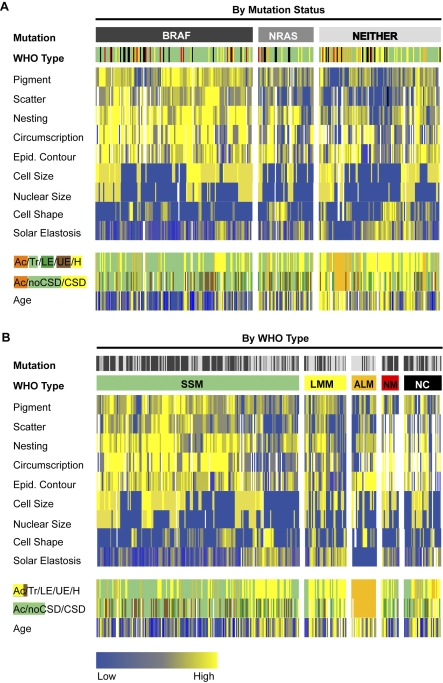
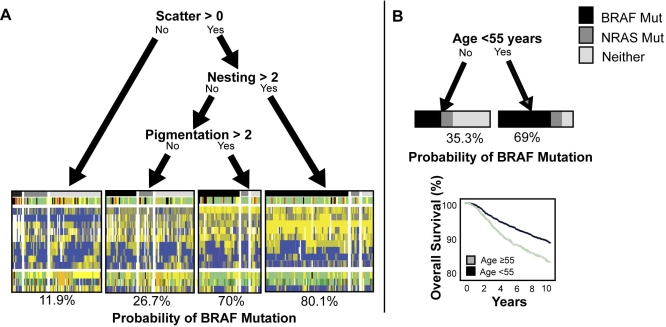
METHODOLOGY/PRINCIPAL FINDINGS: We defined and assessed a panel of histomorphologic measures and correlated them with the mutation status of the oncogenes BRAF and NRAS in a cohort of 302 archival tissues of primary cutaneous melanomas from an academic comprehensive cancer center. Melanomas with BRAF mutations showed distinct morphological features such as increased upward migration and nest formation of intraepidermal melanocytes, thickening of the involved epidermis, and sharper demarcation to the surrounding skin; and they had larger, rounder, and more pigmented tumor cells (all p-values below 0.0001). By contrast, melanomas with NRAS mutations could not be distinguished based on these morphological features. Using simple combinations of features, BRAF mutation status could be predicted with up to 90.8% accuracy in the entire cohort as well as within the categories of the current World Health Organization (WHO) classification. Among the variables routinely recorded in cancer registries, we identified age < 55 y as the single most predictive factor of BRAF mutation in our cohort. Using age < 55 y as a surrogate for BRAF mutation in an independent cohort of 4,785 patients of the Southern German Tumor Registry, we found a significant survival benefit (p < 0.0001) for patients who, based on their age, were predicted to have BRAF mutant melanomas in 69% of the cases. This group also showed a different pattern of metastasis, more frequently involving regional lymph nodes, compared to the patients predicted to have no BRAF mutation and who more frequently displayed satellite, in-transit metastasis, and visceral metastasis (p < 0.0001).
Refined morphological classification of primary melanomas can be used to improve existing melanoma classifications by forming subgroups that are genetically more homogeneous and likely to differ in important clinical variables such as outcome and pattern of metastasis. We expect this information to improve classification and facilitate stratification for therapy as well as retrospective analysis of existing trial data.
在黑色素瘤中,基于形态学的分类系统无法为肿瘤已发生转移的患者选择治疗方案提供相关信息。最近对致病基因改变的鉴定揭示了信号通路中的突变,这些突变为治疗提供了靶点。识别能够鉴定肿瘤表达此类改变(或功能等效改变)的患者的形态学替代指标,对于治疗分层和临床试验数据的回顾性分析具有临床实用价值。
方法/主要发现:我们定义并评估了一组组织形态学指标,并将其与来自一家学术性综合癌症中心的302例原发性皮肤黑色素瘤存档组织队列中癌基因BRAF和NRAS的突变状态进行关联。具有BRAF突变的黑色素瘤表现出独特的形态学特征,如表皮内黑素细胞向上迁移增加和巢状形成、受累表皮增厚以及与周围皮肤的界限更清晰;并且它们具有更大、更圆且色素沉着更多的肿瘤细胞(所有p值均低于0.0001)。相比之下,具有NRAS突变的黑色素瘤无法根据这些形态学特征进行区分。通过简单的特征组合,在整个队列以及世界卫生组织(WHO)当前分类类别中,BRAF突变状态的预测准确率可达90.8%。在癌症登记处常规记录的变量中,我们确定年龄<55岁是我们队列中BRAF突变的最具预测性的单一因素。在德国南部肿瘤登记处的4785例患者的独立队列中,将年龄<55岁作为BRAF突变的替代指标,我们发现,基于年龄预计有69%的病例为BRAF突变型黑色素瘤的患者具有显著的生存获益(p<0.0001)。与预计无BRAF突变且更频繁出现卫星灶、移行转移和内脏转移的患者相比,该组患者还表现出不同的转移模式,更频繁地累及区域淋巴结(p<0.0001)。
原发性黑色素瘤的精细形态学分类可用于通过形成基因上更同质且在重要临床变量(如预后和转移模式)上可能存在差异的亚组来改进现有的黑色素瘤分类。我们期望这些信息能够改善分类并促进治疗分层以及对现有试验数据的回顾性分析。