Peña P V, Hom R A, Hung T, Lin H, Kuo A J, Wong R P C, Subach O M, Champagne K S, Zhao R, Verkhusha V V, Li G, Gozani O, Kutateladze T G
Department of Pharmacology, University of Colorado Health Sciences Center, 12801 East 17th Avenue, Aurora, CO 80045-0511, USA.
J Mol Biol. 2008 Jul 4;380(2):303-12. doi: 10.1016/j.jmb.2008.04.061. Epub 2008 May 2.
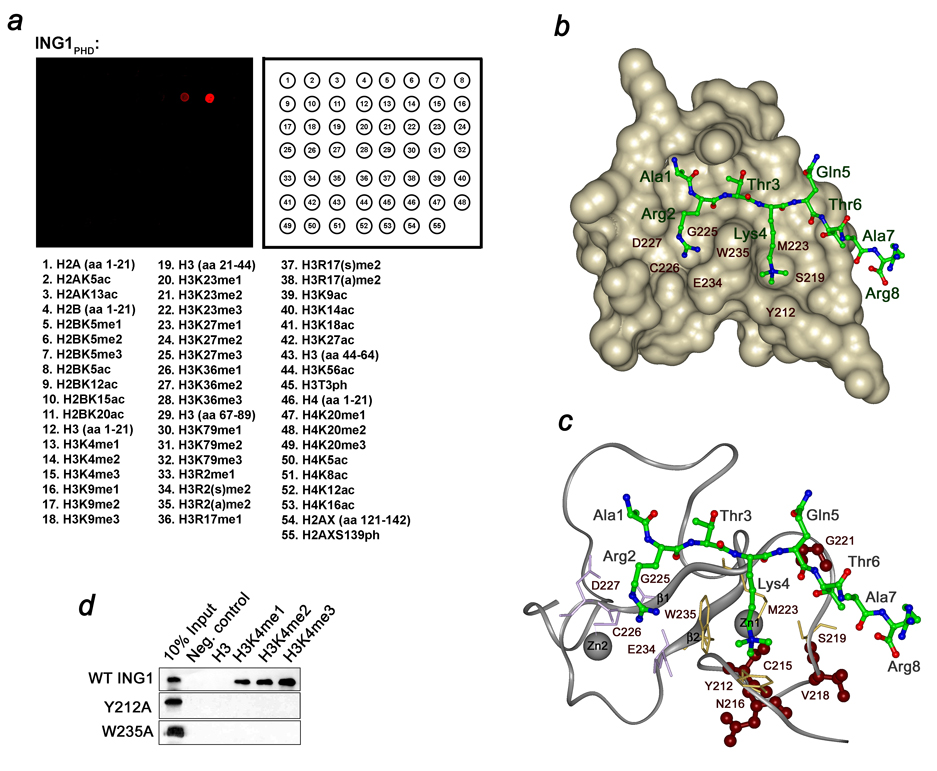
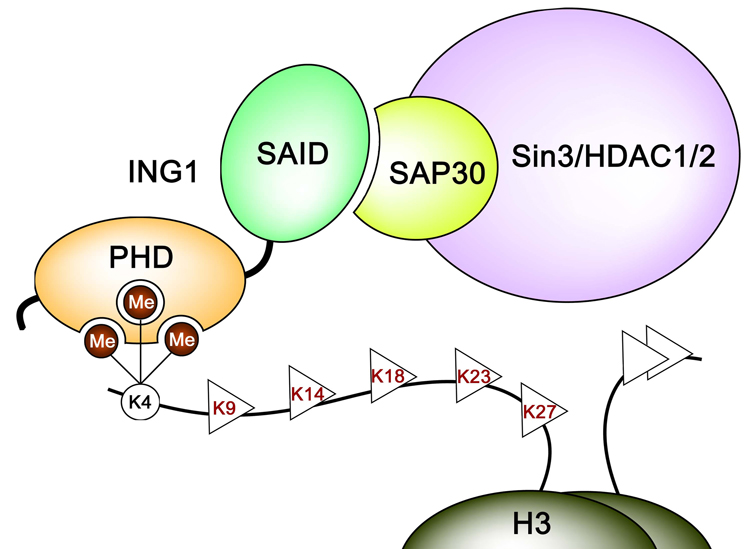
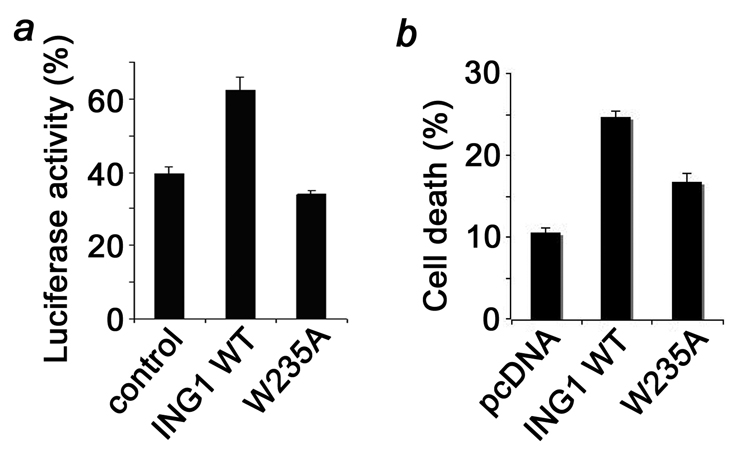
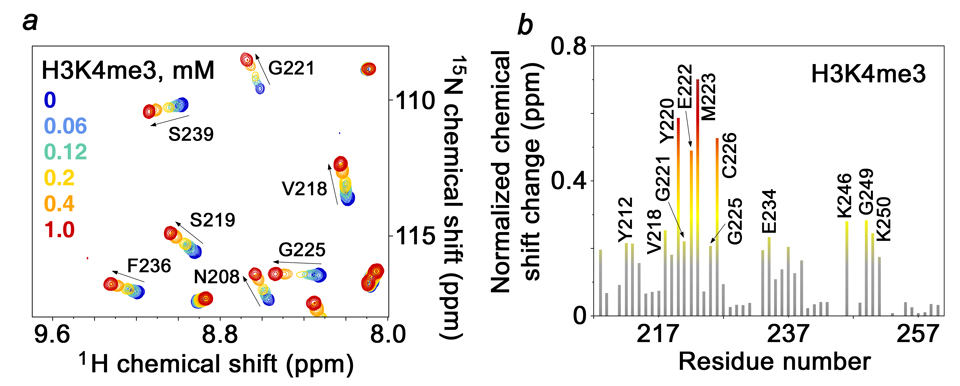
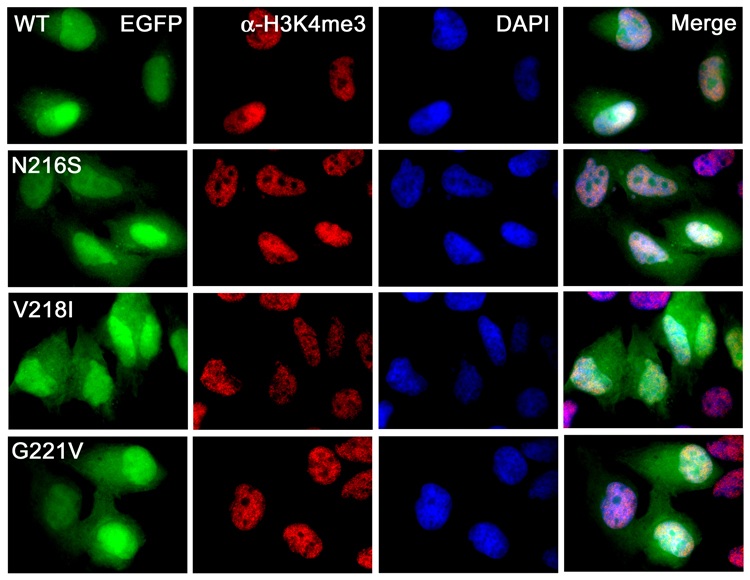
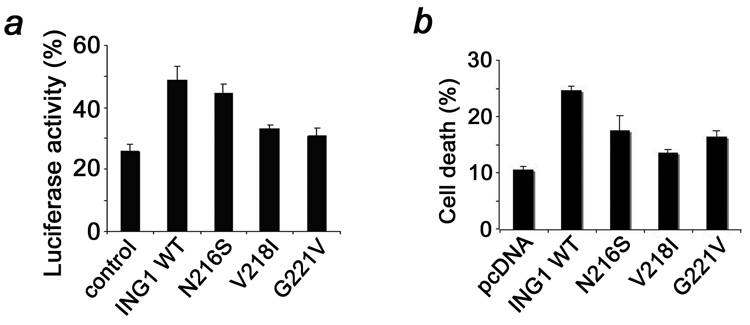
Inhibitor of growth 1 (ING1) is implicated in oncogenesis, DNA damage repair, and apoptosis. Mutations within the ING1 gene and altered expression levels of ING1 are found in multiple human cancers. Here, we show that both DNA repair and apoptotic activities of ING1 require the interaction of the C-terminal plant homeodomain (PHD) finger with histone H3 trimethylated at Lys4 (H3K4me3). The ING1 PHD finger recognizes methylated H3K4 but not other histone modifications as revealed by the peptide microarrays. The molecular mechanism of the histone recognition is elucidated based on a 2.1 A-resolution crystal structure of the PHD-H3K4me3 complex. The K4me3 occupies a deep hydrophobic pocket formed by the conserved Y212 and W235 residues that make cation-pi contacts with the trimethylammonium group. Both aromatic residues are essential in the H3K4me3 recognition, as substitution of these residues with Ala disrupts the interaction. Unlike the wild-type ING1, the W235A mutant, overexpressed in the stable clones of melanoma cells or in HT1080 cells, was unable to stimulate DNA repair after UV irradiation or promote DNA-damage-induced apoptosis, indicating that H3K4me3 binding is necessary for these biological functions of ING1. Furthermore, N216S, V218I, and G221V mutations, found in human malignancies, impair the ability of ING1 to associate with H3K4me3 or to induce nucleotide repair and cell death, linking the tumorigenic activity of ING1 with epigenetic regulation. Together, our findings reveal the critical role of the H3K4me3 interaction in mediating cellular responses to genotoxic stresses and offer new insight into the molecular mechanism underlying the tumor suppressive activity of ING1.
生长抑制因子1(ING1)与肿瘤发生、DNA损伤修复及细胞凋亡有关。在多种人类癌症中均发现了ING1基因的突变以及ING1表达水平的改变。在此,我们发现ING1的DNA修复和凋亡活性均需要其C端植物同源结构域(PHD)指与赖氨酸4位点三甲基化的组蛋白H3(H3K4me3)相互作用。肽微阵列分析表明,ING1的PHD指可识别甲基化的H3K4,而不能识别其他组蛋白修饰。基于PHD-H3K4me3复合物2.1埃分辨率的晶体结构,阐明了组蛋白识别的分子机制。K4me3占据了由保守的Y212和W235残基形成的深疏水口袋,这两个残基与三甲基铵基团形成阳离子-π相互作用。这两个芳香族残基在H3K4me3识别中至关重要,因为用丙氨酸取代这些残基会破坏相互作用。与野生型ING1不同,在黑色素瘤细胞或HT1080细胞的稳定克隆中过表达的W235A突变体,在紫外线照射后无法刺激DNA修复或促进DNA损伤诱导的细胞凋亡,这表明H3K4me3结合对于ING1的这些生物学功能是必需的。此外,在人类恶性肿瘤中发现的N216S、V218I和G221V突变,损害了ING1与H3K4me3结合或诱导核苷酸修复及细胞死亡的能力,将ING1的致瘤活性与表观遗传调控联系起来。总之,我们的研究结果揭示了H3K4me3相互作用在介导细胞对遗传毒性应激反应中的关键作用,并为ING1肿瘤抑制活性的分子机制提供了新的见解。