Toole Bryan P, Slomiany Mark G
Department of Cell Biology and Anatomy, Medical University of South Carolina, 173 Ashley Avenue, Charleston, SC 29425, USA.
Semin Cancer Biol. 2008 Aug;18(4):244-50. doi: 10.1016/j.semcancer.2008.03.009. Epub 2008 Mar 26.
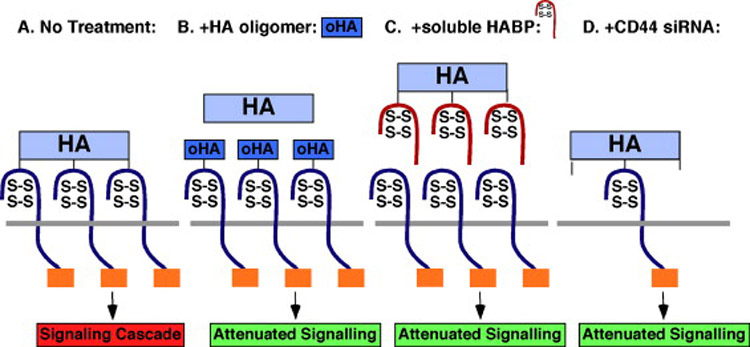
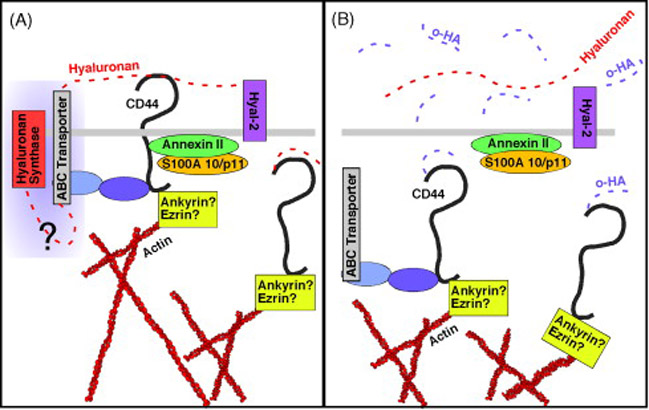
Hyaluronan not only is an important structural component of extracellular matrices but also interacts instructively with cells during embryonic development, healing processes, inflammation, and cancer. It binds to several different types of cell surface receptors, including CD44, thus leading to co-regulation of important signaling pathways, notably those induced by activation of receptor tyrosine kinases. Consequently, interactions of both stromal and tumor cell-derived hyaluronan with tumor cells play important cooperative roles in several aspects of malignancy. This review focuses on cell autonomous hyaluronan-tumor cell interactions that lead to activation of receptor tyrosine kinases and enhanced drug resistance. Particular emphasis is placed on the role of hyaluronan-CD44 interactions in drug transporter expression and activity, especially in cancer stem-like cells that are highly malignant and resistant to chemotherapy. Antagonists of hyaluronan-CD44 interaction, especially small hyaluronan oligomers, may be useful in therapeutic strategies aimed at preventing tumor recurrence from these therapy-resistant sub-populations within malignant cancers.
透明质酸不仅是细胞外基质的重要结构成分,而且在胚胎发育、愈合过程、炎症和癌症期间与细胞进行有指导性的相互作用。它与几种不同类型的细胞表面受体结合,包括CD44,从而导致重要信号通路的共同调节,特别是那些由受体酪氨酸激酶激活诱导的信号通路。因此,基质和肿瘤细胞衍生的透明质酸与肿瘤细胞的相互作用在恶性肿瘤的几个方面发挥着重要的协同作用。本综述重点关注导致受体酪氨酸激酶激活和增强耐药性的细胞自主透明质酸 - 肿瘤细胞相互作用。特别强调透明质酸 - CD44相互作用在药物转运蛋白表达和活性中的作用,尤其是在高度恶性且对化疗耐药的癌症干细胞样细胞中。透明质酸 - CD44相互作用的拮抗剂,特别是小透明质酸寡聚物,可能在旨在预防恶性肿瘤中这些耐药亚群导致肿瘤复发的治疗策略中有用。