Xue Jingqi, Li Yunhui, Tan Hui, Yang Feng, Ma Nan, Gao Junping
Department of Ornamental Horticulture, China Agricultural University, Beijing 100094, China.
J Exp Bot. 2008;59(8):2161-9. doi: 10.1093/jxb/ern078.
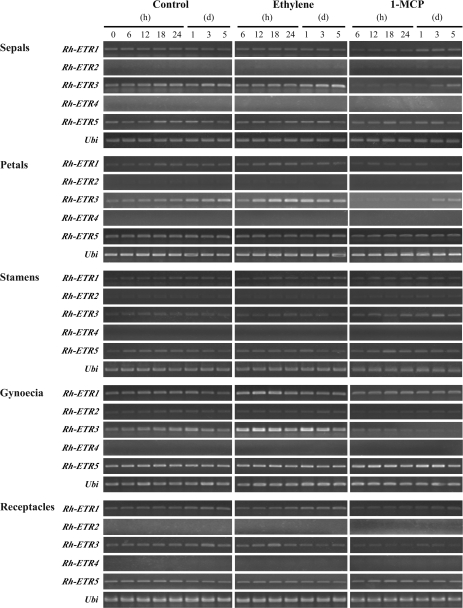
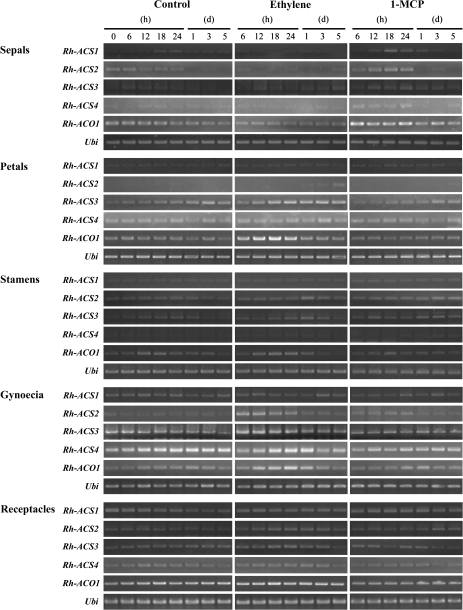
Ethylene production, as well as the expression of ethylene biosynthetic (Rh-ACS1-4 and Rh-ACO1) and receptor (Rh-ETR1-5) genes, was determined in five different floral tissues (sepals, petals, stamens, gynoecia, and receptacles) of cut rose (Rosa hybrida cv. Samantha upon treatment with ethylene or the ethylene inhibitor 1-methylcyclopropene (1-MCP). Ethylene-enhanced ethylene production occurred only in gynoecia, petals, and receptacles, with gynoecia showing the greatest enhancement in the early stage of ethylene treatment. However, 1-MCP did not suppress ethylene production in these three tissues. In sepals, ethylene production was highly decreased by ethylene treatment, and increased dramatically by 1-MCP. Ethylene production in stamens remained unchanged after ethylene or 1-MCP treatment. Induction of certain ethylene biosynthetic genes by ethylene in different floral tissues was positively correlated with the ethylene production, and this induction was also not suppressed by 1-MCP. The expression of Rh-ACS2 and Rh-ACS3 was quickly induced by ethylene in gynoecia, but neither Rh-ACS1 nor Rh-ACS4 was induced by ethylene in any of the five tissues. In addition, Rh-ACO1 was induced by ethylene in all floral tissues except sepals. The induced expression of ethylene receptor genes by ethylene was much faster in gynoecia than in petals, and the expression of Rh-ETR3 was strongly suppressed by 1-MCP in all floral tissues. These results indicate that ethylene biosynthesis in gynoecia is regulated developmentally, rather than autocatalytically. The response of rose flowers to ethylene occurs initially in gynoecia, and ethylene may regulate flower opening mainly through the Rh-ETR3 gene in gynoecia.
在对切花玫瑰(Rosa hybrida cv. Samantha)用乙烯或乙烯抑制剂1-甲基环丙烯(1-MCP)处理后,测定了五个不同花器官组织(萼片、花瓣、雄蕊、雌蕊和花托)中的乙烯生成量,以及乙烯生物合成基因(Rh-ACS1-4和Rh-ACO1)和受体基因(Rh-ETR1-5)的表达情况。乙烯增强的乙烯生成仅在雌蕊、花瓣和花托中出现,其中雌蕊在乙烯处理早期表现出最大程度的增强。然而,1-MCP并未抑制这三个组织中的乙烯生成。在萼片中,乙烯处理使乙烯生成量大幅降低,而1-MCP则使其显著增加。乙烯或1-MCP处理后,雄蕊中的乙烯生成量保持不变。乙烯在不同花器官组织中对某些乙烯生物合成基因的诱导与乙烯生成呈正相关,并且这种诱导也未被1-MCP抑制。乙烯能迅速诱导雌蕊中Rh-ACS2和Rh-ACS3的表达,但在五个组织中的任何一个中,乙烯都未诱导Rh-ACS1和Rh-ACS4的表达。此外,除萼片外,乙烯在所有花器官组织中均诱导了Rh-ACO1的表达。乙烯对乙烯受体基因的诱导表达在雌蕊中比在花瓣中快得多,并且在所有花器官组织中,1-MCP强烈抑制了Rh-ETR3的表达。这些结果表明,雌蕊中的乙烯生物合成是受发育调控的,而非自催化调控。玫瑰花对乙烯的反应最初发生在雌蕊中,并且乙烯可能主要通过雌蕊中的Rh-ETR3基因来调控花朵开放。