Green Mark P, Spate Lee D, Parks Tina E, Kimura Koji, Murphy Clifton N, Williams Jim E, Kerley Monty S, Green Jonathan A, Keisler Duane H, Roberts R Michael
Division of Animal Sciences, University of Missouri, Columbia MO 65211, USA.
Reprod Biol Endocrinol. 2008 Jun 9;6:21. doi: 10.1186/1477-7827-6-21.
Evolutionary theory suggests that in polygynous mammalian species females in better body condition should produce more sons than daughters. Few controlled studies have however tested this hypothesis and controversy exists as to whether body condition score or maternal diet is in fact the determining factor of offspring sex. Here, we examined whether maternal diet, specifically increased n-6 polyunsaturated fatty acid (PUFA) intake, of ewes with a constant body condition score around the time of conception influenced sex ratio.
Ewes (n = 44) maintained in similar body condition throughout the study were assigned either a control (C) diet or one (F) enriched in rumen-protected PUFA, but otherwise essentially equivalent, from four weeks prior to breeding until d13 post-estrus. On d13, conceptuses were recovered, measured, cultured to assess their capacity for interferon-tau (IFNT) production and their sex determined. The experiment was repeated with all ewes being fed the F diet to remove any effects of parity order on sex ratio. Maternal body condition score (BCS), plasma hormone and metabolite concentrations were also assessed throughout the study and related to diet.
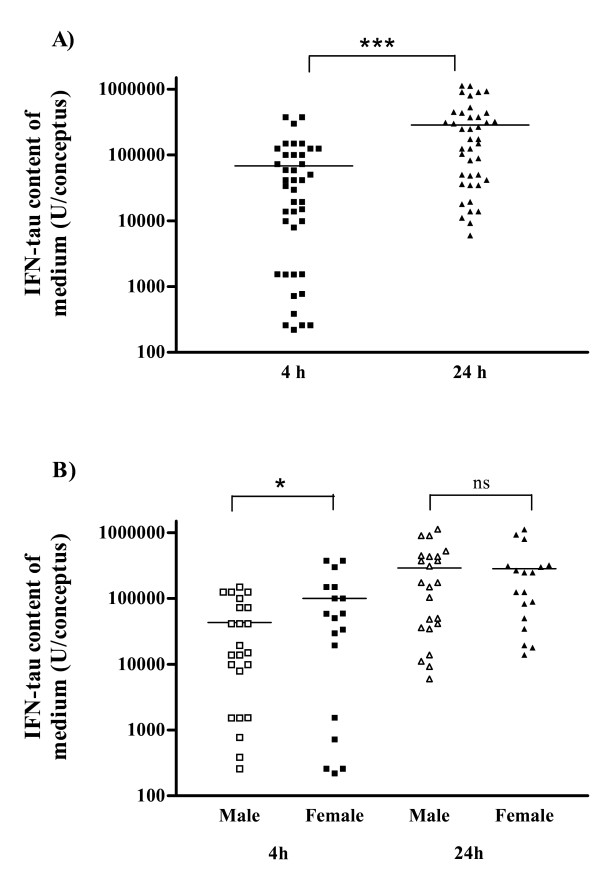
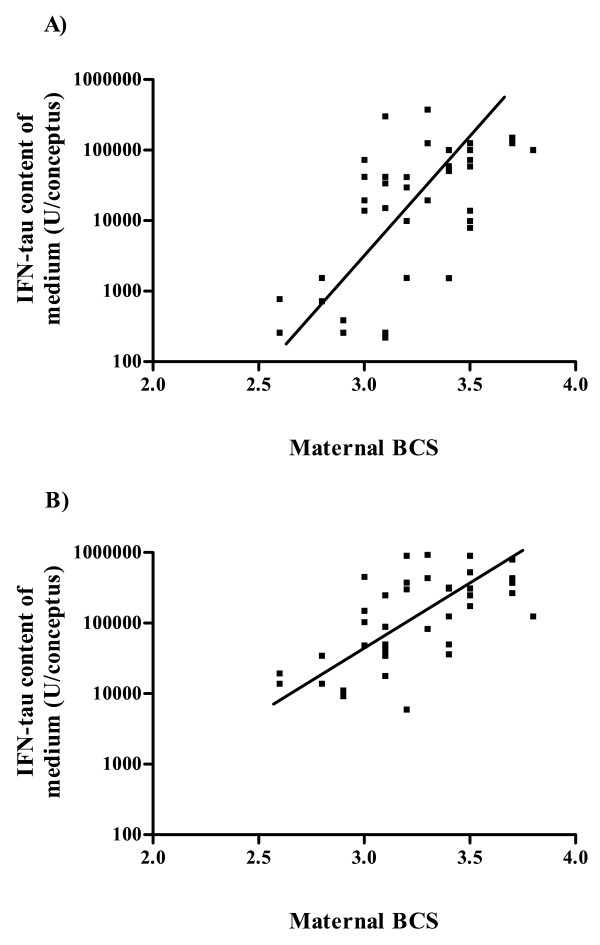
In total 129 conceptuses were recovered. Ewes on the F diet produced significantly more male than female conceptuses (proportion male = 0.69; deviation from expected ratio of 0.5, P < 0.001). Conceptus IFNT production was unaffected by diet (P > 0.1), but positively correlated with maternal body condition score (P < 0.05), and was higher (P < 0.05) in female than male conceptuses after 4 h culture. Maternal plasma hormone and metabolite concentrations, especially progesterone and fatty acid, were also modulated by diet.
These results provide evidence that maternal diet, in the form of increased amounts of rumen-protected PUFA fed around conception, rather than maternal body condition, can skew the sex ratio towards males. These observations may have implications to the livestock industry and animal management policies when offspring of one sex may be preferred over the other.
进化理论表明,在一夫多妻制的哺乳动物物种中,身体状况较好的雌性所产的儿子应多于女儿。然而,很少有对照研究检验这一假设,并且关于身体状况评分或母体饮食实际上是否是后代性别的决定因素存在争议。在此,我们研究了在受孕前后身体状况评分恒定的母羊的母体饮食,特别是增加n-6多不饱和脂肪酸(PUFA)的摄入量,是否会影响性别比例。
在整个研究过程中,将身体状况相似的母羊(n = 44)分为对照组(C)饮食或富含瘤胃保护PUFA的饮食(F),但在繁殖前四周至发情后第13天,其他方面基本相同。在第13天,回收、测量并培养胚胎,以评估其产生干扰素-τ(IFNT)的能力并确定其性别。对所有母羊都饲喂F饮食重复该实验,以消除胎次顺序对性别比例的任何影响。在整个研究过程中还评估了母体身体状况评分(BCS)、血浆激素和代谢物浓度,并将其与饮食相关联。
总共回收了129个胚胎。饲喂F饮食的母羊所产的雄性胚胎明显多于雌性胚胎(雄性比例 = 0.69;偏离预期比例0.5,P < 0.001)。胚胎IFNT的产生不受饮食影响(P > 0.1),但与母体身体状况评分呈正相关(P < 0.05),并且在培养4小时后,雌性胚胎中的IFNT产生高于雄性胚胎(P < 0.05)。母体血浆激素和代谢物浓度,特别是孕酮和脂肪酸,也受到饮食的调节。
这些结果提供了证据,表明受孕前后饲喂增加量的瘤胃保护PUFA形式的母体饮食,而非母体身体状况,可使性别比例偏向雄性。当偏好某一性别的后代时,这些观察结果可能对畜牧业和动物管理政策有影响。