Park Jung Yoon, Cho Mi-Ook, Leonard Shanique, Calder Brent, Mian I Saira, Kim Woo Ho, Wijnhoven Susan, van Steeg Harry, Mitchell James, van der Horst Gijsbertus T J, Hoeijmakers Jan, Cohen Pinchas, Vijg Jan, Suh Yousin
Department of Medicine, Albert Einstein College of Medicine, Bronx, New York, United States of America.
PLoS One. 2008 Jun 11;3(6):e2346. doi: 10.1371/journal.pone.0002346.
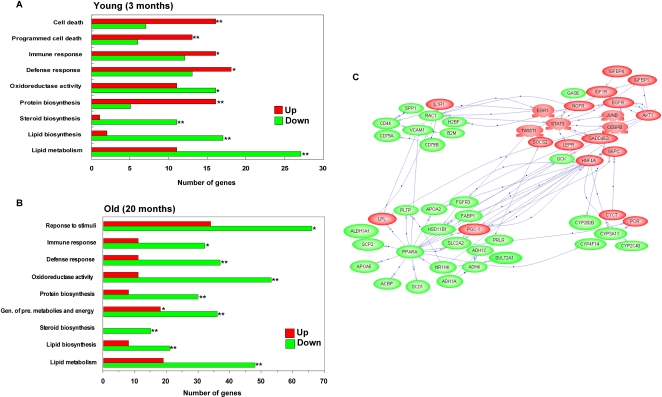
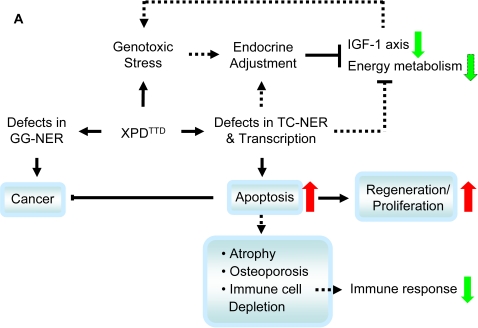
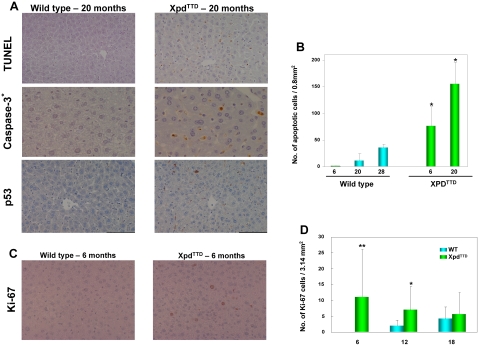
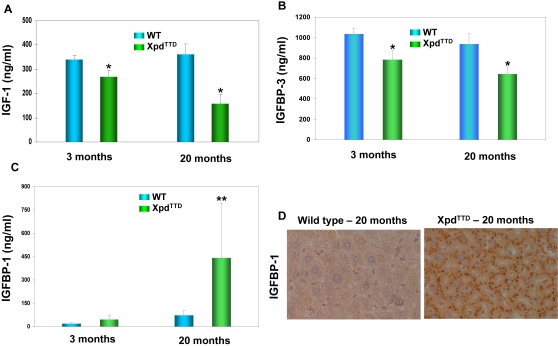
Unrepaired or misrepaired DNA damage has been implicated as a causal factor in cancer and aging. Xpd(TTD) mice, harboring defects in nucleotide excision repair and transcription due to a mutation in the Xpd gene (R722W), display severe symptoms of premature aging but have a reduced incidence of cancer. To gain further insight into the molecular basis of the mutant-specific manifestation of age-related phenotypes, we used comparative microarray analysis of young and old female livers to discover gene expression signatures distinguishing Xpd(TTD) mice from their age-matched wild type controls. We found a transcription signature of increased apoptosis in the Xpd(TTD) mice, which was confirmed by in situ immunohistochemical analysis and found to be accompanied by increased proliferation. However, apoptosis rate exceeded the rate of proliferation, resulting in homeostatic imbalance. Interestingly, a metabolic response signature was observed involving decreased energy metabolism and reduced IGF-1 signaling, a major modulator of life span. We conclude that while the increased apoptotic response to endogenous DNA damage contributes to the accelerated aging phenotypes and the reduced cancer incidence observed in the Xpd(TTD) mice, the signature of reduced energy metabolism is likely to reflect a compensatory adjustment to limit the increased genotoxic stress in these mutants. These results support a general model for premature aging in DNA repair deficient mice based on cellular responses to DNA damage that impair normal tissue homeostasis.
未修复或修复错误的DNA损伤被认为是癌症和衰老的一个致病因素。Xpd(TTD)小鼠由于Xpd基因(R722W)发生突变,在核苷酸切除修复和转录方面存在缺陷,表现出严重的早衰症状,但癌症发病率降低。为了进一步深入了解与年龄相关表型的突变特异性表现的分子基础,我们对年轻和年老雌性小鼠的肝脏进行了比较微阵列分析,以发现区分Xpd(TTD)小鼠与其年龄匹配的野生型对照的基因表达特征。我们发现Xpd(TTD)小鼠中凋亡增加的转录特征,这通过原位免疫组织化学分析得到证实,并发现其伴随着增殖增加。然而,凋亡率超过了增殖率,导致体内平衡失衡。有趣的是,观察到一种代谢反应特征,涉及能量代谢降低和IGF-1信号传导减少,IGF-1是寿命的主要调节因子。我们得出结论,虽然对内源性DNA损伤增加的凋亡反应导致了Xpd(TTD)小鼠中观察到的加速衰老表型和降低的癌症发病率,但能量代谢降低的特征可能反映了一种补偿性调节,以限制这些突变体中增加的基因毒性应激。这些结果支持了基于细胞对损害正常组织稳态的DNA损伤的反应的DNA修复缺陷小鼠早衰的一般模型。