Geisen Marc J, Di Meglio Thomas, Pasqualetti Massimo, Ducret Sebastien, Brunet Jean-François, Chedotal Alain, Rijli Filippo M
Institut de Génétique et de Biologie Moléculaire et Cellulaire, CNRS/INSERM/ULP, UMR 7104, CU de Strasbourg, Illkirch, France.
PLoS Biol. 2008 Jun 10;6(6):e142. doi: 10.1371/journal.pbio.0060142.
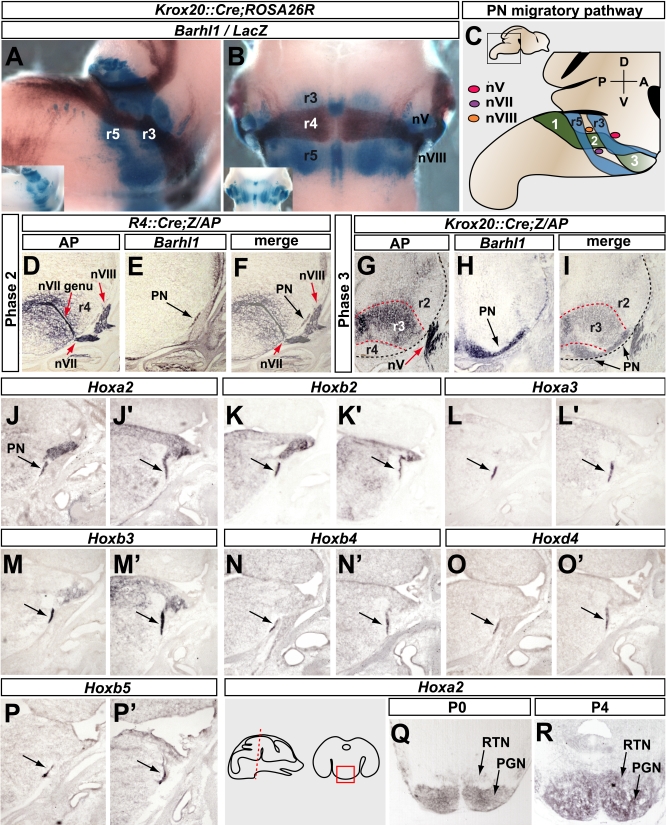
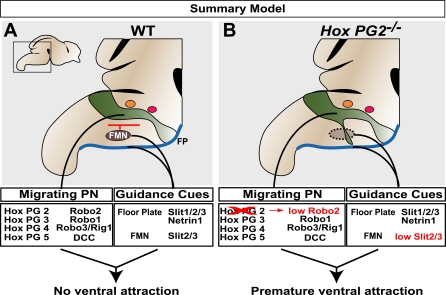
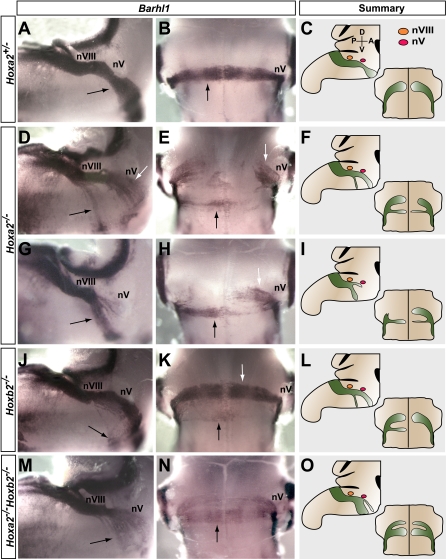
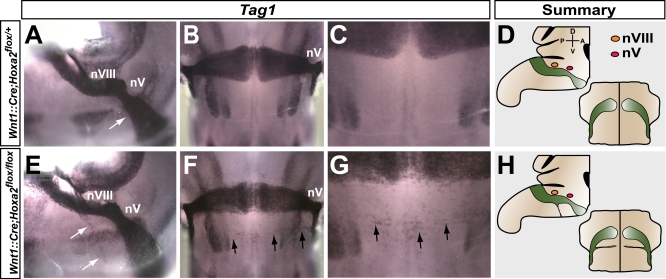
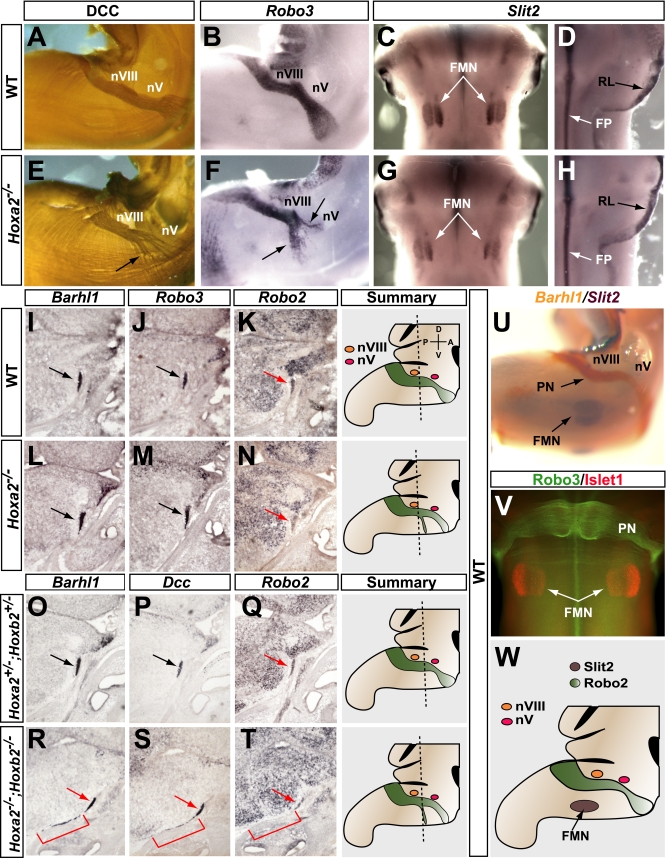
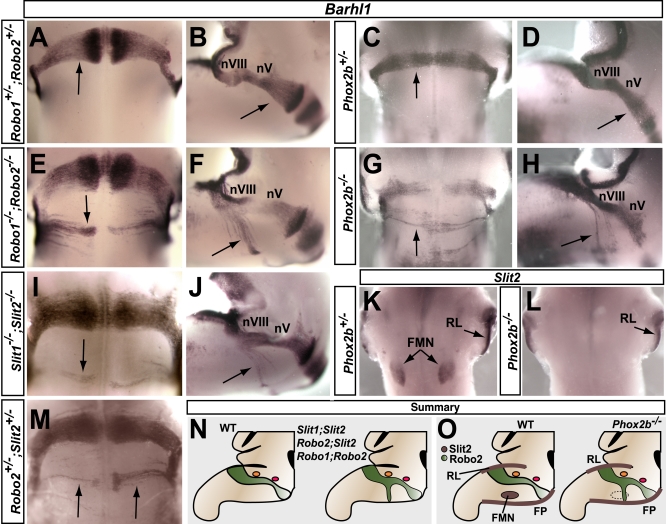
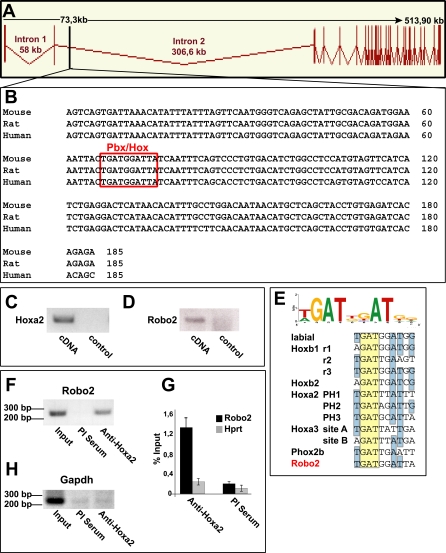
The pontine neurons (PN) represent a major source of mossy fiber projections to the cerebellum. During mouse hindbrain development, PN migrate tangentially and sequentially along both the anteroposterior (AP) and dorsoventral (DV) axes. Unlike DV migration, which is controlled by the Netrin-1/Dcc attractive pathway, little is known about the molecular mechanisms guiding PN migration along the AP axis. Here, we show that Hoxa2 and Hoxb2 are required both intrinsically and extrinsically to maintain normal AP migration of subsets of PN, by preventing their premature ventral attraction towards the midline. Moreover, the migration defects observed in Hoxa2 and Hoxb2 mutant mice were phenocopied in compound Robo1;Robo2, Slit1;Slit2, and Robo2;Slit2 knockout animals, indicating that these guidance molecules act downstream of Hox genes to control PN migration. Indeed, using chromatin immunoprecipitation assays, we further demonstrated that Robo2 is a direct target of Hoxa2 in vivo and that maintenance of high Robo and Slit expression levels was impaired in Hoxa2 mutant mice. Lastly, the analysis of Phox2b-deficient mice indicated that the facial motor nucleus is a major Slit signaling source required to prevent premature ventral migration of PN. These findings provide novel insights into the molecular control of neuronal migration from transcription factor to regulation of guidance receptor and ligand expression. Specifically, they address the question of how exposure to multiple guidance cues along the AP and DV axes is regulated at the transcriptional level and in turn translated into stereotyped migratory responses during tangential migration of neurons in the developing mammalian brain.
脑桥神经元(PN)是向小脑投射苔藓纤维的主要来源。在小鼠后脑发育过程中,PN沿前后(AP)轴和背腹(DV)轴依次进行切向迁移。与由Netrin-1/Dcc吸引通路控制的DV迁移不同,关于引导PN沿AP轴迁移的分子机制知之甚少。在这里,我们表明,Hoxa2和Hoxb2在内在和外在方面都是维持PN亚群正常AP迁移所必需的,它们通过防止PN过早地向腹侧中线吸引。此外,在Hoxa2和Hoxb2突变小鼠中观察到的迁移缺陷在复合Robo1;Robo2、Slit1;Slit2和Robo2;Slit2基因敲除动物中也有类似表现,这表明这些导向分子在Hox基因下游起作用以控制PN迁移。事实上,通过染色质免疫沉淀分析,我们进一步证明Robo2是Hoxa2在体内的直接靶点,并且在Hoxa2突变小鼠中,Robo和Slit的高表达水平维持受到损害。最后,对Phox2b缺陷小鼠的分析表明,面神经运动核是防止PN过早腹侧迁移所需的主要Slit信号来源。这些发现为从转录因子到导向受体和配体表达调控的神经元迁移分子控制提供了新的见解。具体而言,它们解决了在发育中的哺乳动物大脑中,神经元切向迁移过程中,如何在转录水平上调节沿AP轴和DV轴暴露于多种导向线索,并进而转化为定型迁移反应的问题。