Scott Ansley E, Simon Eric, Park Samuel K, Andrews Philip, Zusman David R
Department of Molecular and Cell Biology, University of California, Berkeley, CA, USA.
Mol Microbiol. 2008 Aug;69(3):724-35. doi: 10.1111/j.1365-2958.2008.06323.x. Epub 2008 Jun 28.
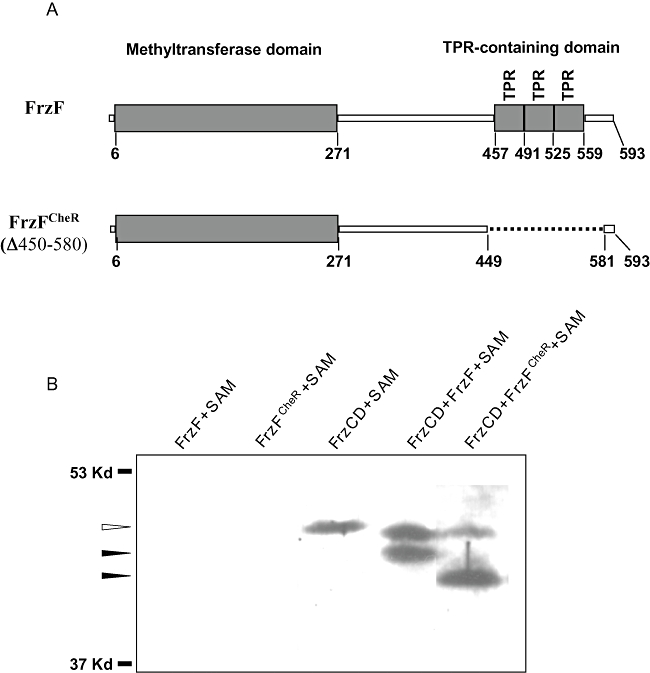
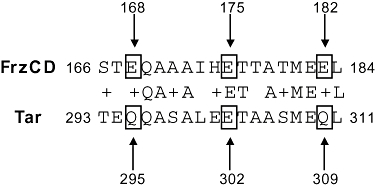
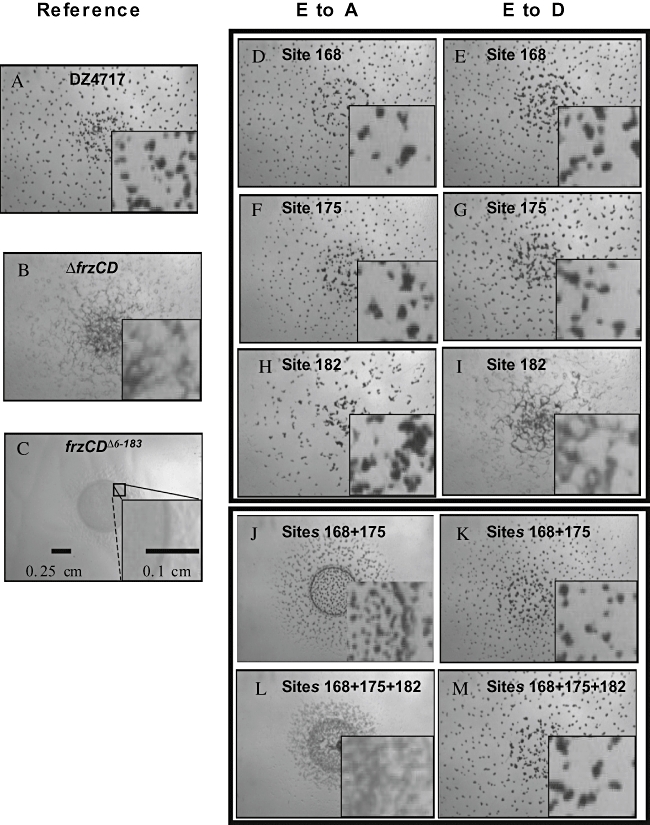
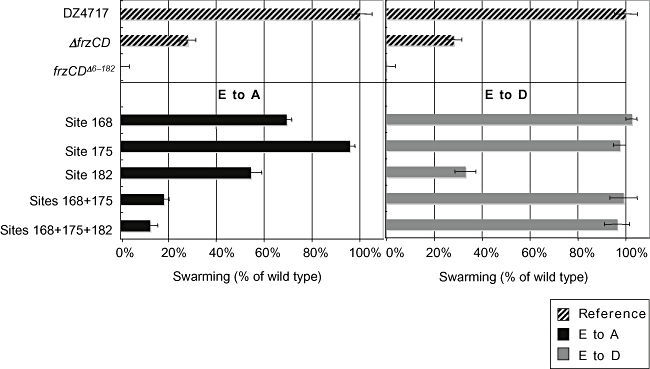
Myxococcus xanthus is a gliding bacterium with a complex life cycle that includes swarming, predation and fruiting body formation. Directed movements in M. xanthus are regulated by the Frz chemosensory system, which controls cell reversals. The Frz pathway requires the activity of FrzCD, a cytoplasmic methyl-accepting chemotaxis protein, and FrzF, a methyltransferase (CheR) containing an additional domain with three tetra trico-peptide repeats (TPRs). To investigate the role of the TPRs in FrzCD methylation, we used full-length FrzF and FrzF lacking its TPRs (FrzF(CheR)) to methylate FrzCD in vitro. FrzF methylated FrzCD on a single residue, E182, while FrzF(CheR) methylated FrzCD on three residues, E168, E175 and E182, indicating that the TPRs regulate site-specific methylation. E168 and E182 were predicted consensus methylation sites, but E175 is methylated on an HE pair. To determine the roles of these sites in vivo, we substituted each methylatable glutamate with either an aspartate or an alanine residue and determined the impact of the point mutants on single cell reversals, swarming and fruiting body formation. Single, double and triple methylation site mutants revealed that each site played a unique role in M. xanthus behaviour and that the pattern of receptor methylation determined receptor activity. This work also shows that methylation can both activate and inactivate the receptor.
黄色粘球菌是一种具有复杂生命周期的滑行细菌,其生命周期包括群体运动、捕食和子实体形成。黄色粘球菌中的定向运动受Frz化学感应系统调控,该系统控制细胞反转。Frz信号通路需要FrzCD(一种细胞质甲基接受趋化蛋白)和FrzF(一种甲基转移酶(CheR),含有一个带有三个四三肽重复序列(TPR)的额外结构域)的活性。为了研究TPR在FrzCD甲基化中的作用,我们使用全长FrzF和缺失其TPR的FrzF(FrzF(CheR))在体外对FrzCD进行甲基化。FrzF在单个残基E182上对FrzCD进行甲基化,而FrzF(CheR)在三个残基E168、E175和E182上对FrzCD进行甲基化,这表明TPR调节位点特异性甲基化。E168和E182是预测的共有甲基化位点,但E175是在一对组氨酸-谷氨酸上被甲基化。为了确定这些位点在体内的作用,我们将每个可甲基化的谷氨酸替换为天冬氨酸或丙氨酸残基,并确定点突变体对单细胞反转、群体运动和子实体形成的影响。单甲基化、双甲基化和三甲基化位点突变体表明,每个位点在黄色粘球菌的行为中都发挥着独特的作用,并且受体甲基化模式决定了受体活性。这项工作还表明,甲基化既能激活受体,也能使受体失活。