Kendall Anna, Ley Charles, Egenvall Agneta, Bröjer Johan
University Hospital of the Swedish University of Agricultural Sciences, Box 7040, SE-750 07 Uppsala, Sweden.
Acta Vet Scand. 2008 Jun 13;50(1):17. doi: 10.1186/1751-0147-50-17.
Ingestion of sand can cause colic, diarrhoea and weight loss in horses, but these signs are unspecific and can have many other causes. The amount of sand that induces disease may vary between individuals. To avoid over-diagnosing, it is important to determine the amount of sand that can be found in horses without clinical signs of gastrointestinal disease. The aim of this study was to use previously suggested parameters for establishing a radiographic diagnosis of sand colic, and compare these findings between a sand colic group and a control group.
Abdominal radiographs were obtained in 30 horses with a complaint unrelated to the gastrointestinal tract. In addition, archived abdominal radiographs of 37 clinical cases diagnosed with sand impaction were investigated. The size of the mineral opacity indicative of sand in the abdomen was measured and graded according to a previously published protocol based on height and length. Location, homogeneity, opacity and number of sand accumulations were also recorded.
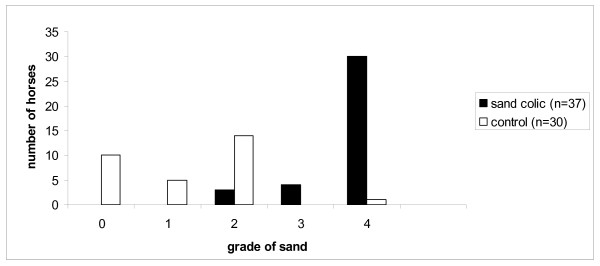
Twenty out of 30 control horses (66%) had one or more sand accumulations. In the present study; height, length and homogeneity of the accumulations were useful parameters for establishing a diagnosis of sand colic. Radiographically defined intestinal sand accumulation grades of up to 2 was a common finding in horses with no clinical signs from the gastrointestinal tract whereas most of the clinical cases had much larger grades, indicating larger sand accumulations.
Further work to establish a reliable grading system for intestinal sand content is warranted, but a previously proposed grading system based on measurements of height and length may be an alternative for easy assessment of sand accumulations in the meantime. The present study indicates that a grade 1 - 2 sand accumulation in the intestine is a frequent finding in horses. When working up a case with clinical signs from the gastrointestinal tract, one or more accumulations of this grade should not be considered the cause until other possibilities have been ruled out.
马匹摄入沙子可导致绞痛、腹泻和体重减轻,但这些症状并无特异性,且可能由许多其他原因引起。引发疾病的沙子量在个体之间可能有所不同。为避免过度诊断,确定无胃肠道疾病临床症状的马匹体内的沙子量非常重要。本研究的目的是使用先前建议的参数来建立沙积腹痛的放射学诊断,并比较沙积腹痛组和对照组之间的这些发现。
对30匹主诉与胃肠道无关的马匹进行腹部X光检查。此外,还研究了37例诊断为沙积滞的临床病例的存档腹部X光片。根据先前发表的基于高度和长度的方案,测量并分级腹部中指示沙子的矿物质不透明度的大小。还记录了沙子积聚的位置、均匀性、不透明度和数量。
30匹对照马中有20匹(66%)有一处或多处沙子积聚。在本研究中,积聚物的高度、长度和均匀性是建立沙积腹痛诊断的有用参数。在无胃肠道临床症状的马匹中,放射学定义的肠道沙子积聚等级高达2是常见发现,而大多数临床病例的等级要大得多,表明沙子积聚量更大。
有必要进一步开展工作以建立可靠的肠道沙子含量分级系统,但同时基于高度和长度测量的先前提出的分级系统可能是一种易于评估沙子积聚的替代方法。本研究表明,肠道中1 - 2级沙子积聚在马匹中很常见。在处理有胃肠道临床症状的病例时,在排除其他可能性之前,不应将一处或多处这种等级的积聚视为病因。