Temtamy Samia A, Aglan Mona S
Department of Clinical Genetics, Human Genetics and Genome Research Division, National Research Centre, El-Buhouth St., Dokki, 12311, Cairo, Egypt.
Orphanet J Rare Dis. 2008 Jun 13;3:15. doi: 10.1186/1750-1172-3-15.
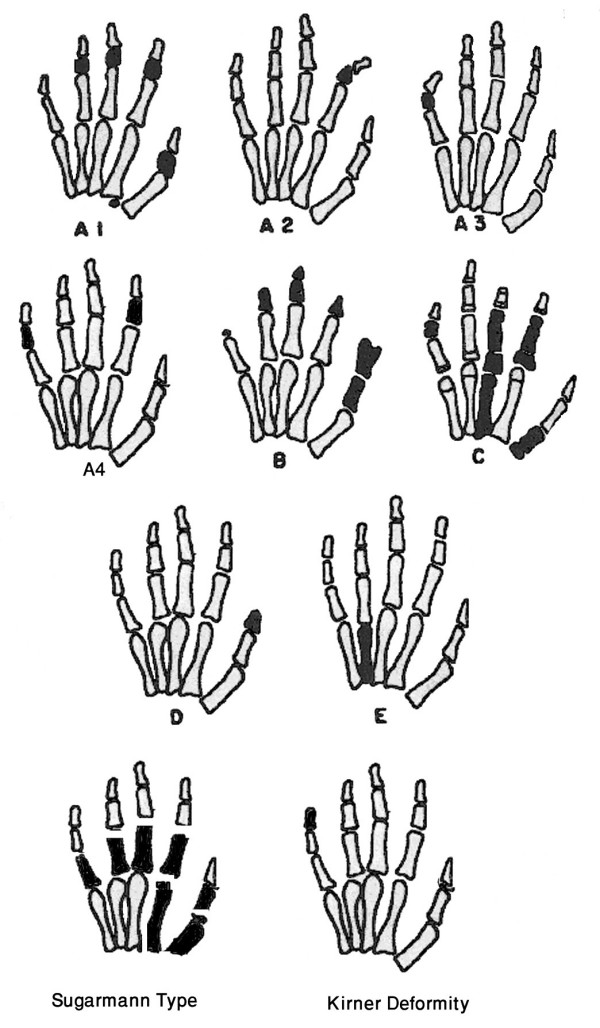
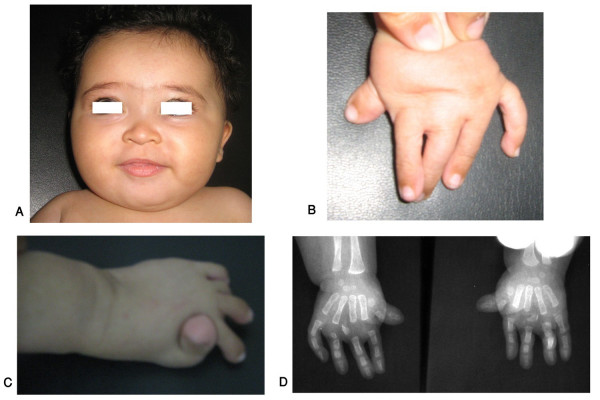
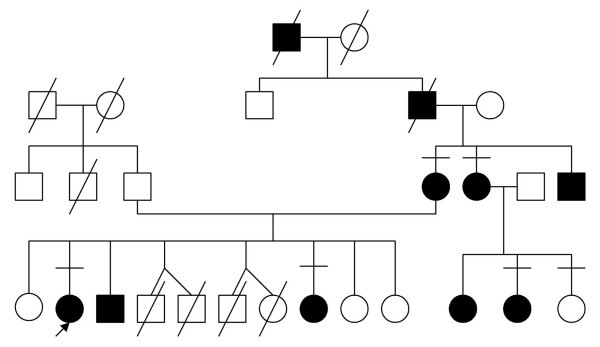
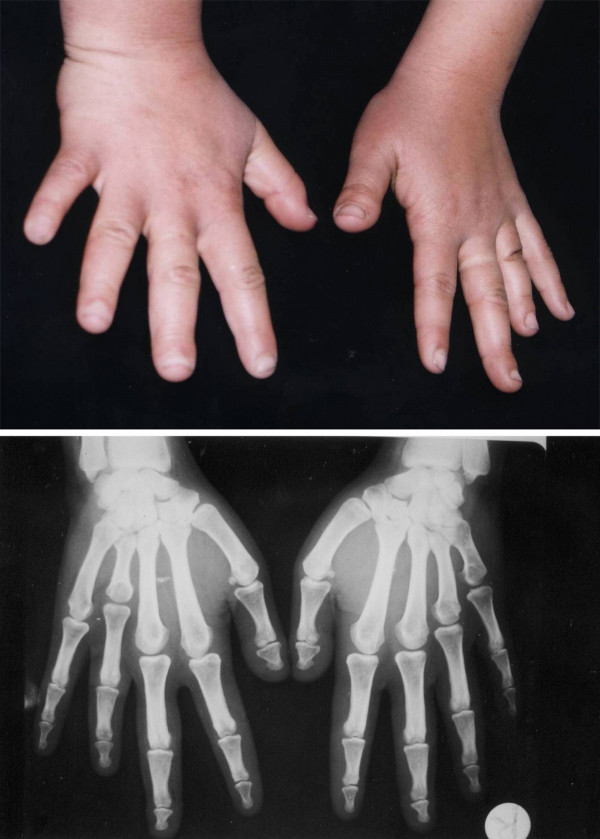
Brachydactyly ("short digits") is a general term that refers to disproportionately short fingers and toes, and forms part of the group of limb malformations characterized by bone dysostosis. The various types of isolated brachydactyly are rare, except for types A3 and D. Brachydactyly can occur either as an isolated malformation or as a part of a complex malformation syndrome. To date, many different forms of brachydactyly have been identified. Some forms also result in short stature. In isolated brachydactyly, subtle changes elsewhere may be present. Brachydactyly may also be accompanied by other hand malformations, such as syndactyly, polydactyly, reduction defects, or symphalangism. For the majority of isolated brachydactylies and some syndromic forms of brachydactyly, the causative gene defect has been identified. In isolated brachydactyly, the inheritance is mostly autosomal dominant with variable expressivity and penetrtance. Diagnosis is clinical, anthropometric and radiological. Prenatal diagnosis is usually not indicated for isolated forms of brachydactyly, but may be appropriate in syndromic forms. Molecular studies of chorionic villus samples at 11 weeks of gestation and by amniocentesis after the 14th week of gestation can provide antenatal diagnosis if the causative mutation in the family is known. The nature of genetic counseling depends both on the pattern of inheritance of the type of brachydactyly present in the family and on the presence or absence of accompanying symptoms. There is no specific management or treatment that is applicable to all forms of brachydactyly. Plastic surgery is only indicated if the brachydactyly affects hand function or for cosmetic reasons, but is typically not needed. Physical therapy and ergotherapy may ameliorate hand function. Prognosis for the brachydactylies is strongly dependent on the nature of the brachydactyly, and may vary from excellent to severely influencing hand function. If brachydactyly forms part of a syndromic entity, prognosis often depends on the nature of the associated anomalies.
短指(“短手指”)是一个通用术语,指手指和脚趾不成比例地短小,是一组以骨发育异常为特征的肢体畸形的一部分。除A3型和D型外,各种孤立性短指均较为罕见。短指既可以作为一种孤立的畸形出现,也可以作为复杂畸形综合征的一部分出现。迄今为止,已识别出许多不同形式的短指。有些形式还会导致身材矮小。在孤立性短指中,其他部位可能存在细微变化。短指也可能伴有其他手部畸形,如并指、多指、发育不全或关节粘连。对于大多数孤立性短指和一些综合征性短指形式,已确定了致病基因缺陷。在孤立性短指中,遗传方式大多为常染色体显性遗传,具有可变的表达性和外显率。诊断依靠临床、人体测量和放射学检查。对于孤立性短指形式,通常不进行产前诊断,但对于综合征性形式可能适用。如果已知家族中的致病突变,在妊娠11周时对绒毛膜绒毛样本进行分子研究以及在妊娠14周后进行羊膜穿刺术可提供产前诊断。遗传咨询的性质既取决于家族中存在的短指类型的遗传模式,也取决于是否存在伴随症状。不存在适用于所有形式短指的特定管理或治疗方法。仅在短指影响手部功能或出于美容原因时才考虑进行整形手术,但通常不需要。物理治疗和职业疗法可能会改善手部功能。短指的预后很大程度上取决于短指的性质,可能从极好到严重影响手部功能不等。如果短指是综合征实体的一部分,预后通常取决于相关异常的性质。