Liu Xianghui, Yang Jennifer W, Lynn David M
Department of Chemical and Biological Engineering, University of Wisconsin-Madison, 1415 Engineering Drive, Madison, Wisconsin 53706, USA.
Biomacromolecules. 2008 Jul;9(7):2063-71. doi: 10.1021/bm800291v. Epub 2008 Jun 20.
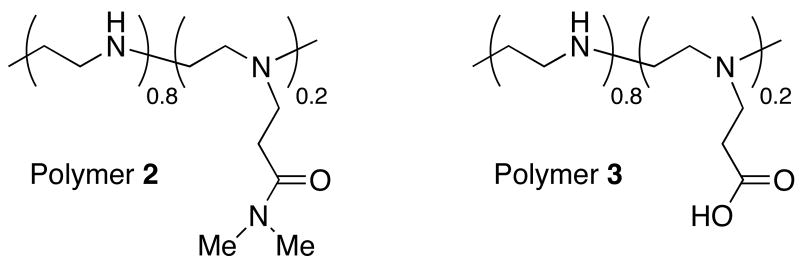
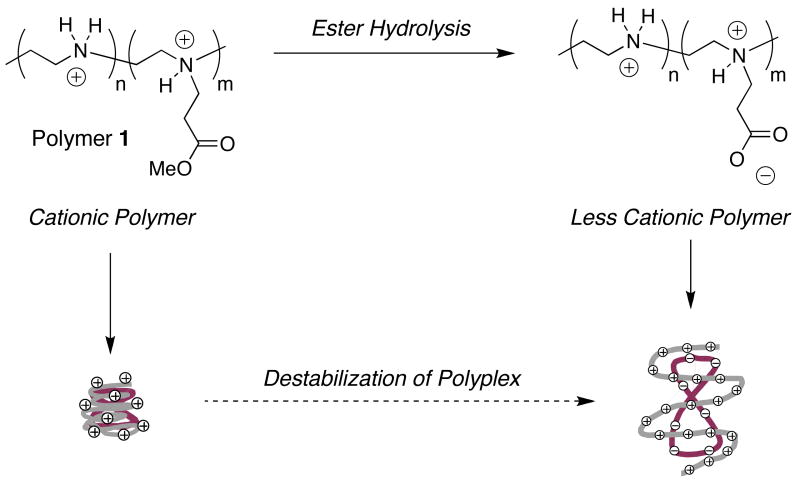
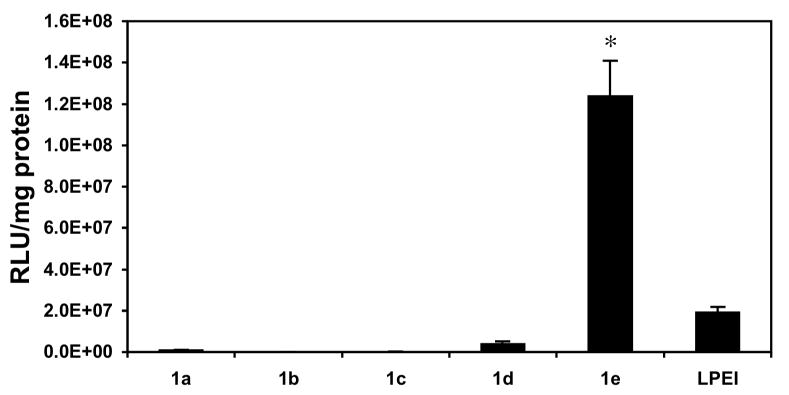
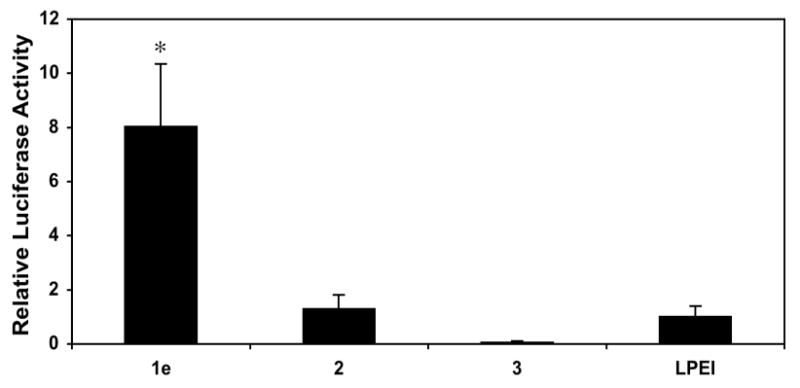
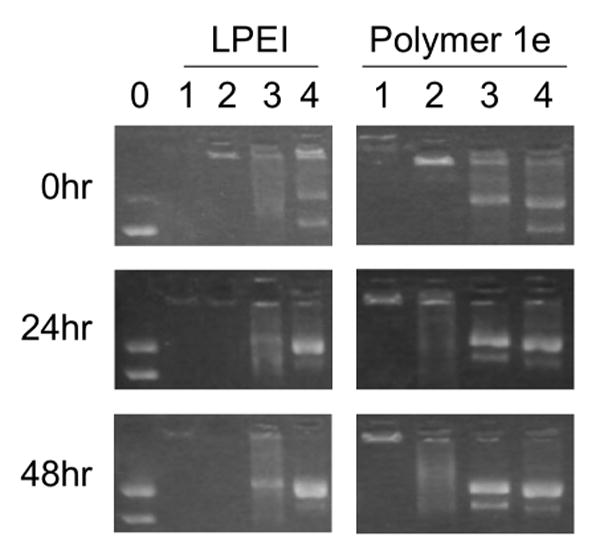
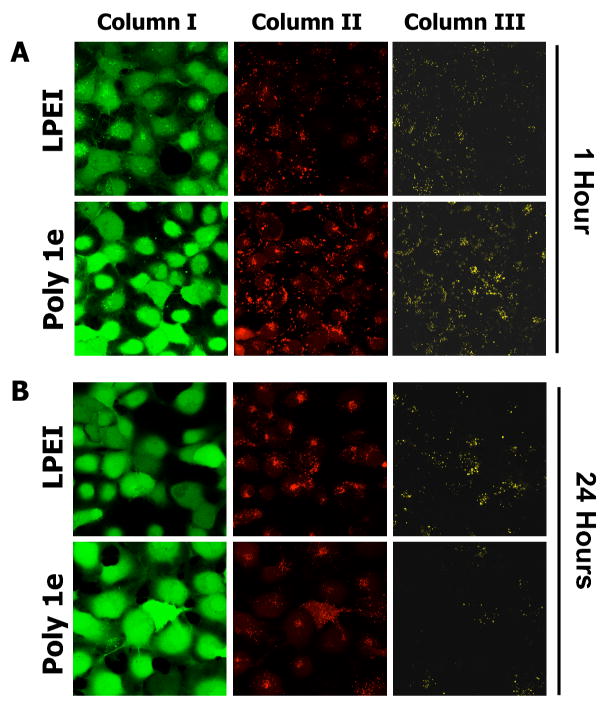
We reported recently that the addition of ester-functionalized, "charge-shifting" side chains to linear poly(ethyleneimine) (LPEI) can be used to design polyamines that promote both self-assembly and self-disassembly with DNA in aqueous environments. This investigation sought to characterize the influence of charge-shifting side chains on the ability of LPEI to mediate cell transfection and understand the extent to which increases (or decreases) in levels of transfection could be understood in terms of time-dependent changes in the net charges of these polymers. We report that the addition of "charge-shifting" side chains to LPEI leads to significant increases in levels of LPEI-mediated transfection. In particular, polymer 1e, functionalized with 20 mol % ester-functionalized side chains, mediates levels of transgene expression in vitro up to 8-fold higher than LPEI. Experiments using an amide-functionalized analog of polymer 1e demonstrated that the esters in polymer 1e play an important role in promoting increased levels of transfection. These results, in combination with the results of additional gel electrophoresis experiments, provide support for the view that increases in transfection result from time-dependent changes in the net charge of polymer 1e and the disruption of ionic interactions in polyplexes. Additional support for this view is provided by the results of confocal microscopy experiments and measurements of fluorescence resonance energy transfer, which suggest that polymer 1e promotes the disruption of polyplexes in intracellular environments effectively. The approach reported here provides a means of addressing one important "late-stage" obstacle to polyplex-mediated transfection (polyplex unpackaging). If integrated successfully with methods that have been developed to address other important barriers to transfection, this general approach could lead to the development of multifunctional polyplexes that mimic more effectively the range of functions of viruses as agents for the delivery of DNA.
我们最近报道,将酯官能化的“电荷转移”侧链添加到线性聚(乙烯亚胺)(LPEI)中,可用于设计在水性环境中促进与DNA自组装和自拆卸的多胺。本研究旨在表征电荷转移侧链对LPEI介导细胞转染能力的影响,并了解转染水平的增加(或减少)在多大程度上可以根据这些聚合物净电荷的时间依赖性变化来理解。我们报告称,向LPEI添加“电荷转移”侧链会导致LPEI介导的转染水平显著提高。特别是,用20摩尔%酯官能化侧链官能化的聚合物1e,在体外介导的转基因表达水平比LPEI高8倍。使用聚合物1e的酰胺官能化类似物进行的实验表明,聚合物1e中的酯在促进转染水平提高方面起着重要作用。这些结果与其他凝胶电泳实验的结果相结合,为以下观点提供了支持:转染的增加是由于聚合物1e净电荷的时间依赖性变化以及多聚体中离子相互作用的破坏。共聚焦显微镜实验结果和荧光共振能量转移测量为这一观点提供了额外支持,这些结果表明聚合物1e有效地促进了细胞内环境中多聚体的破坏。本文报道的方法提供了一种解决多聚体介导转染的一个重要“后期”障碍(多聚体解包)的手段。如果成功地与已开发的解决其他重要转染障碍的方法相结合,这种通用方法可能会导致开发出更有效地模拟病毒作为DNA递送剂功能范围的多功能多聚体。