Vacca Rosa A, Giannattasio Sergio, Capitani Guido, Marra Ersilia, Christen Philipp
Institute of Biomembranes and Bioenergetics, CNR, Via Amendola 165/A, I-70126 Bari, Italy.
BMC Biochem. 2008 Jun 19;9:17. doi: 10.1186/1471-2091-9-17.
The pyridoxal-5'-phosphate (PLP)-dependent or vitamin B6-dependent enzymes that catalyze manifold reactions in the metabolism of amino acids belong to no fewer than four evolutionarily independent protein families. The multiple evolutionary origin and the essential mechanistic role of PLP in these enzymes argue for the cofactor having arrived on the evolutionary scene before the emergence of the respective apoenzymes and having played a dominant role in the molecular evolution of the B6 enzyme families. Here we report on an attempt to re-enact the emergence of a PLP-dependent protoenzyme. The starting protein was pancreatic ribonuclease A (RNase), in which active-site Lys41 or Lys7 readily form a covalent adduct with PLP.
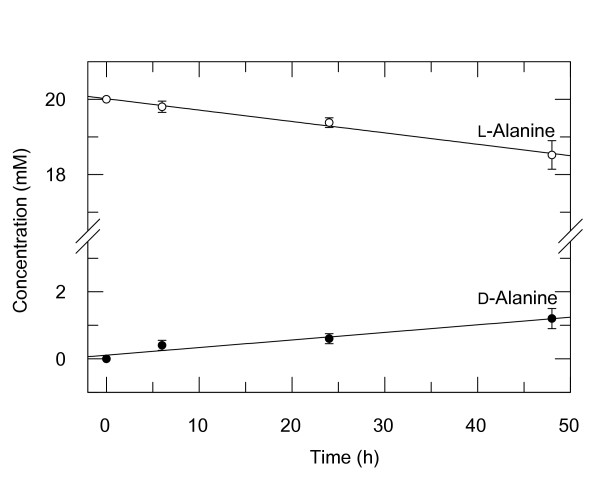
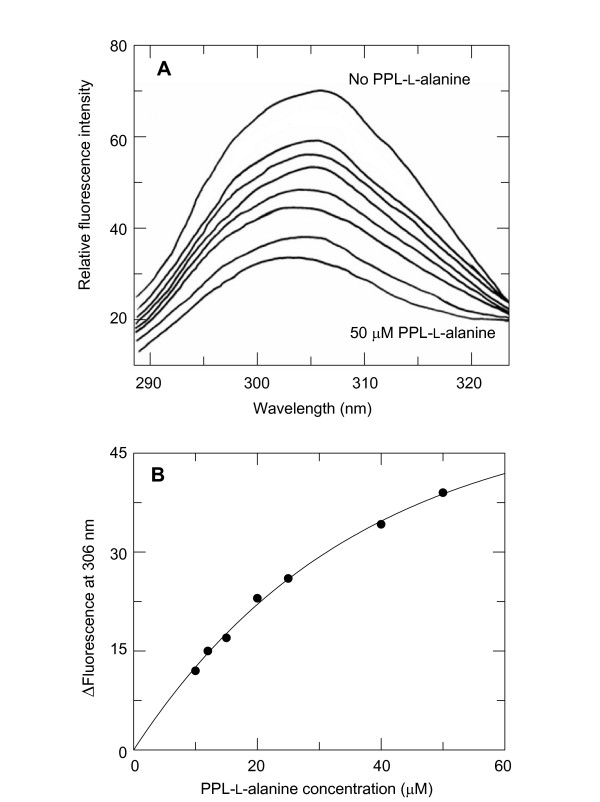
We screened the PLP adduct of wild-type RNase and two variant RNases (K7R and K41R) for catalytic effects toward L- and D-amino acids. RNase(K41R)-PLP, in which the cofactor is bound through an imine linkage to Lys7, qualifies for a model proto-B6 enzyme by the following criteria: (1) covalent linkage of PLP (internal aldimine); (2) catalytic activity toward amino acids that depends on formation of an imine linkage with the substrate (external aldimine); (3) adjoining binding sites for the cofactor and amino acid moiety that facilitate the transimination reaction of the internal to the external aldimine and stabilize the resulting noncovalent complex of the coenzyme-substrate adduct with the protein; (4) reaction specificity, the only detectable reactions being racemization of diverse amino acids and beta-decarboxylation of L-aspartate; (5) acceleration factors for racemization and beta-decarboxylation of >103 over and above that of PLP alone; (6) ribonuclease activity that is 103-fold lower than that of wild-type RNase, attenuation of a pre-existing biological activity being indispensable for the further evolution as a PLP-dependent protoenzyme.
A single amino acid substitution (Lys41Arg) and covalent binding of PLP to active-site Lys7 suffice to turn pancreatic ribonuclease A into a protein catalyst that complies with all plausible criteria for a proto-B6 enzyme. The study thus retraces in a model system what may be considered the committed step in the molecular evolution of a potential ancestor of a B6 enzyme family.
催化氨基酸代谢中多种反应的磷酸吡哆醛(PLP)依赖性或维生素B6依赖性酶属于不少于四个进化上独立的蛋白质家族。PLP在这些酶中的多重进化起源和基本机制作用表明,该辅因子在相应的脱辅基酶出现之前就已出现在进化舞台上,并在B6酶家族的分子进化中发挥了主导作用。在此,我们报告了一项重现PLP依赖性原酶出现过程的尝试。起始蛋白质是胰腺核糖核酸酶A(RNase),其活性位点的赖氨酸41(Lys41)或赖氨酸7(Lys7)很容易与PLP形成共价加合物。
我们筛选了野生型RNase以及两种变体RNase(K7R和K41R)的PLP加合物对L-氨基酸和D-氨基酸的催化作用。RNase(K41R)-PLP中,辅因子通过亚胺键与Lys7结合,根据以下标准符合原B6酶模型:(1)PLP的共价连接(内部醛亚胺);(2)对氨基酸的催化活性取决于与底物形成亚胺键(外部醛亚胺);(3)辅因子和氨基酸部分相邻的结合位点,有利于内部醛亚胺向外部醛亚胺的转亚胺化反应,并稳定辅酶-底物加合物与蛋白质形成的非共价复合物;(4)反应特异性,唯一可检测到的反应是多种氨基酸的消旋化和L-天冬氨酸的β-脱羧反应;(5)消旋化和β-脱羧反应的加速因子比单独的PLP高出103倍以上;(6)核糖核酸酶活性比野生型RNase低103倍,作为PLP依赖性原酶进一步进化,预先存在的生物活性减弱是必不可少的。
单个氨基酸取代(Lys41Arg)以及PLP与活性位点Lys7的共价结合足以将胰腺核糖核酸酶A转变为一种蛋白质催化剂,该催化剂符合原B6酶的所有合理标准。因此,这项研究在一个模型系统中追溯了在B6酶家族潜在祖先分子进化中可能被视为关键步骤的过程。