Tenenbaum Alexander, Boyko Valentina, Fisman Enrique Z, Goldenberg Ilan, Adler Yehuda, Feinberg Micha S, Motro Michael, Tanne David, Shemesh Joseph, Schwammenthal Ehud, Behar Solomon
Cardiac Rehabilitation Institute, Chaim Sheba Medical Center, Tel-Hashomer, affiliated with Sackler Faculty of Medicine, Tel-Aviv University, Tel-Aviv, Israel.
Cardiovasc Diabetol. 2008 Jun 19;7:18. doi: 10.1186/1475-2840-7-18.
Epidemiologic studies have suggested that hypertriglyceridemia and insulin resistance are related to the development of colon cancer. Nuclear peroxisome proliferator-activated receptors (PPAR), which play a central role in lipid and glucose metabolism, had been hypothesized as being involved in colon cancerogenesis. In animal studies the lipid-lowering PPAR ligand bezafibrate suppressed colonic tumors. However, the effect of bezafibrate on colon cancer development in humans is unknown. Therefore, we proposed to investigate a possible preventive effect of bezafibrate on the development of colon cancer in patients with coronary artery disease during a 6-year follow-up.
Our population included 3011 patients without any cancer diagnosis who were enrolled in the randomized, double blind Bezafibrate Infarction Prevention (BIP) Study. The patients received either 400 mg of bezafibrate retard (1506 patients) or placebo (1505 patients) once a day. Cancer incidence data were obtained by matching a subject's identification numbers with the National Cancer Registry. Each matched record was checked for correct identification.
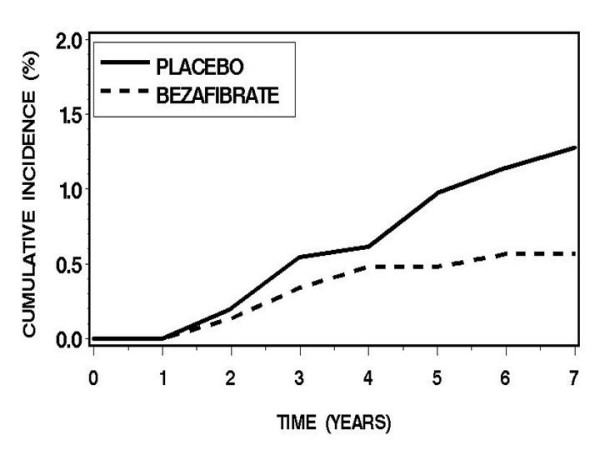
Development of new cancer (all types) was recorded in 177 patients: in 79 (5.25%) patients from the bezafibrate group vs. 98 (6.51%) from the placebo group. Development of colon cancer was recorded in 25 patients: in 8 (0.53%) patients from the bezafibrate group vs. 17 (1.13%) from the placebo group, (Fisher's exact test: one side p = 0.05; two side p = 0.07). A difference in the incidence of cancer was only detectable after a 4 year lag and progressively increased with continued follow-up. On multivariable analysis the colon cancer risk in patients who received bezafibrate tended to be lower with a hazard ratio of 0.47 and 95% confidence interval 0.2-1.1.
Our data, derived from patients with coronary artery disease, support the hypothesis regarding a possible preventive effect of bezafibrate on the development of colon cancer.
流行病学研究表明,高甘油三酯血症和胰岛素抵抗与结肠癌的发生有关。核过氧化物酶体增殖物激活受体(PPAR)在脂质和葡萄糖代谢中起核心作用,已被假设参与结肠癌的发生。在动物研究中,降血脂的PPAR配体苯扎贝特可抑制结肠肿瘤。然而,苯扎贝特对人类结肠癌发生的影响尚不清楚。因此,我们建议在6年的随访中研究苯扎贝特对冠心病患者结肠癌发生的可能预防作用。
我们的研究对象包括3011例未被诊断患有任何癌症的患者,他们参加了随机、双盲的苯扎贝特心肌梗死预防(BIP)研究。患者每天接受400毫克缓释苯扎贝特(1506例患者)或安慰剂(1505例患者)。通过将受试者的识别号码与国家癌症登记处进行匹配来获得癌症发病率数据。对每条匹配记录进行正确识别检查。
177例患者出现新发癌症(所有类型):苯扎贝特组79例(5.25%),安慰剂组98例(6.51%)。25例患者被记录为患结肠癌:苯扎贝特组8例(0.53%),安慰剂组17例(1.13%),(Fisher精确检验:单侧p = 0.05;双侧p = 0.07)。癌症发病率的差异仅在4年的滞后时间后才检测到,并随着持续随访而逐渐增加。多变量分析显示,接受苯扎贝特治疗的患者患结肠癌的风险倾向于较低,风险比为0.47,95%置信区间为0.2 - 1.1。
我们从冠心病患者中获得的数据支持了苯扎贝特对结肠癌发生可能具有预防作用的假设。