Ying Lihua, Sarwal Minnie
Department of Pediatrics, Stanford University, 300 Pasteur Drive, Stanford, CA 94305, USA.
Pediatr Nephrol. 2009 Sep;24(9):1643-59; quiz 1655, 1659. doi: 10.1007/s00467-008-0808-z. Epub 2008 Jun 21.
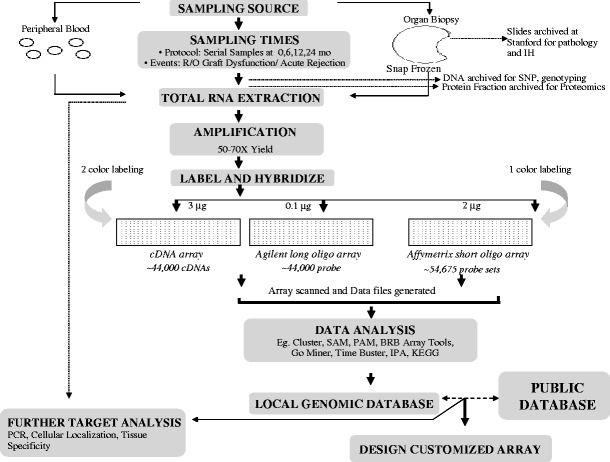
Microarray technologies have both fascinated and frustrated the transplant community since their introduction roughly a decade ago. Fascination arose from the possibility offered by the technology to gain a profound insight into the cellular response to immunogenic injury and the potential that this genomic signature would be indicative of the biological mechanism by which that stress was induced. Frustrations have arisen primarily from technical factors such as data variance, the requirement for the application of advanced statistical and mathematical analyses, and difficulties associated with actually recognizing signature gene-expression patterns and discerning mechanisms. To aid the understanding of this powerful tool, its versatility, and how it is dramatically changing the molecular approach to biomedical and clinical research, this teaching review describes the technology and its applications, as well as the limitations and evolution of microarrays, in the field of organ transplantation. Finally, it calls upon the attention of the transplant community to integrate into multidisciplinary teams, to take advantage of this technology and its expanding applications in unraveling the complex injury circuits that currently limit transplant survival.
大约十年前微阵列技术问世以来,它既让移植界为之着迷,又让其感到沮丧。着迷源于该技术提供了深入了解细胞对免疫原性损伤反应的可能性,以及这种基因组特征可能指示诱导该应激的生物学机制的潜力。沮丧主要源于技术因素,如数据差异、应用先进统计和数学分析的要求,以及实际识别特征基因表达模式和辨别机制的困难。为了帮助理解这个强大的工具、它的多功能性以及它如何极大地改变生物医学和临床研究的分子方法,这篇教学综述描述了该技术及其应用,以及微阵列在器官移植领域的局限性和发展。最后,它呼吁移植界融入多学科团队,利用这项技术及其不断扩展的应用来揭示目前限制移植存活的复杂损伤通路。