Shen Ronglai, Chinnaiyan Arul M, Ghosh Debashis
Department of Epidemiology and Biostatistics, Memorial Sloan-Kettering Cancer Center, New York, NY, USA.
BMC Med Genomics. 2008 Jun 27;1:28. doi: 10.1186/1755-8794-1-28.
A recent study has shown high concordance of several breast-cancer gene signatures in predicting disease recurrence despite minimal overlap of the gene lists. It raises the question if there are common themes underlying such prediction concordance that are not apparent on the individual gene-level. We therefore studied the similarity of these gene-signatures on the basis of their functional annotations.
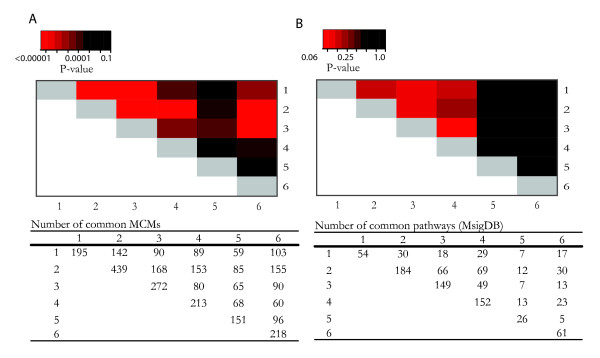
We found the signatures did not identify the same set of genes but converged on the activation of a similar set of oncogenic and clinically-relevant pathways. A clear and consistent pattern across the four breast cancer signatures is the activation of the estrogen-signaling pathway. Other common features include BRCA1-regulated pathway, reck pathways, and insulin signaling associated with the ER-positive disease signatures, all providing possible explanations for the prediction concordance.
This work explains why independent breast cancer signatures that appear to perform equally well at predicting patient prognosis show minimal overlap in gene membership.
最近一项研究表明,尽管基因列表重叠很少,但几种乳腺癌基因特征在预测疾病复发方面具有高度一致性。这就提出了一个问题,即是否存在这种预测一致性背后的共同主题,而这些主题在单个基因层面并不明显。因此,我们基于功能注释研究了这些基因特征的相似性。
我们发现这些特征并未识别出相同的基因集,但在激活一组相似的致癌和临床相关通路方面趋于一致。四种乳腺癌特征中一个清晰且一致的模式是雌激素信号通路的激活。其他共同特征包括与雌激素受体阳性疾病特征相关的BRCA1调节通路、reck通路和胰岛素信号通路,所有这些都为预测一致性提供了可能的解释。
这项工作解释了为什么在预测患者预后方面表现同样出色的独立乳腺癌特征在基因成员上重叠很少。