Falster Kathleen, Gelgor Linda, Shaik Ansari, Zablotska Iryna, Prestage Garrett, Grierson Jeffrey, Thorpe Rachel, Pitts Marian, Anderson Jonathan, Chuah John, Mulhall Brian, Petoumenos Kathy, Kelleher Anthony, Law Matthew
National Centre in HIV Epidemiology and Clinical Research, University of New South Wales, Sydney, NSW 2010, Australia.
Sex Health. 2008 Jun;5(2):141-54. doi: 10.1071/sh07082.
To determine if there were any differences in antiretroviral treatment (ART) use across the three eastern states of Australia, New South Wales (NSW), Victoria and Queensland, during the period 1997 to 2006.
We used data from a clinic-based cohort, the Australian HIV Observational Database (AHOD), to determine the proportion of HIV-infected patients on ART in selected clinics in each state and the proportion of treated patients with an undetectable viral load. Data from the national Highly Specialised Drugs program and AHOD were used to estimate total numbers of individuals on ART and the proportion of individuals living with HIV on ART nationally and by state. Data from the HIV Futures Survey and the Gay Community Periodic Survey were used to determine the proportion of community-based men who have sex with men on ART. The proportion of patients with primary HIV infection (PHI) who commenced ART within 1 year of diagnosis was obtained from the Acute Infection and Early Disease Research Program (AIEDRP) CORE01 protocol and Primary HIV and Early Disease Research: Australian Cohort (PHAEDRA) cohorts.
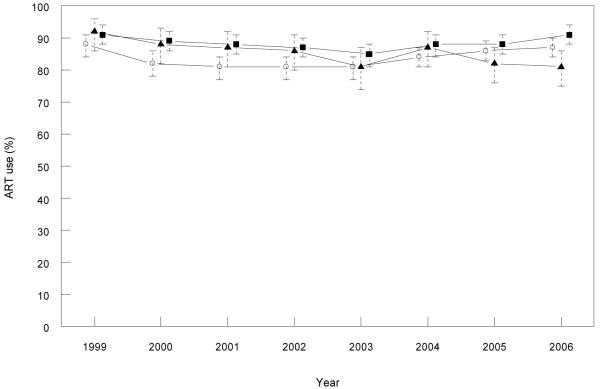
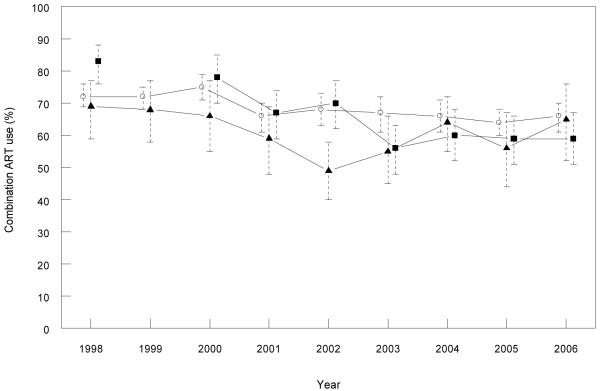
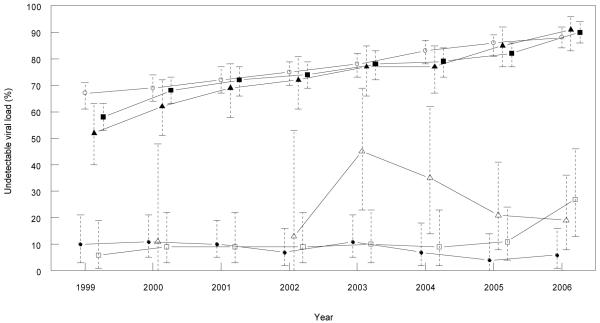
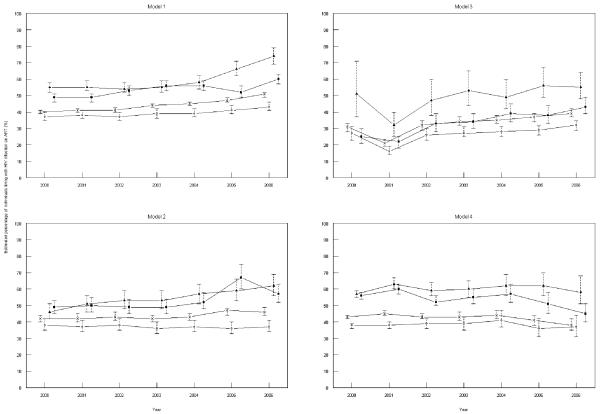
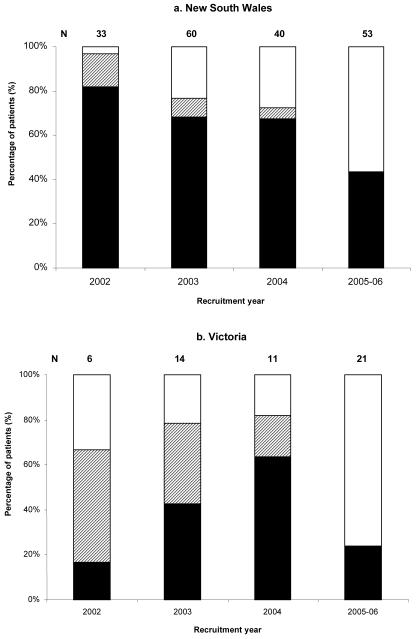
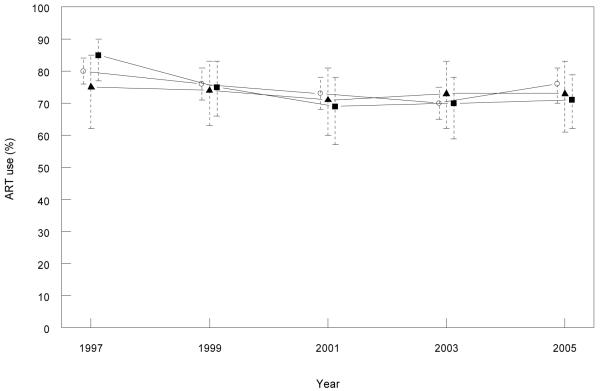
We estimated that the numbers of individuals on ART increased from 3181 to 4553 in NSW, 1309 to 1926 in Victoria and 809 to 1615 in Queensland between 2000 and 2006. However, these numbers may reflect a lower proportion of individuals living with HIV on ART in NSW compared with the other states (37% compared with 49 and 55% in 2000). We found similar proportions of HIV-positive men who have sex with men participants were on ART in all three states over the study period in the clinic-based AHOD cohort (81-92%) and two large, community-based surveys in Australia (69-85% and 49-83%). Similar proportions of treated patients had an undetectable viral load across the three states, with a consistently increasing trend over time observed in all states. We found that more PHI patients commenced treatment in the first year following HIV diagnosis in NSW compared with Victoria; however, the sample size was very small.
For the most part, patterns of ART use were similar across NSW, Victoria and Queensland using a range of available data from cohort studies, community surveys and national prescription databases in Australia. However, there may be a lower proportion of individuals living with HIV on ART in NSW compared with the other states, and there is some indication of a more aggressive treatment approach with PHI patients in NSW compared with Victoria.
确定1997年至2006年期间,澳大利亚东部三个州新南威尔士州(NSW)、维多利亚州和昆士兰州在抗逆转录病毒治疗(ART)的使用上是否存在差异。
我们使用了基于诊所的队列数据,即澳大利亚艾滋病毒观察数据库(AHOD),来确定每个州选定诊所中接受ART治疗的艾滋病毒感染患者比例以及病毒载量检测不到的接受治疗患者比例。来自国家高度专业化药物项目和AHOD的数据用于估计全国和各州接受ART治疗的个体总数以及艾滋病毒感染者接受ART治疗的比例。艾滋病毒未来调查和同性恋社区定期调查的数据用于确定社区中男男性行为者接受ART治疗的比例。从急性感染和早期疾病研究项目(AIEDRP)CORE01方案以及原发性艾滋病毒和早期疾病研究:澳大利亚队列(PHAEDRA)队列中获取原发性艾滋病毒感染(PHI)患者在诊断后1年内开始接受ART治疗的比例。
我们估计,在2000年至2006年期间,新南威尔士州接受ART治疗的人数从3181人增加到4553人,维多利亚州从1309人增加到1926人,昆士兰州从809人增加到1615人。然而,这些数字可能反映出与其他州相比,新南威尔士州接受ART治疗的艾滋病毒感染者比例较低(2000年为37%,而其他州为49%和55%)。我们发现在基于诊所的AHOD队列研究期间以及澳大利亚两项大型社区调查中,所有三个州的男男性行为艾滋病毒阳性参与者接受ART治疗的比例相似(81%-92%)(社区调查中为69%-85%和49%-83%)。三个州接受治疗的患者中病毒载量检测不到的比例相似,且所有州均观察到随时间持续上升的趋势。我们发现,与维多利亚州相比,新南威尔士州更多的PHI患者在艾滋病毒诊断后的第一年开始接受治疗;然而,样本量非常小。
总体而言,利用澳大利亚队列研究、社区调查和国家处方数据库中的一系列可用数据,新南威尔士州、维多利亚州和昆士兰州在ART使用模式上相似。然而,与其他州相比,新南威尔士州接受ART治疗的艾滋病毒感染者比例可能较低,并且有迹象表明,与维多利亚州相比,新南威尔士州对PHI患者采取了更积极的治疗方法。