Kirby Institute (formerly the National Centre in HIV Epidemiology and Clinical Research), Sydney, NSW, Australia.
BMC Public Health. 2011 Apr 19;11:247. doi: 10.1186/1471-2458-11-247.
In Australia, HIV is concentrated in men who have sex with men (MSM) and rates have increased steadily over the past ten years. Health promotion strategies should ideally be informed by an understanding of both the prevalence of the factors being modified, as well as the size of the risk that they confer. We undertook an analysis of the potential population impact and cost saving that would likely result from modifying key HIV risk factors among men who have sex with men (MSM) in Sydney, Australia.
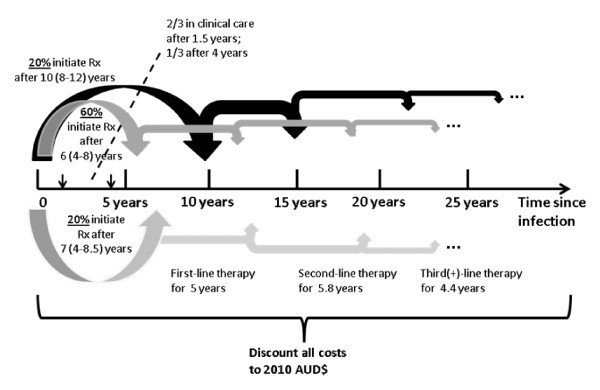
Proportional hazard analyses were used to examine the association between sexual behaviours in the last six months and sexually transmissible infections on HIV incidence in a cohort of 1426 HIV-negative MSM who were recruited primarily from community-based sources between 2001 and 2004 and followed to mid-2007. We then estimated the proportion of HIV infections that would be prevented if specific factors were no longer present in the population, using a population attributable risk (PAR) method which controls for confounding among factors. We also calculated the average lifetime healthcare costs incurred by the HIV infections associated with specific factors by estimating costs associated with clinical care and treatment following infection and discounting at 3% (1% and 5% sensitivity) to present value.
Unprotected anal intercourse (UAI) with a known HIV-positive partner was reported by 5% of men, the hazard ratio (HR) was 16.1 (95%CI:6.4-40.5), the PAR was 34% (95%CI:24-44%) and the average lifetime HIV-related healthcare costs attributable to UAI with HIV-positive partners were $AUD102 million (uncertainty range: $93-114 m). UAI with unknown HIV status partners was reported by 25% of men, the HR was 4.4 (95%CI:1.8-11.2), the PAR was 33% (95%CI:26-42%) and the lifetime incurred costs were $AUD99 million. Anal warts prevalence was 4%, the HR was 5.2 (95%CI:2.4-11.2), the PAR was 13% (95%CI:9-19%) and the lifetime incurred costs were $AUD39 million.
Our analysis has found that although UAI with an HIV-positive sexual partner is a relatively low-prevalence behaviour (reported by 5% of men), if this behaviour was not present in the population, the number of infections would be reduced by one third. No other single behaviour or sexually transmissible infections contributes to a greater proportion of infections and HIV-related healthcare costs.
在澳大利亚,艾滋病毒主要集中在男男性行为者(MSM)中,过去十年中发病率稳步上升。健康促进策略理想情况下应基于对正在修改的因素的普遍性以及它们带来的风险大小的理解。我们对悉尼的男男性行为者(MSM)中的关键艾滋病毒风险因素进行了分析,以评估对人口的潜在影响和节省成本。
我们使用比例风险分析来检查在 2001 年至 2004 年间主要从社区招募的 1426 名 HIV 阴性 MSM 队列中,过去六个月的性行为与性传播感染之间与 HIV 发病率之间的关联,该队列随访至 2007 年年中。然后,我们使用人群归因风险(PAR)方法来估计,如果人群中不再存在特定因素,将会预防多少比例的 HIV 感染,该方法控制了因素之间的混杂。我们还通过估计与感染后临床护理和治疗相关的成本并贴现至当前值(3%(1%和 5%的敏感性)来计算与特定因素相关的 HIV 感染相关的终生医疗保健成本。
5%的男性报告与已知 HIV 阳性伴侣发生无保护的肛交(UAI),风险比(HR)为 16.1(95%CI:6.4-40.5),PAR 为 34%(95%CI:24-44%),与 HIV 阳性伴侣发生 UAI 相关的终生 HIV 相关医疗保健成本为 1.02 亿澳元(不确定性范围:93-1.14 亿澳元)。25%的男性报告与未知 HIV 状况的伴侣发生 UAI,HR 为 4.4(95%CI:1.8-11.2),PAR 为 33%(95%CI:26-42%),终生费用为 9900 万澳元。肛门疣的患病率为 4%,HR 为 5.2(95%CI:2.4-11.2),PAR 为 13%(95%CI:9-19%),终生费用为 3900 万澳元。
我们的分析发现,尽管与 HIV 阳性性伴侣发生 UAI 是一种相对低流行的行为(5%的男性报告),但如果这种行为在人群中不存在,感染人数将减少三分之一。没有其他单一行为或性传播感染导致更大比例的感染和与 HIV 相关的医疗保健成本。