Hashimoto Kunihiko, Noguchi Sanai, Morimoto Yasuhiko, Hamada Shinichi, Wasada Kenshi, Imai Shiro, Murata Yuji, Kasayama Soji, Koga Masafumi
Department of Medicine, Aizenbashi Hospital, Osaka, Japan.
Diabetes Care. 2008 Oct;31(10):1945-8. doi: 10.2337/dc08-0352. Epub 2008 Jul 3.
A1C levels have been shown to be elevated in relation to glycemia in late pregnancy, although the precise mechanisms remain undetermined. We hypothesized that iron deficiency is involved in the A1C increase in late pregnancy.
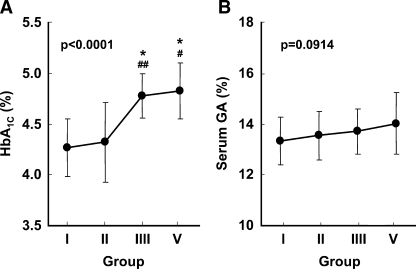
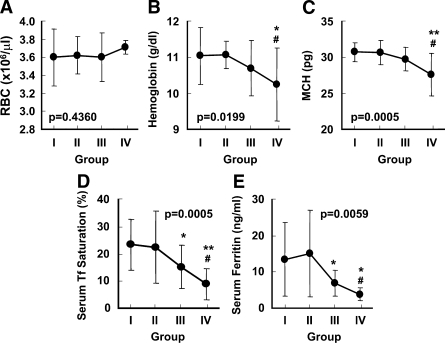
In study 1, A1C, serum glycated albumin, erythrocyte indexes, and iron metabolism indexes were determined in 47 nondiabetic pregnant women not receiving iron supplementation who were divided into four groups according to gestational period (group I, 21-24 weeks; group II, 25-28 weeks; group III, 29-32 weeks; and group IV, 33-36 weeks). In study 2, these determinants were obtained at two gestational periods (20-23 weeks and 32-33 weeks) in 17 nondiabetic pregnant women.
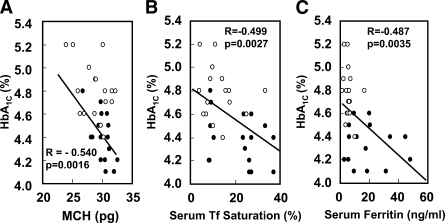
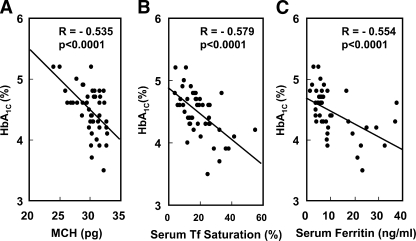
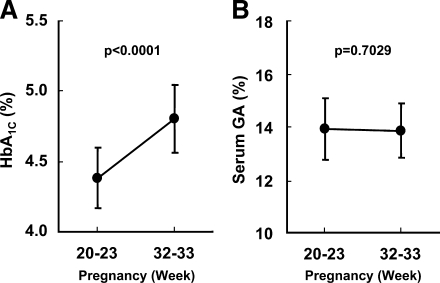
In study 1, A1C levels were higher in groups III and IV than those in groups I and II, whereas serum glycated albumin levels were not different among these four groups. Hemoglobin, mean corpuscular hemoglobin (MCH), serum transferrin saturation, and serum ferritin were lower in groups III and IV. A1C levels were negatively correlated with MCH, serum transferrin saturation, and serum ferritin. In study 2, A1C levels were significantly increased at gestational weeks 32-33 from those at weeks 20-23, whereas serum glycated albumin levels did not differ between the two gestational periods. MCH, serum transferrin saturation, and serum ferritin were decreased at gestational weeks 32-33. A1C levels showed a negative correlation with MCH, serum transferrin saturation, and serum ferritin.
A1C levels were elevated in late pregnancy owing to iron deficiency. Serum glycated albumin may offer a better index for monitoring glycemic control in pregnancy.
尽管确切机制尚不清楚,但已表明妊娠晚期糖化血红蛋白(A1C)水平与血糖水平相关且有所升高。我们推测缺铁与妊娠晚期A1C升高有关。
在研究1中,对47名未接受铁补充剂的非糖尿病孕妇进行了A1C、血清糖化白蛋白、红细胞指标和铁代谢指标的测定,这些孕妇根据孕周分为四组(I组,21 - 24周;II组,25 - 28周;III组,29 - 32周;IV组,33 - 36周)。在研究2中,对17名非糖尿病孕妇在两个孕周(20 - 23周和32 - 33周)进行了这些指标的测定。
在研究1中,III组和IV组的A1C水平高于I组和II组,而这四组的血清糖化白蛋白水平无差异。III组和IV组的血红蛋白、平均红细胞血红蛋白含量(MCH)、血清转铁蛋白饱和度和血清铁蛋白较低。A1C水平与MCH、血清转铁蛋白饱和度和血清铁蛋白呈负相关。在研究2中,32 - 33周时的A1C水平较20 - 23周时显著升高,而两个孕周的血清糖化白蛋白水平无差异。32 - 33周时MCH、血清转铁蛋白饱和度和血清铁蛋白降低。A1C水平与MCH、血清转铁蛋白饱和度和血清铁蛋白呈负相关。
妊娠晚期由于缺铁导致A1C水平升高。血清糖化白蛋白可能为监测孕期血糖控制提供更好的指标。