Brandstätter Anita, Zimmermann Bettina, Wagner Janine, Göbel Tanja, Röck Alexander W, Salas Antonio, Carracedo Angel, Parson Walther
Institute of Legal Medicine, Innsbruck Medical University, Innsbruck, Austria.
BMC Evol Biol. 2008 Jul 4;8:191. doi: 10.1186/1471-2148-8-191.
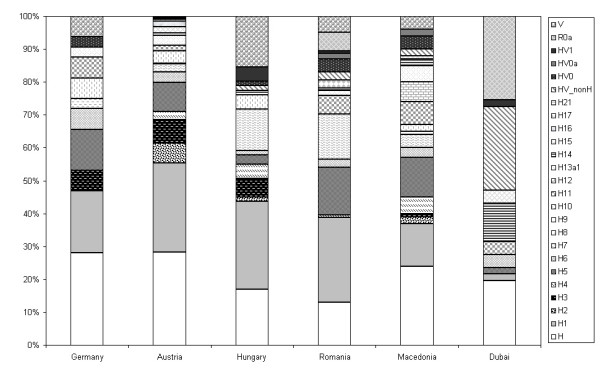
Nearly half of the West Eurasian assemblage of human mitochondrial DNA (mtDNA) is fractioned into numerous sub-lineages of the predominant haplogroup (hg) R0. Several hypotheses have been proposed on the origin and the expansion times of some R0 sub-lineages, which were partially inconsistent with each other. Here we describe the phylogenetic structure and genetic variety of hg R0 in five European populations and one population from the Middle East.
Our analysis of 1,350 mtDNA haplotypes belonging to R0, including entire control region sequences and 45 single nucleotide polymorphisms from the coding region, revealed significant differences in the distribution of different sub-hgs even between geographically closely located regions. Estimates of coalescence times that were derived using diverse algorithmic approaches consistently affirmed that the major expansions of the different R0 hgs occurred in the terminal Pleistocene and early Holocene.
Given an estimated coalescence time of the distinct lineages of 10-18 kya, the differences in the distributions could hint to either limited maternal gene flow after the Last Glacial Maximum due to the alpine nature of the regions involved or to a stochastic loss of diversity due to environmental events and/or disease episodes occurred at different times and in distinctive regions. Our comparison of two different ways of obtaining the timing of the most recent common ancestor confirms that the time of a sudden expansion can be adequately recovered from control region data with valid confidence intervals. For reliable estimates, both procedures should be applied in order to cross-check the results for validity and soundness.
近一半的西欧亚人类线粒体DNA(mtDNA)组合被细分为主要单倍群(hg)R0的众多亚谱系。关于一些R0亚谱系的起源和扩张时间,已经提出了几种假说,这些假说部分相互矛盾。在这里,我们描述了五个欧洲人群和一个中东人群中hg R0的系统发育结构和遗传多样性。
我们对属于R0的1350个mtDNA单倍型进行了分析,包括整个控制区序列和编码区的45个单核苷酸多态性,结果显示,即使在地理位置相近的区域之间,不同亚单倍群的分布也存在显著差异。使用不同算法方法得出的合并时间估计一致证实,不同R0单倍群的主要扩张发生在末次冰期晚期和全新世早期。
考虑到不同谱系的估计合并时间为10 - 18千年前,分布上的差异可能暗示末次盛冰期后由于相关区域的高山性质导致母系基因流动有限,或者由于不同时间和不同区域发生的环境事件和/或疾病事件导致多样性的随机丧失。我们对获得最近共同祖先时间的两种不同方法的比较证实,从控制区数据中可以以有效的置信区间充分恢复突然扩张的时间。为了获得可靠的估计,应同时应用这两种方法,以便交叉检查结果的有效性和合理性。