Glisky Elizabeth L, Marquine Maria J
University of Arizona, Tucson, 85721, USA.
Memory. 2009 Feb;17(2):144-57. doi: 10.1080/09658210802077405.
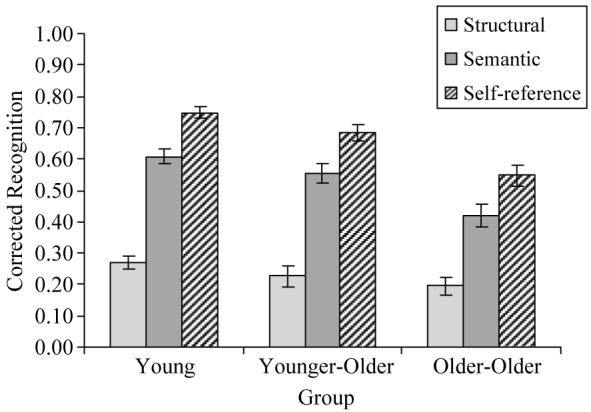
The beneficial effects of self-referential processing on memory have been demonstrated in numerous experiments with younger adults but have rarely been studied in older individuals. In the present study we tested young people, younger-older adults, and older-older adults in a self-reference paradigm, and compared self-referential processing to general semantic processing. Findings indicated that older adults over the age of 75 and those with below average episodic memory function showed a decreased benefit from both semantic and self-referential processing relative to a structural baseline condition. However, these effects appeared to be confined to the shared semantic processes for the two conditions, leaving the added advantage for self-referential processing unaffected These results suggest that reference to the self engages qualitatively different processes compared to general semantic processing. These processes seem relatively impervious to age and to declining memory and executive function, suggesting that they might provide a particularly useful way for older adults to improve their memories.
自我参照加工对记忆的有益影响已在针对年轻人的大量实验中得到证实,但在老年人中却鲜有研究。在本研究中,我们在自我参照范式下对年轻人、年轻老年人和年长老年人进行了测试,并将自我参照加工与一般语义加工进行了比较。研究结果表明,75岁以上的老年人以及情节记忆功能低于平均水平的老年人,相对于结构基线条件,在语义加工和自我参照加工中受益均有所减少。然而,这些影响似乎仅限于两种条件下共有的语义加工过程,自我参照加工的额外优势未受影响。这些结果表明,与一般语义加工相比,自我参照涉及质的不同的过程。这些过程似乎相对不受年龄以及记忆和执行功能衰退的影响,这表明它们可能为老年人改善记忆提供一种特别有用的方式。