
抗逆转录病毒疗法的公共卫生与个体方法:南非乡镇与瑞士的比较
Public-health and individual approaches to antiretroviral therapy: township South Africa and Switzerland compared.
作者信息
Keiser Olivia, Orrell Catherine, Egger Matthias, Wood Robin, Brinkhof Martin W G, Furrer Hansjakob, van Cutsem Gilles, Ledergerber Bruno, Boulle Andrew
机构信息
Institute of Social and Preventive Medicine (ISPM), University of Bern, Bern, Switzerland.
出版信息
PLoS Med. 2008 Jul 8;5(7):e148. doi: 10.1371/journal.pmed.0050148.
BACKGROUND
The provision of highly active antiretroviral therapy (HAART) in resource-limited settings follows a public health approach, which is characterised by a limited number of regimens and the standardisation of clinical and laboratory monitoring. In industrialized countries doctors prescribe from the full range of available antiretroviral drugs, supported by resistance testing and frequent laboratory monitoring. We compared virologic response, changes to first-line regimens, and mortality in HIV-infected patients starting HAART in South Africa and Switzerland.
METHODS AND FINDINGS
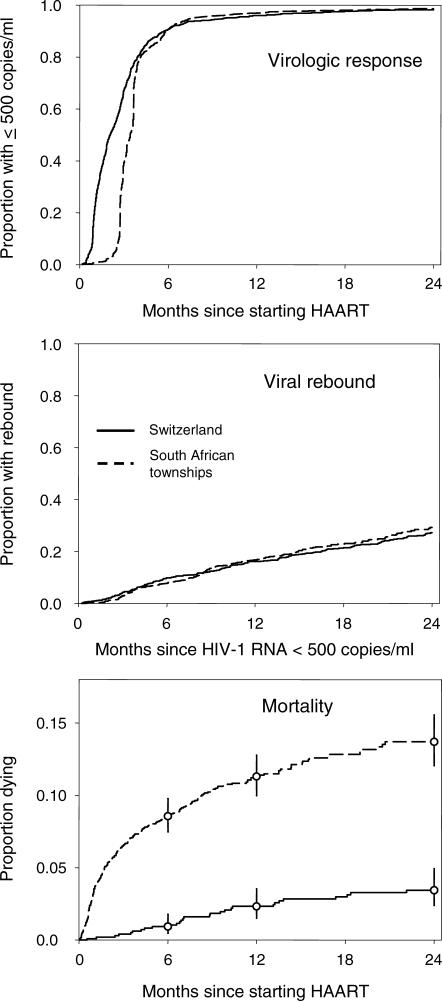
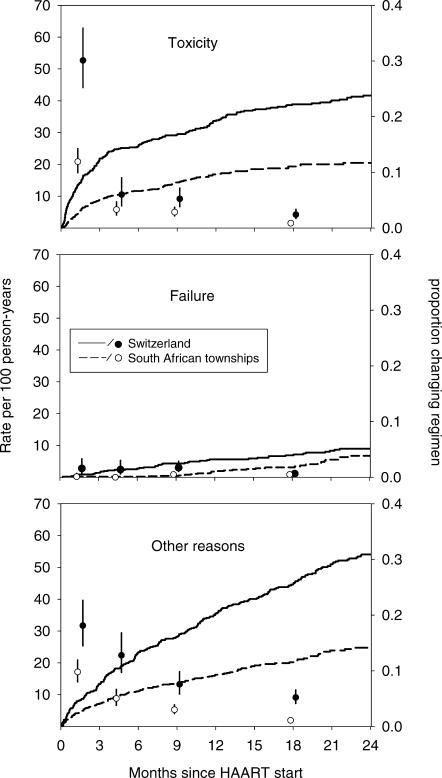
We analysed data from the Swiss HIV Cohort Study and two HAART programmes in townships of Cape Town, South Africa. We included treatment-naïve patients aged 16 y or older who had started treatment with at least three drugs since 2001, and excluded intravenous drug users. Data from a total of 2,348 patients from South Africa and 1,016 patients from the Swiss HIV Cohort Study were analysed. Median baseline CD4+ T cell counts were 80 cells/mul in South Africa and 204 cells/mul in Switzerland. In South Africa, patients started with one of four first-line regimens, which was subsequently changed in 514 patients (22%). In Switzerland, 36 first-line regimens were used initially, and these were changed in 539 patients (53%). In most patients HIV-1 RNA was suppressed to 500 copies/ml or less within one year: 96% (95% confidence interval [CI] 95%-97%) in South Africa and 96% (94%-97%) in Switzerland, and 26% (22%-29%) and 27% (24%-31%), respectively, developed viral rebound within two years. Mortality was higher in South Africa than in Switzerland during the first months of HAART: adjusted hazard ratios were 5.90 (95% CI 1.81-19.2) during months 1-3 and 1.77 (0.90-3.50) during months 4-24.
CONCLUSIONS
Compared to the highly individualised approach in Switzerland, programmatic HAART in South Africa resulted in similar virologic outcomes, with relatively few changes to initial regimens. Further innovation and resources are required in South Africa to both achieve more timely access to HAART and improve the prognosis of patients who start HAART with advanced disease.
背景
在资源有限的环境中提供高效抗逆转录病毒疗法(HAART)遵循公共卫生方法,其特点是治疗方案数量有限以及临床和实验室监测标准化。在工业化国家,医生在耐药性检测和频繁的实验室监测支持下,从所有可用的抗逆转录病毒药物中进行处方。我们比较了在南非和瑞士开始接受HAART治疗的HIV感染患者的病毒学反应、一线治疗方案的变化以及死亡率。
方法和结果
我们分析了瑞士HIV队列研究以及南非开普敦两个乡镇的HAART项目的数据。我们纳入了自2001年以来开始使用至少三种药物治疗的16岁及以上初治患者,并排除了静脉吸毒者。对来自南非的2348名患者和瑞士HIV队列研究的1016名患者的数据进行了分析。南非患者基线CD4 + T细胞计数中位数为80个/微升,瑞士为204个/微升。在南非,患者从四种一线治疗方案之一开始治疗,随后514名患者(22%)更换了方案。在瑞士,最初使用了36种一线治疗方案,其中539名患者(53%)更换了方案。在大多数患者中,HIV-1 RNA在一年内被抑制到500拷贝/毫升或更低:南非为96%(95%置信区间[CI] 95%-97%),瑞士为96%(94%-97%),两年内分别有26%(22%-29%)和27%(24%-31%)出现病毒反弹。在HAART治疗的头几个月里,南非的死亡率高于瑞士:第1至3个月调整后的风险比为5.90(95% CI 1.81-19.2),第4至24个月为1.77(0.90-3.50)。
结论
与瑞士高度个体化的方法相比,南非的HAART项目在病毒学结果方面相似,初始治疗方案的变化相对较少。南非需要进一步创新和资源,以更及时地获得HAART,并改善患有晚期疾病开始接受HAART治疗患者的预后。
 Zotero 插件