Rizo Josep, Rosenmund Christian
Department of Biochemistry, University of Texas Southwestern Medical Center, 6000 Harry Hines Boulevard, Dallas, Texas 75390, USA.
Nat Struct Mol Biol. 2008 Jul;15(7):665-74. doi: 10.1038/nsmb.1450.
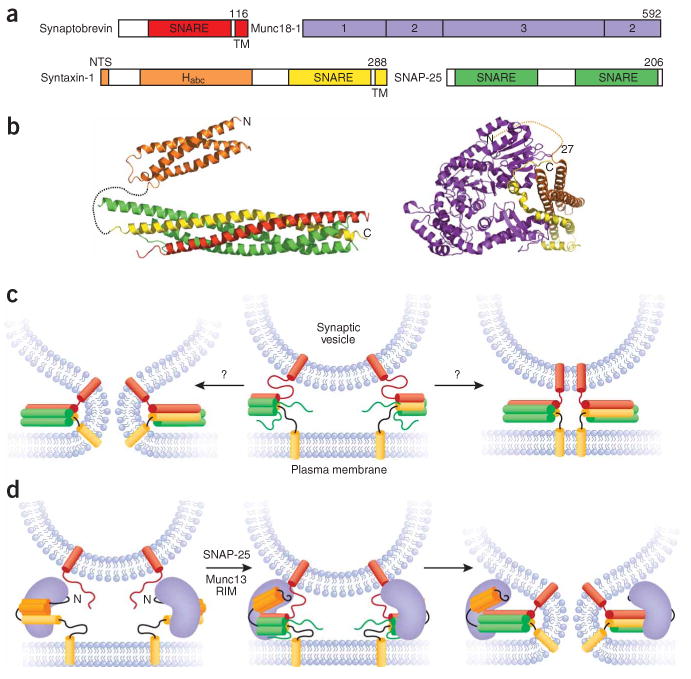
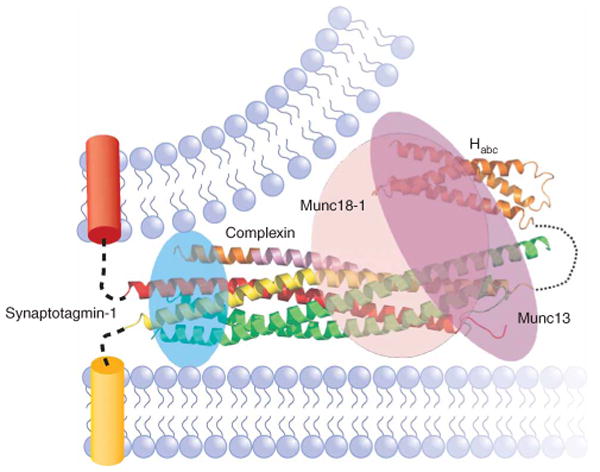
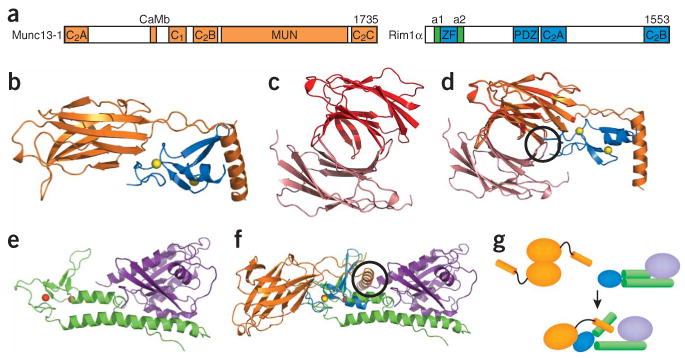
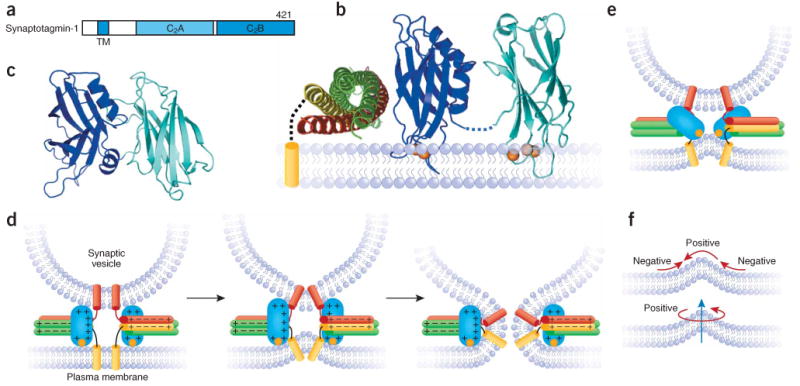
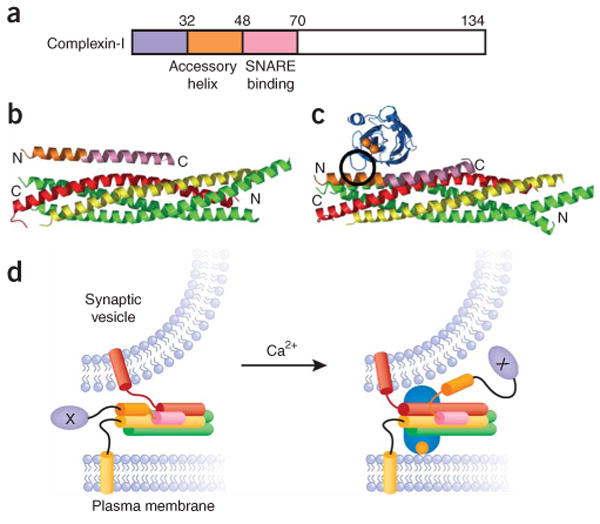
The core of the neurotransmitter release machinery is formed by SNARE complexes, which bring the vesicle and plasma membranes together and are key for fusion, and by Munc18-1, which controls SNARE-complex formation and may also have a direct role in fusion. In addition, SNARE complex assembly is likely orchestrated by Munc13s and RIMs, active-zone proteins that function in vesicle priming and diverse forms of presynaptic plasticity. Synaptotagmin-1 mediates triggering of release by Ca2+, probably through interactions with SNAREs and both membranes, as well as through a tight interplay with complexins. Elucidation of the release mechanism will require a full understanding of the network of interactions among all these proteins and the membranes.
神经递质释放机制的核心由SNARE复合体构成,它使囊泡膜和质膜结合在一起,是融合的关键,还由Munc18-1构成,它控制SNARE复合体的形成,并且可能在融合中也发挥直接作用。此外,SNARE复合体的组装可能由Munc13s和RIMs精心安排,它们是活跃区蛋白,在囊泡引发和多种形式的突触前可塑性中发挥作用。突触结合蛋白-1可能通过与SNAREs、两种膜的相互作用以及与复合体蛋白的紧密相互作用,介导Ca2+触发释放。要阐明释放机制,需要全面了解所有这些蛋白质与膜之间的相互作用网络。